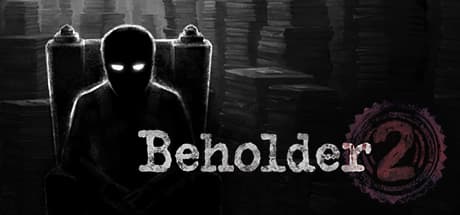
Beholder 2: Rise Through the Ranks in a Dystopian Prime Ministry is a narrative simulation about entering a totalitarian bureaucracy and pursuing promotion through surveillance, reports, bargains, and difficult choices. You begin at the lowest level as an intern in the Prime Ministry.
Completing assigned work is only part of the challenge: exploiting a colleague's secret or helping someone at personal risk can redirect both your career and their fate.
Game Overview
The central loop involves exploring the Ministry, speaking with its employees, accepting assignments, gathering information, and deciding what to do with it. The apparent objective is career advancement, but each step can force you to balance loyalty to the state, personal conscience, and survival.
Choices are not always marked as correct or incorrect, and an immediate advantage may create a later complication.
The story branches toward multiple outcomes. It is therefore better approached as a game about deciding what to protect and what to sacrifice, rather than a puzzle in which everyone can be saved without consequences.
A first run based on personal judgment can be followed by later runs that test different alliances and decisions.
Features and Systems
Success depends on more than selecting dialogue responses. You need to understand who possesses useful information, what each person wants, and how exposed you will become by acting against them.
A discovered secret may be used for reporting, negotiation, or self-preservation, and immediate denunciation is not automatically the best option.
Assignments and relationships compete for attention. Spending time on one request can mean losing another opportunity, while rushing toward promotion may damage a useful alliance.
The strategy comes from managing people, information, and risk through limited actions rather than commanding armies or maintaining a large economy.
The game retains the surveillance-state theme of its predecessor but changes the player's position. Instead of managing an apartment building, you work inside the center of state power and gradually move closer to those who administer the system.
Promotion becomes a temptation within the narrative: additional influence may offer new options while also binding you more tightly to the regime.
How to Approach the Choices
Read conversations carefully and keep track of names, positions, and the purpose behind each request. A suspicious character may have understandable motives, while an apparently helpful task may conceal another agenda.
Looking at who benefits from an outcome, rather than judging only its immediate effect, makes the political maneuvering easier to follow.
Failure and unwanted consequences are part of the experience. Following an optimal route from the beginning can remove much of the tension created by accepting responsibility for a decision.
Even players who eventually want a particular ending may get more from an initial run played without a step-by-step solution.
System Requirements
The minimum specification calls for a 64-bit version of Windows 7, 8, or 10. The listed processors are an Intel Core 2 Quad Q6600 at 2.4GHz or an AMD FX-8120 at 3.1GHz, accompanied by 4GB RAM.
Graphics requirements list an NVIDIA GT 630 or 650M, an AMD Radeon HD 6570, or an equivalent GPU, with DirectX 9.0c and 4GB of available storage.
These requirements are modest compared with modern graphics-heavy releases, so a recent high-end GPU is not the intended baseline. No recommended specification is present in the supplied data, however, so the minimum should be treated as a starting point rather than a guarantee of ideal performance.Check the review panel on this page or the Steam listing for the latest user review trend.
Reception and Common Impressions
Beholder 2 has maintained a positive reputation among players who enjoy morally uncomfortable decisions, political satire, and stories in which earlier actions reshape later events. Surveillance and denunciation are presented as tools for survival and advancement rather than distant acts performed only by obvious villains.
The setting also uses dark humor and bureaucratic absurdity, preventing the oppressive subject matter from becoming tonally uniform.
Players looking for rapid combat or spectacle may find the repeated conversations, movement, and information gathering slow. Decisions can have consequences that cannot be cleanly undone, and the game may ask the player to accept an outcome without fully explaining it in advance.
Enjoyment therefore depends heavily on whether experimentation feels like participating in a personal political drama or simply repeating administrative tasks.
Who Should Play It
The game suits players who want to discover narrative branches through their own decisions and who enjoy political stories without simple heroes or villains. It is also a good fit for those who prefer intimate information-based maneuvering to the large-scale warfare of traditional strategy games.
Players comfortable treating mistakes as part of the story will have more reason to revisit different routes.
Cautions and Who May Not Enjoy It
Reading, remembering relationships, and weighing dialogue matter more than reflexes. Players who need to rescue every sympathetic character or obtain a perfect result in one run may find the deliberately uncomfortable tradeoffs frustrating.
The themes of surveillance, denunciation, punishment, and totalitarian control can also be unpleasant for those seeking a relaxing experience.
The supplied language list includes English, Simplified Chinese, Russian, German, Korean, Polish, Spanish, and Turkish; Japanese is not listed. Because understanding dialogue and choices is essential, anyone who requires Japanese text should verify the current language options before buying.
Steam Achievements and Trading Cards are supported.
Release Information
Developed by Alawar Stargaze (Warm Lamp Games) and published by Alawar, Beholder 2 was released on December 5, 2018. It is a single-player experience built around gradually collecting information and living with the results of bureaucratic decisions.
Its strongest distinction is that it does not merely show a dystopian system from outside; it asks how far the player will cooperate once that system offers a path upward.


