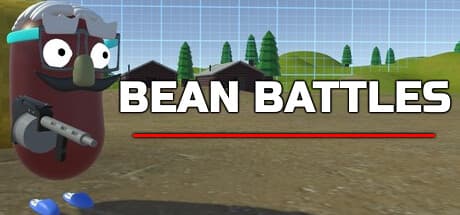
Bean Battles: Fast-Paced Battle Royale Rounds is a competitive action game built around repeated, compact firefights instead of extended looting. Survival still matters, but kills are also emphasized, giving players a reason to seek encounters rather than hide at the edge of the safe zone.
It supports 2–3 local players and up to 16 players online, with the smaller and larger formats producing different kinds of battles.
Game Overview
A round lasts only a few minutes. Players collect weapons and equipment, locate nearby opponents, and reposition before the playable area becomes too restrictive.
Vehicles scattered around the map make it possible to cross open ground quickly or enter a fight before the opportunity disappears.
The zone begins shrinking after 60 seconds, so there is little time to search for a perfect loadout. This compresses the familiar battle royale loop and reduces the chance of spending a long session gathering supplies only to lose in the first encounter.
Because the game uses multiple rounds, a mistake leads to another attempt relatively quickly.
That faster structure does not remove decision-making. Players still need to judge weapon range, enemy positions, movement routes, and the right moment to attack.
Bean Battles is therefore better understood as a rapid sequence of tactical skirmishes than as a long exploration and survival match.
Features and Systems
One of the defining ideas is that eliminating opponents matters alongside being the final survivor. Passive play is less likely to be the only worthwhile strategy, while taking a calculated risk can improve a round.
The central loop is to secure a usable weapon, read the shrinking zone, and move toward the next engagement.
Weapons and equipment are plentiful, keeping the preparation phase short. Players must still adapt to whatever they find and choose a suitable fighting distance.
Vehicles reduce travel time and can help reach contested areas, although using one may also make an aggressive approach more obvious.
Local support for 2–3 players suits brief sessions around one machine. Online matches allow up to 16 participants, increasing the chance of crowded encounters and third-party attacks.
The design favors playing several rounds, accepting a loss, and immediately trying a different approach.
Early-Round Priorities
At the start of a round, finding a functional weapon is more important than searching indefinitely for an ideal setup. Since the zone moves after 60 seconds, spreading the search over too wide an area can leave too little time to reposition.
Once minimally equipped, decide whether to pursue nearby gunfire or occupy a useful location first.
Kills are valuable, but attacking every visible opponent is not automatically the best choice. When several players converge, waiting for two opponents to weaken each other may create a safer opening.
The short format makes each movement and engagement decision unusually significant.
PC Requirements
The minimum specification lists Windows 7, a 1.5GHz processor, 2GB RAM, and 2GB of available storage.
Graphics options include Intel HD 4000, a GeForce 200 Series card, or a Radeon HD 4000 Series card with 512MB VRAM. These modest requirements may allow older PCs and some integrated graphics systems to run the game, though resolution and background applications will affect consistency.
The recommended specification lists Windows 10, an Intel Core i5-4670 or AMD A10-7850K, and 8GB RAM. For graphics, it calls for a GeForce GTX 960 or Radeon R9 380 with at least 2GB VRAM.
The storage requirement remains 2GB.
For online matches with up to 16 players, the recommended tier is the safer target when stable frame delivery matters. Systems close to the minimum should begin with reduced resolution and graphics settings, while closing browsers and other memory-heavy applications.
Integrated GPUs may share system memory, so checking available RAM and current graphics drivers is also worthwhile.
Reception and Player Impressions
Bean Battles has maintained a strong overall reception over time. Its quick access to firefights, minimal preparation, and suitability for casual sessions with friends are central parts of its appeal.
Players who dislike the slow opening phase of many battle royale games may find the condensed structure refreshing.
The same simplicity can be a limitation for anyone seeking a large map, extensive loadout planning, or tension that builds across a long match. As a multiplayer-focused title, the experience can also depend on the current player population and available opponents.
Checking recent Steam activity and current user feedback before buying is sensible.
Who Should Play It
Bean Battles is a good fit for players who want to complete several competitive rounds in a short session. It particularly suits those who value frequent gunfights over prolonged scavenging, enjoy making decisions under time pressure, or want an approachable game to play with friends.
The 2–3 player local mode is also relevant for groups specifically looking for shared-screen multiplayer.
Limitations and Who Should Skip It
Players primarily looking for a story campaign, careful exploration, or crafting will find little overlap with those interests. The rapidly shrinking zone and compact rounds can feel rushed to anyone who prefers to prepare methodically before a single decisive fight.
Its 16-player maximum also creates a smaller-scale experience than battle royale games built around very large lobbies.
The supplied article category identifies the game as a visual novel, but the available game data describes an action and indie PvP title. Treat it as a compact battle royale rather than a narrative visual novel.
Store metadata and supported features can change, so confirm the title, screenshots, language support, and present online activity before purchasing.
Game Information
Bean Battles was developed and published by Gupa Games and released on August 22, 2018. Its listed features include multiplayer, online PvP, Steam Achievements, statistics, and Steam leaderboards.
Although it requires only 2GB of storage, both a stable network connection and suitable hardware remain important for smooth online play.