Game Overview
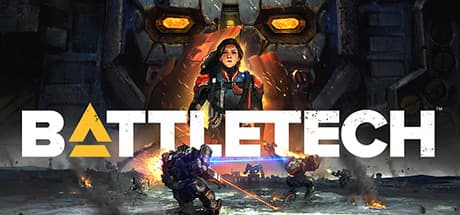
“BATTLETECH: Command Your Mercenary Mech Outfit” is a turn-based tactical game set amid the conflicts of 3025. You command a mercenary company rather than a single ace, choosing contracts, deploying MechWarriors, repairing BattleMechs, and managing a mobile base.
Developed by Harebrained Schemes and published by Paradox Interactive, it was released on April 24, 2018.
The core loop is to travel between systems, negotiate work, deploy a lance of up to four BattleMechs, and turn payment or salvage into future strength. Victory alone does not guarantee progress: damaged armor, destroyed equipment, and injured pilots consume time and resources.
A technically successful mission can still leave the company in a worse strategic position.
What Matters in Combat
Battles revolve around range, line of sight, terrain, facing, and the condition of individual armor sections. An enemy protected from the front may be vulnerable from a flank or behind.
Concentrating fire on one exposed target is often more valuable than spreading impressive attacks across an entire enemy lance.
Weapons generate heat, so firing everything every turn is not always sustainable. A balanced force can combine a long-range fire-support platform, a durable front-line unit, and a mobile flanker.
Ammunition-based weapons also bring limited endurance and the danger of losing stored ammunition, making raw damage only one part of loadout design.
Initiative, stability, knockdowns, and component damage create options beyond simply reducing total durability. You can pressure a damaged side, attack the legs to restrict a target, or delay exposure until an opponent has acted.
Since attacks can miss, reliable plans leave useful positions and defensive options available when the ideal shot fails.
Company Management and Customization
Recovered parts and equipment let you rebuild BattleMechs for specific roles. Every design must balance tonnage, armor, heat generation, ammunition, and weapon range.
Removing armor to mount more guns may produce a dangerous striker, but it can also turn routine return fire into expensive internal damage.
MechWarriors improve over time but can be injured or killed. Building only a tiny group of elite pilots makes the roster fragile when one of them becomes unavailable, so developing substitutes has practical value.
Ship upgrades can improve company operations, yet those investments must be weighed against continuing expenses.
Contract terms create another strategic choice. Cash helps cover immediate repairs and operating costs, while salvage rights may support long-term upgrades.
Pursuing rare equipment through a mission beyond the company's strength can cost more than the recovered components are worth.
A Safer Start
Early on, controlling damage is usually more important than ending every encounter as quickly as possible. Rotate a battered unit away from the enemy and present healthier armor sections when possible.
Keeping the lance close enough to focus its fire also prevents fast enemies from isolating one BattleMech.
Low-probability attacks can waste heat and ammunition before the decisive exchange begins. Defensive movement, sensor information, and positions that limit retaliation can be more useful than taking every available shot.
On escort, defense, or objective missions, completing the assignment may also matter more than destroying every hostile unit.
System Requirements
The minimum specification lists 64-bit Windows 10, an Intel Core i3-2105 or AMD Phenom II X3 720, a GeForce GTX 560 Ti or Radeon HD 5870, and 8GB RAM. The listed GPU requirement includes 1GB VRAM.
DirectX 11 and 35GB of available storage are also required, so this should be treated as an entry point rather than a guarantee of generous performance headroom.
The recommended specification raises the processor to a Core i5-4460 or AMD FX-4300 and the graphics card to a GeForce GTX 670 or Radeon R9 285 with 2GB VRAM. It also calls for 16GB RAM, while storage remains 35GB.
A modern gaming PC should clear the graphics requirement comfortably, but systems limited to 8GB RAM may benefit from closing background applications.
Reception and Player Experience
BATTLETECH has maintained a strong reputation among players who enjoy positional tactics, detailed damage modeling, and campaigns where battlefield losses affect the larger economy. Its appeal is not limited to established fans of the setting; players familiar with squad tactics such as XCOM can recognize the emphasis on cover, risk management, and persistent soldiers.
Experimenting with a build and correcting its weaknesses after a difficult mission is a major part of the experience.
The deliberate pace will not suit everyone. Movement animations, uncertain attack results, travel time, repair delays, and early financial pressure can feel slow to players seeking immediate action.
This is a game about planning several turns ahead and considering the state of the company after the battle, not merely producing a spectacular volley.
Who Should Play It
It is a strong fit for players who enjoy adjusting equipment, controlling a small squad, and making long-term decisions across both combat and management. It also rewards players who become attached to individual pilots but can accept injuries and losses as part of an evolving campaign.
Single-player commanders have a substantial company-building structure, while multiplayer provides a place to test force composition and tactics against another player.
Caveats and Who Should Skip It
This is not a real-time mech action game in which the player directly pilots a machine. Each turn asks you to inspect movement, firing lines, heat, armor facing, and target priority.
Anyone primarily looking for fast reactions or continuous action may find that structure too methodical.
A badly damaged flagship or a long-term pilot injury can affect several later contracts. The campaign expects the company to absorb setbacks and rebuild instead of treating each mission as an isolated encounter.
Players who dislike accuracy-based uncertainty, layered management screens, or the possibility of lasting consequences may prefer a more forgiving tactics game.