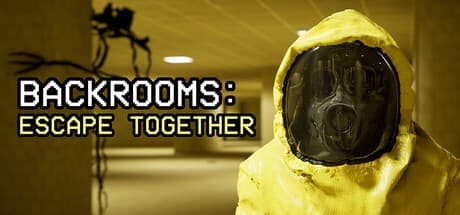
Game Overview
Backrooms: Escape Together — Survive Procedurally Generated Horror is a first-person co-op survival horror game for up to six players. A team explores spaces with no obvious exit, collects useful items, solves puzzles, and searches for a way into the next area.
When an entity appears, observation, escape, and clear communication matter more than charging directly at the threat.
Each level works as a compact adventure with its own environment, mechanics, collectibles, puzzles, and hostile entities. Procedural generation changes layouts and encounters, so memorizing a route from an earlier run is not enough.
The core loop is about reading the environment, tracking the team's position, and turning limited clues into a safe path forward.
How Co-op Changes the Experience
Adding players does not automatically make every situation easier. A larger team can inspect more ground, but splitting up also creates opportunities for someone to attract danger or discover something they cannot explain clearly.
Groups must decide whether to stay together or divide tasks according to the risks in each area.
Proximity voice chat makes distance part of the horror. A teammate who wanders too far may become difficult to hear, turning separation into a mechanical problem as well as a source of tension.
Loosely assigning roles such as navigator, rear guard, and item carrier can reduce confusion without removing the spontaneous feel of a run.
Support for up to six players makes the game suitable for groups that want to share scares and failed plans. More voices can also obscure environmental sounds or warnings, however.
Smaller parties suit deliberate, immersive exploration, while a full group favors a louder and more chaotic social experience.
Procedural Levels and Practical Tactics
Because routes change, landmarks and escape plans are more dependable than fixed walkthrough directions. Before entering a branching corridor, identify a recognizable feature and agree on where to retreat.
Distributing important items also gives the team a better chance to recover if one player becomes isolated.
Puzzle solving benefits from precise callouts. Descriptions based on walls, lights, doors, or nearby intersections are more useful than saying that an object is “over there.” On a first run, exploring without outside answers preserves the uncertainty; when progress stops, review unchecked branches and collected objects systematically.
PC Requirements
The minimum specification lists Windows 10 64-bit version 1909 revision .1350, an Intel Core i5-4430, 4 GB RAM, and either a GeForce GTX 960 2GB or Radeon R7 370 2GB.
DirectX 11 and 15 GB of available storage are also required. Treat this as an entry point, with room to reduce visual settings if stable performance matters more than image quality.
The recommended target is 64-bit Windows 11 with the latest feature update, a Core i5-6600K or Ryzen 5 1600, and 16 GB RAM. Graphics recommendations rise to a GeForce RTX 2070 8GB or Radeon RX 6600 XT, together with DirectX 12.
The large gap in memory and GPU capability suggests using the recommended tier when realistic lighting and higher visual settings are priorities.
Both tiers require 15 GB of available storage. The requirements also call for current AMD or NVIDIA drivers, with AMD users specifically instructed to install the latest OPTIONAL drivers.
If the game has rendering or startup problems on otherwise suitable hardware, check the GPU driver and Windows update status first.
Player Feedback Trends
Positive feedback commonly centers on shared scares, changing routes, and unpredictable situations created through proximity chat. Groups that can laugh at navigation mistakes and failed communication are likely to get more from the game than players focused only on efficient completion.
Procedural generation also creates a tradeoff. It supports replayable uncertainty, but it does not feel the same as horror built around one tightly scripted route.
Players who need constant narrative momentum may find periods of searching less compelling, especially when the group's communication determines the pace.
Who Should Play It
This is a strong fit for players who treat voice-chat reactions as part of a co-op horror session and prefer observation and discussion over memorizing a fixed map. Its six-player capacity supports both cautious small-party runs and chaotic sessions with a larger friend group.
The listed language support includes Japanese alongside English and several other languages.
Unlike the combat-driven teamwork of Left 4 Dead 2, this game emphasizes navigation, puzzles, evasion, and information sharing. Players who enjoy the proximity-chat confusion of Lethal Company but want the anxiety of an enclosed maze should find the premise appealing.
Caveats and Who May Not Enjoy It
Players seeking a self-contained solo narrative, weapon-focused combat, or a clear equipment progression may not find their priorities here. Repeatedly exploring generated spaces can also feel slow if getting lost and testing ideas are frustrations rather than part of the entertainment.
Those who value identical competitive conditions should consider whether randomized layouts suit them.
A voice-capable group helps the proximity-chat design reach its potential. At the same time, overlapping conversation can hide useful sounds, so concise callouts improve tense situations.
Backrooms: Escape Together was released on October 18, 2022; check its current development state, available features, and language options in the store before installing.