Game Overview
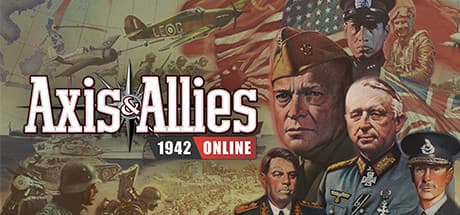
Axis & Allies 1942 Online: WWII Strategy Board Game is Beamdog's official digital adaptation of Hasbro's Axis & Allies 1942 Second Edition. Players command the United States, United Kingdom, or Soviet Union for the Allies, or Germany and Japan for the Axis.
Victory depends on managing territory, production, and military strength across a shared global board.
A turn revolves around deciding where to commit limited resources, resolving battles, and converting territorial gains into a stronger future position. This is not a real-time strategy game built around rapid unit control.
Its focus is the board-wide plan: where new forces will arrive, which fronts can be held, and which risks are acceptable several turns ahead.
Features and Systems
The five powers begin with different territories, forces, and geographic problems. Germany must consider the European front, Japan operates across the Pacific, and the Allied powers depend heavily on coordination between separate economies and positions.
The result is an asymmetric game in which priorities change with the nation being controlled.
Combat includes an element of chance, so even a favorable attack can produce costly losses. Good play is therefore less about expecting perfect results and more about building positions that can survive an unfavorable roll.
Concentrating force, protecting exposed territory, and preserving routes for reinforcements matter as much as winning the immediate battle.
The digital format handles setup, board state, and rule resolution. That removes much of the physical administration associated with a large tabletop game and makes repeated matches more convenient.
It does not remove the underlying learning curve, however; newcomers still need to understand unit roles, turn order, and the strategic value of each region.
Single-Player and Online Play
Single-player is useful for learning the sequence of play and testing openings without pressure from another person. A practical way to improve is to examine what becomes exposed after each attack and how many turns newly purchased units need to reach the front.
Those questions are more valuable than trying to memorize every possible opening immediately.
Online multiplayer adds human prediction to the strategic puzzle. A quiet defensive purchase can reveal an opponent's priorities, while an exposed transport or thinly defended territory may invite a response on the following turn.
Fast reflexes are unnecessary, but the total pace of a match depends on how regularly every participant takes a turn.
System Requirements
The listed minimum requires 64-bit Windows 7 or newer, an Intel Pentium based on Sandy Bridge or newer or an AMD A6 APU, Intel HD 3000 graphics or better, and 6GB of RAM. Storage demand is only 600MB, and the required display resolution is 1366×768 or higher.
A dedicated graphics card is not listed as essential, making older laptops and integrated-graphics systems plausible candidates.
Minimum specifications should still be treated as a baseline for launching and playing the game. On an older computer, check operating-system support, graphics drivers, and display resolution before buying.
The supplied requirements also mention an online connection, so anyone planning to play without reliable internet should verify the current connection requirements first.
Reception and Review Themes
Player reception is broadly positive, with the convenient conversion of a physical board game into a managed PC experience forming much of the appeal. Automatic state tracking and rule handling are especially useful in a game with several nations, many territories, and numerous pieces.
Potential frustrations are closely tied to the original design. Battles are influenced by probability, matches reward patient territorial planning, and the presentation is more functional than cinematic.
When reading current feedback, it helps to separate comments about the software interface from opinions about the board game's core rules.
Who Should Play It
Axis & Allies 1942 Online suits players who enjoy World War II board games, asymmetric national positions, and deliberate allocation of forces. It is also a good fit for people who prefer prediction and planning over mechanical speed.
The combination of single-player practice and human competition provides a sensible route from learning the rules to testing complete strategies.
Players comparing it with Hearts of Iron IV should expect a more contained board-game framework rather than detailed national administration. Those seeking long-form civilization building, diplomacy, and technological development may find Sid Meier's Civilization VI a more relevant alternative.
The best choice depends on whether the desired focus is a defined global war scenario or a broader historical sandbox.
Limitations and Who Should Avoid It
The listed languages are English, French, Italian, German, Spanish, Polish, Arabic, and Russian; Japanese is not listed. This can be a meaningful obstacle for newcomers who must learn both the interface and unfamiliar board-game terminology.
Players who require Japanese text should confirm the current language listing before purchasing.
It may also feel slow to anyone seeking brief tactical rounds or direct control of individual units. Players who strongly dislike probability affecting combat outcomes should approach it cautiously, even though careful positioning can reduce risk.
The game was released on November 9, 2021, but online functionality and connection requirements can change, so multiplayer-focused buyers should check the current service information.