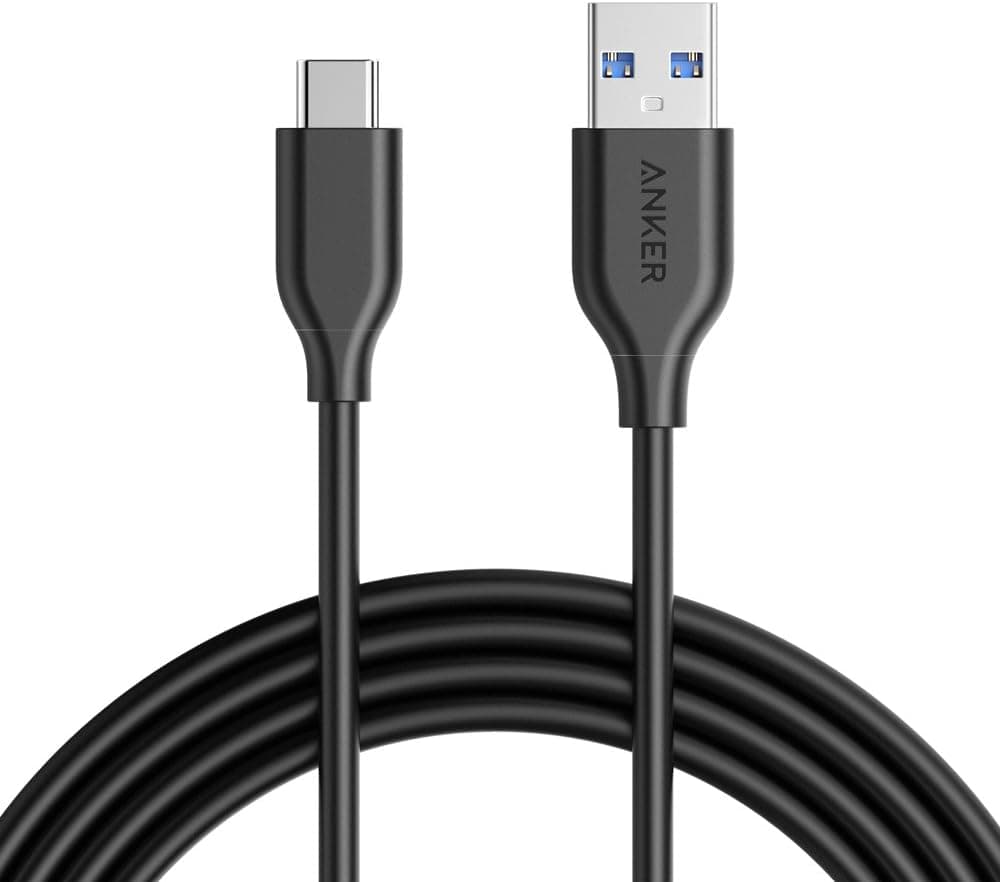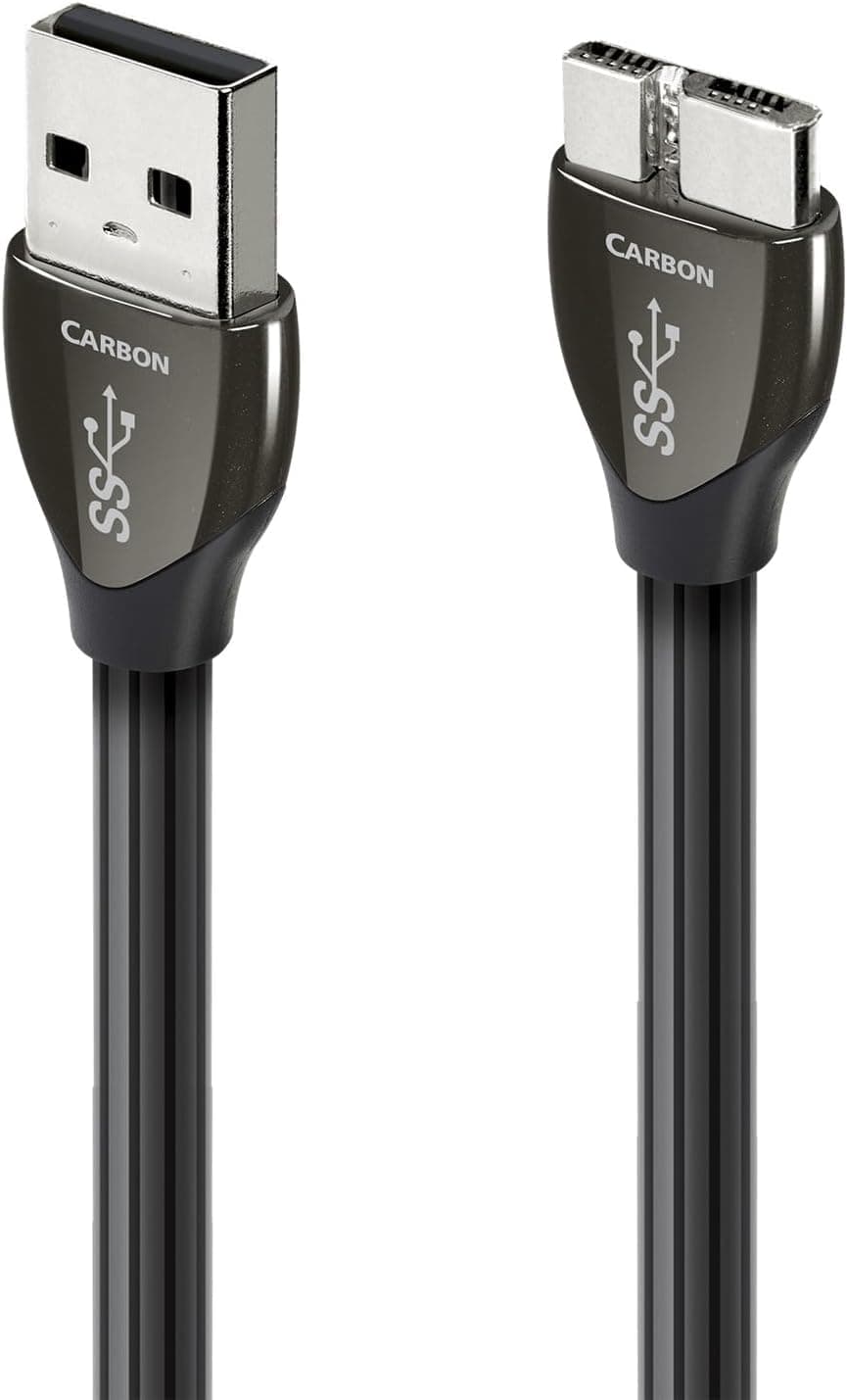
The AudioQuest 0.75m カーボン USB-A 3.0 > Micro B 3.0 高解像度オーディオケーブル (AudioQuest Carbon USB-A 3.0 to Micro-B 3.0, 0.75m) is a short, audio-focused USB cable for linking a computer to a USB DAC or audio interface.
This article goes past the marketing and answers the three questions that actually matter: will it physically fit your gear, does the price make sense, and who should not buy it.
Overview
This cable belongs to AudioQuest's Carbon series. It is rated for USB 3.0 (3.1 Gen 1) with a nominal 4.8 Gbps transfer rate, uses silver-plated contacts, and adds a carbon layer for shielding.
At 0.75 m it is deliberately short, aimed at a desktop where the source and the DAC sit within arm's reach of each other.
The honest summary: this is a product for people who reject the idea that "digital is digital, so any cable will do." As captured on 18 September 2026 it listed at ¥40,808 on Amazon.co.jp, with 28 reviews averaging 5.0 (100% positive).
That is the classic profile of a niche premium accessory — few reviews, but no dissent. Twenty-eight reviews is not the same statistical comfort as a mass-market cable with thousands.
More than half of the buying decision here is not about sound at all. It is about the connector.
USB 3.0 Micro-B (10-pin) is a different plug from the common Micro-USB 2.0 (5-pin), and getting that wrong means a ¥40,808 cable that will not go into your device.
Connectivity & Compatibility
| Item | Value | What it means in practice |
|---|---|---|
| Connector 1 | USB-A (male) | PC, laptop, or hub side |
| Connector 2 | Micro-USB B (male, USB 3.0 / 10-pin) | USB 3.0 devices only |
| USB version | 3.0 (3.1 Gen 1) | Works on USB 2.0 hosts, but speed drops to that standard |
| Transfer rate | 4.8 Gbps | Far more headroom than audio playback needs |
| Length | 0.75 m | Assumes under ~60 cm between devices |
| Contact plating | Silver | Guards against oxidation and contact resistance |
| Shielding | Carbon layer | External noise rejection |
The manufacturer's note is unambiguous: designed for USB 3.0 Micro-B (10-pin) ports, not compatible with USB 2.0 Micro-B (5-pin).
The USB 3.0 Micro-B plug looks like a standard Micro-USB with an extra contact block bolted to its side — the port you see on many external hard drives and SSDs.
So if your portable DAC or interface has an ordinary narrow Micro-USB input, this cable simply will not fit. Look at the port itself rather than trusting a spec sheet; listings that say only "Micro-B" usually mean the 2.0 version.
The host end is USB-A, so a USB-C-only laptop needs an adapter or hub in the chain. Buying a premium cable and then inserting a cheap hub in front of it defeats the purpose.
On a USB-C machine, a cable that is natively USB-C makes more sense.
Power matters too. USB 3.0 Micro-B devices are often bus-powered, so cable quality shows up first as stability, not tone.
The short 0.75 m run helps with voltage drop.
Product Info
The price captured on 18 September 2026 was ¥40,808 on Amazon.co.jp; the US listing was captured at the same yen figure.
The eBay entry is a search link only, with no fixed price. That is an extreme figure for a single cable — roughly what an entry-level DAC costs.
Prices move, and this article will not, so check the product page for the current figure before buying.
The 28 reviews average 5.0, or 100% positive.
With that few reviews, each one carries heavy weight and a single poor rating would shift the average noticeably. Read it as "a clearly defined audience that it does not disappoint," not as a guarantee.
Products like this also attract buyers who already expect an improvement, which skews scores upward.
The Carbon generation dates to around 2013, making this a long-running SKU. Nothing ships in the box beyond the cable itself.
Warranty terms depend on the seller and the manufacturer, so check the listing before ordering.
How It Compares
Within the USB 3.0 Micro-B category there are roughly three tiers: bundled or generic cables at a few hundred yen, audio-brand cables in the ¥3,000–10,000 range, and high-end options like this one.
Against a generic cable, the difference is not in whether the data arrives — any compliant cable will carry 4.8 Gbps.
The claim here concerns noise entering the device through the power and shield paths. That effect is relatively larger when the rest of the chain is already quiet and the device's own noise immunity is modest.
Practically speaking, the same ¥40,808 spent on the DAC, the power supply, or the headphones and speakers will produce a bigger and more reliable change. A cable is the investment you make once the upstream chain is settled and there is nothing else left to adjust.
Starting here is poor value ordering.
Best Use Cases
- Owners of DACs or interfaces that genuinely use USB 3.0 Micro-B. Options in this connector shape are limited, which makes a quality cable easier to justify.
- Listeners with a finished chain. If you are not replacing the DAC or amplifier, cable-level refinement is a reasonable last step.
- Desktop setups under 60 cm apart. The short run keeps the desk tidy and stops excess cable from tangling with power leads.
- People who care about build and feel. The thickness and rigidity are visibly different from a bundled cable.
Before You Buy
The connector is the big trap. USB 3.0 Micro-B (10-pin) is not compatible with ordinary Micro-USB 2.0.
If your device uses the 2.0 port, the cable will not fit and you will be filing a return.
Look at the physical port before you order.
0.75 m gives you no slack. If the PC is under the desk and the DAC is on top, it probably will not reach — and adding an extension contradicts the whole reason for buying it.
Measure the run and add 5–10 cm per end for bend radius; a thick cable cannot be folded tightly, so the rated length is not the usable distance.
The perceived benefit varies, and "I heard no difference" is not a defect. That usually means a standard return, not a warranty claim.
At this price, accept up front that the outcome is not guaranteed. If you are not confident you could pick out the difference blind, spend the money on the gear first.
Listing data is not always accurate. This page lists AudioQuest as the manufacturer, which matches the product, but Amazon fields are often seller-entered and details from other products do sometimes leak in.
Cross-check the product photo (is the plug the wide 10-pin Micro-B?) and the stated 0.75 m length against the title rather than trusting a model string alone.
Expect price movement. Imported audio accessories swing by thousands of yen with exchange rates and stock.
Parallel-import and authorised stock also carry different warranty terms, so check who is selling.
FAQ
Q. Will it work with a normal Micro-USB device? A.
No. It is USB 3.0 Micro-B (10-pin) only and will not physically fit a 5-pin Micro-USB 2.0 port.
Q. Does it actually change the sound? A.
It depends on the system. Carbon shielding and silver plating are sensible engineering against noise and contact resistance, but no figure quantifies the audible result.
Quieter rooms and higher-S/N chains make any difference easier to notice.
Q. Can I use it on a USB 2.0 port? A.
Yes, with backward compatibility, but throughput is capped at USB 2.0 speeds.
Audio playback never needs the full 4.8 Gbps anyway.
Q. What if 0.75 m is too short? A.
Look at a longer cable in the same line or another brand. Extensions and hubs undermine the point of a premium cable.
Q. Is 5.0 from 28 reviews trustworthy? A.
The direction is consistent, but the sample is small and should not be weighed like a listing with thousands of reviews. Niche premium products tend to attract favourable ratings.
Product Disclosure (Amazon)
- Manufacturer: AudioQuest
- Seller: クリエイトハマダ
- Fulfilled by: クリエイトハマダ
- ASIN: B00DQDBBUG
- Note: This article covers a manufacturer-made product based on Amazon listing details.