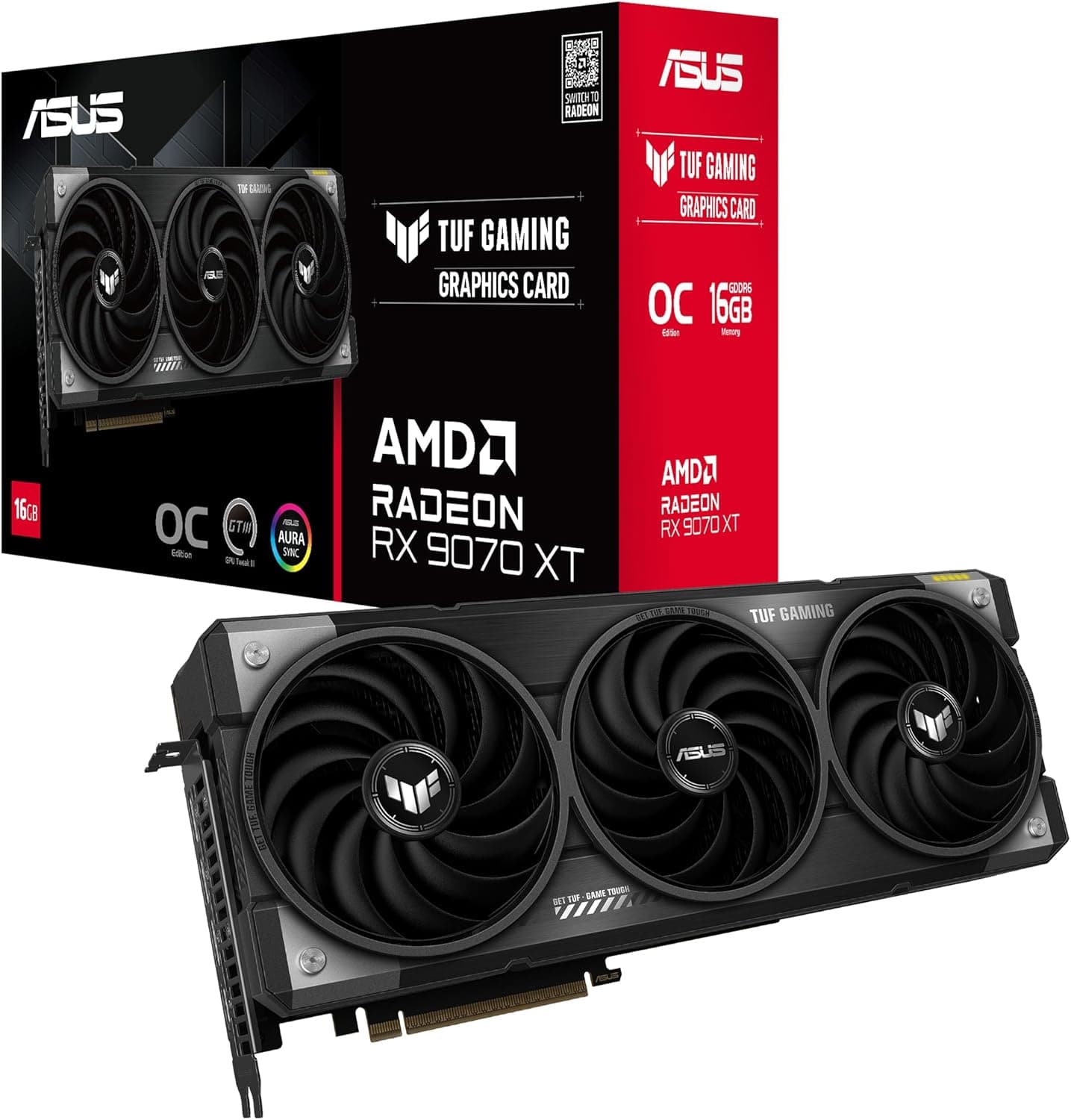
This article covers ASUS TUF Gaming Radeon RX 9070 XT OC Edition 16GB ゲーミンググラフィックスカード (16GB GDDR6.
Overview
The ASUS TUF Gaming Radeon RX 9070 XT OC Edition 16GB is a mid-high range graphics card built on AMD's latest RDNA 4 architecture. Powered by the Navi 48 GPU fabricated on a 4nm process, it offers a standard boost clock of 2520 MHz and an OC mode boost of 2670 MHz. The 16GB GDDR6 memory over a 256-bit bus provides ample bandwidth for WQHD and 4K gaming. True to the TUF lineage, it features military-grade components, PCB coating, and a reinforced frame for long-term durability. This card is primarily aimed at WQHD (2560×1440) high-refresh-rate gaming, while also capable of delivering playable framerates at 4K in most titles. Ray tracing performance has been significantly improved with RDNA 4, and the inclusion of DisplayPort 2.1 ensures future-proofing for high-bandwidth displays beyond 4K. It competes directly with the NVIDIA GeForce RTX 5070 Ti, offering a compelling package with a focus on resilience and build quality. Market positioning: premium mid-high tier. The TUF series targets users who prioritize reliability and extended lifespan over raw overclocking headroom, though this OC Edition already provides a factory-overclocked boost.
Compatibility Guide
PCIe Interface: PCIe 5.0 x16, fully backward compatible with PCIe 4.0 and 3.0 slots. No significant bandwidth bottleneck expected on current-gen motherboards. Power Connectors: Two 8-pin PCIe power connectors required. Ensure your PSU has two dedicated cables (daisy-chaining from one cable is not recommended for stability). Recommended PSU Wattage: 750W or higher for a typical gaming build with a high-end CPU. For an absolute top-tier system (e.g., Ryzen 9 + RX 9070 XT), an 850W unit is advisable. Physical Dimensions: 3.125-slot thickness and approximately 330mm length. Most mid-tower and full-tower cases should accommodate it, but always check clearance, especially near the front fans and PSU shroud. * Display Outputs: 1× HDMI 2.1, 3× DisplayPort 2.1. Supports multi-monitor setups and high refresh rates up to 8K.
Product Info
The ASUS TUF Gaming Radeon RX 9070 XT OC Edition was launched alongside AMD's RX 9070 series in March 2025. It carries a factory overclock with a boost of up to 2670 MHz in OC mode (via GPU Tweak III). Pricing is around ¥150,000 in Japan, placing it in the mid-high segment. ASUS backs it with a standard 3-year warranty (registration required). The cooling solution uses three Axial-tech fans with a large fin stack and phase-change GPU thermal pad for efficient heat transfer. Dual ball bearings extend fan lifespan. The metal exoskeleton adds rigidity, and the Auto-Extreme manufacturing process ensures precision soldering. A PCB coating protects against moisture and dust.
Best Use Cases
WQHD/4K Gamers: Perfect for 1440p high-refresh monitors in demanding titles like Cyberpunk 2077 or Black Myth: Wukong at ultra settings. The 16GB VRAM allows for high-resolution texture packs and future-proofs against VRAM-heavy games. Users Prioritizing Durability: If your PC lives in a dusty or humid environment, or if you transport it frequently, the military-grade components and protective coatings offer extra peace of mind. * Ray Tracing Enthusiasts on a Budget: RDNA 4 brings significant RT improvements, making this card a strong contender against the RTX 5070 Ti at a potentially lower price point, while still offering good rasterization performance. ## Alternatives
The primary competitor is the NVIDIA GeForce RTX 5070 Ti (16GB). The RTX card excels in ray tracing performance with dedicated RT cores, supports DLSS 4 with multi-frame generation, and has broader software support. However, the RX 9070 XT often comes at a lower MSRP, includes full DisplayPort 2.1 (which NVIDIA's 50-series also supports, but with limitations on some cards), and offers comparable raw rasterization speed. Within AMD's own lineup, the standard RX 9070 (non-XT) is a cost-effective alternative if you can sacrifice a few frames per second. The XT variant has roughly 8% more shaders and higher clocks, justifying its premium. For pure value, the non-XT might be better; for maximum performance, the XT is the clear choice.
Things to Consider
Power Supply Planning: Two separate 8-pin cables are strongly recommended. Some newer PSUs may use the 12VHPWR connector, requiring an adapter; verify compatibility. Case Airflow: The large triple-fan cooler exhausts hot air inside the case. Ensure adequate intake fans and a mesh front panel to prevent thermal throttling. Price Volatility: GPU prices fluctuate. ¥150,000 is a typical street price, but shopping during sales or from reputable sellers can yield savings. Overclocking Headroom: The factory OC already pushes near the limit. Manual overclocking may yield marginal gains at the cost of higher power draw and noise, and may void warranty. The included GPU Tweak III software allows safe tuning. *Note: Alwa
Product Disclosure (Amazon)
- Manufacturer: ASUS
- Seller: zikgootime
- Fulfilled by: zikgootime
- ASIN: B0DSWJL78F
- Note: This article covers a manufacturer-made product based on Amazon listing details.