Game Overview
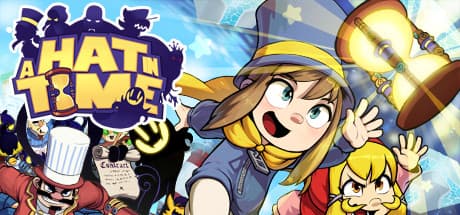
“A Hat in Time — A Cute 3D Platformer Where You Collect Time Pieces to Save the World” is an exploration-led 3D platformer starring Hat Kid. After the Time Pieces powering her spaceship fall onto an unfamiliar planet, she visits distinct regions to recover them.
The core loop combines running, jumping, wall-assisted movement, and hat abilities to cross platforms and solve environmental obstacles.
Its chapters are arranged as compact worlds rather than one uninterrupted corridor. Missions can alter objectives, routes, and character placement within a familiar location, so returning to an area does not always mean repeating the same activity.
Beyond the required Time Pieces, players can search for yarn and cosmetic collectibles along optional paths.
Released on October 5, 2017, the game draws on the collectathon structure associated with classic 3D platformers while using shorter, varied missions. Pursuits, stealth-like sequences, races, boss encounters, and open exploration regularly replace one another.
That variety matters more to the experience than raw mechanical complexity.
Building a Moveset with Hats and Badges
Yarn can be used to create hats whose abilities open routes or activate particular mechanisms. These are not merely statistical upgrades: they change how Hat Kid interacts with parts of a level.
Revisiting an earlier location after gaining another ability can reveal platforms and collectibles that were previously inaccessible.
Badges provide a second layer of customization by adjusting movement, utility, or other abilities. Limited equipment space means players must decide which conveniences are useful for the current mission.
This remains a lightweight system built to support platforming and discovery, rather than a dense progression tree that requires extensive build planning.
How Each Stage Changes the Formula
The regions differ in mission structure as well as visual theme. One assignment may let the player roam and locate an objective, while another emphasizes escaping danger or moving quickly along a defined route.
Dialogue and small events are scattered throughout the environments, and the eccentric characters often influence the rules of their stages.
Difficulty is uneven by design. Much of the regular exploration is approachable, but later platforming and optional challenges demand better midair correction and more accurate ability timing.
Players are expected to learn through occasional failure, although the main adventure leaves more room for exploration and collection than a platformer focused exclusively on precision trials.
Co-op and Multiplayer
The adventure works naturally as a solo game, but multiplayer features allow friends to share parts of the experience. Online participation and local split-screen should not be assumed to have identical player limits or progression behavior.
If a listing mentions support for up to four players, check the selected mode, required add-on content, and whether every participant has a compatible setup.
Multiplayer is less about assigning specialized roles and more about running through the same playful spaces together. It suits a group that wants to share mistakes, discoveries, and improvised races rather than coordinate through strict tactical roles.
Players who want to follow every conversation and story beat may prefer a solo first playthrough.
PC Requirements and What They Mean
The minimum requirements list a 3.0 GHz processor, 4 GB of RAM, 8 GB of available storage, and DirectX 9.0c.
The recommended tier raises the processor target to 3.5 GHz and memory to 8 GB, while retaining the same 8 GB storage requirement.
On paper, this is not a game built around a large installation or a recent DirectX generation.
No specific GPU model is included in the supplied requirements, so they cannot guarantee performance on a particular graphics card or integrated GPU. On older hardware, begin with conservative resolution, shadow, and quality settings if those options are available.
The listed operating systems also focus on older Windows releases, making it sensible to verify current OS and controller compatibility on the Steam listing before playing.
Review Trends
A Hat in Time has maintained strong user sentiment over time, with movement, expressive characters, and mission variety frequently standing out. It captures the appeal of classic collectible-driven platformers without making every objective follow the same pattern.
Its music and comic presentation also give players a reason to linger in each chapter.
Common reservations concern the camera in confined spaces and occasional difficulty judging the distance between platforms. The jump in challenge between ordinary missions and harder optional content may also surprise some players.
Completionists have plenty of reasons to revisit areas, while players uninterested in cosmetic rewards may find some optional collecting less compelling.
Who Should Play It
This is a good fit for players who instinctively investigate side paths, rooftops, and suspicious corners in compact 3D worlds. It also suits anyone who enjoys cute character design mixed with mischievous humor and deliberately exaggerated personalities.
Short missions make it practical to alternate among exploration, collection, and action without committing to one activity for too long.
Players who enjoy changing outfits, experimenting with movement abilities, and returning to older locations will get more from the progression. Compared with a precision-first platformer such as Celeste, A Hat in Time is the better match when freeform spatial exploration is the priority.
Caveats and Who May Not Enjoy It
The friendly presentation does not mean every section is aimed at very young or inexperienced players. Anyone uncomfortable controlling both a character and a camera in three dimensions may struggle with narrow platforms and chained jumps.
It is also a weaker fit for players who want a clearly marked route at every moment rather than searching for objectives and collectibles.
Japanese is listed among the supported languages, but interface and subtitle support should be distinguished from full voice support before purchase. Multiplayer limits, split-screen conditions, and possible add-on requirements should likewise be checked against the current store description.
Platform feature labels can change, so compare them with the operating system and input devices you actually intend to use.