Game Overview
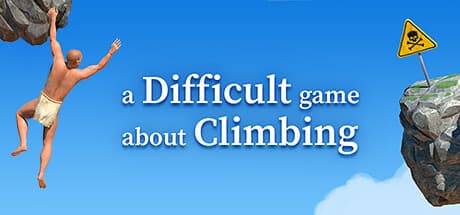
A Difficult Game About Climbing: Reach the Legendary Peak is a physics-based climbing game in which the player uses mouse-driven movement to grip surfaces and ascend without falling. Developed by Pontypants and released on March 6, 2024, it replaces combat and equipment progression with precise control, route reading, and persistence.
The play loop is deliberately simple: identify a usable hold, extend an arm, pull the body upward, and prepare for the next move. Rushing an input or releasing from a poor position can send the climber back down through previously cleared terrain.
The main opponent is therefore not a monster, but the player's own impatience and inconsistent execution.
Climbing Mechanics
Movement is built around direct mouse control rather than a fixed jump activated by a single button. The direction of each arm movement, the chosen grip point, and the body's momentum all affect the result.
Knowing the route is only part of the challenge; players must also develop a repeatable feel for the controls.
Hard sections reward both commitment and restraint. A large swing may be needed to reach a distant surface, while a safer position may justify stopping to stabilize first.
When a move fails, examining the grip height, approach angle, and amount of momentum is more useful than immediately repeating the same motion.
A free expansion adds another substantial and more demanding chapter. It gives players who finish the original ascent a new place to apply the skills they have learned.
The extra content makes mastery, rather than merely reaching one ending, a meaningful long-term goal.
Tension Without Combat
There are no conventional battles, deaths, or gore driving the experience. Its tension comes from the possibility that one mistake high on the route may erase a meaningful amount of visible progress.
The farther the player climbs, the harder it becomes to choose between a risky shortcut and a controlled move.
A fall does not remove the player's knowledge. Previously intimidating sections often become faster and more reliable after repeated attempts, making improvement easy to recognize.
Progress is stored in the player's technique rather than in character levels or upgraded gear.
PC Requirements and Performance
The minimum specification lists Windows 7 SP1 or later, a 2 GHz dual-core CPU, Intel HD Graphics 4000 or better, and 2 GB of RAM. The recommended specification calls for Windows 10, a 2.5 GHz dual-core CPU, a GeForce GTX 970 or Radeon RX 470 or better, and 4 GB of RAM.
Both tiers require DirectX 11 and 1 GB of available storage.
The storage and memory requirements are modest, and the minimum tier includes older integrated graphics. However, merely launching the game is not the same as getting a comfortable precision-control experience.
Input latency or an unstable frame rate can make grip placement and release timing harder, so the recommended GPU tier is the safer target when consistent control matters.
Players should also consider physical desk space. The game asks for both broad and precise mouse movement, so cramped surroundings or an unsuitable sensitivity setting can become practical obstacles.
It is worth using the opening area to adjust and learn the feel of movement before treating every fall as an execution failure.
Player Feedback Trends
Positive feedback commonly focuses on how a small set of inputs creates a demanding skill curve and how rewarding it feels to clear a section through personal improvement. Players can see their growth when a route that once took many attempts becomes familiar and fast.
The spectacular failures also give the game a naturally entertaining quality for spectators and streaming.
Critical reactions tend to come from frustration with lost progress and with the unpredictability inherent in manipulating physics. A missed grip may feel harsher than failure in a conventional platformer, especially after a long uninterrupted climb.
Enjoyment therefore depends not only on liking difficult games, but also on being willing to repeat familiar ground after a setback.
Early Climbing Advice
Do not prioritize speed at the beginning. First learn the effective reach of each movement and observe how the body responds when weight shifts between holds.
Building several small, repeatable techniques is more useful than clearing a hard obstacle once through an uncontrolled swing.
Before committing to the next hold, create a stable position whenever the terrain allows it. If the same move repeatedly fails, adjust the grip point or mouse path instead of adding more force.
Fatigue and frustration quickly damage precision, so taking a break can be a legitimate part of solving a difficult section.
Who Should Play It
This is a strong fit for players who enjoy precision platformers, physics puzzles, and improvement through repeated practice. It particularly suits anyone who wants success to depend on personal control rather than character upgrades or better equipment.
Players who can analyze a fall and calmly attempt the route again will get the most from its design.
The game supports multiple languages, including English and Japanese. Its emphasis is on interaction rather than lengthy reading, making individual sections suitable for focused practice sessions.
Meaningful forward progress, however, may require a longer stretch of concentration.
Caveats and Who Should Avoid It
Players who strongly dislike losing visible progress may find the central design exhausting. It is also a poor match for anyone expecting frequent checkpoints, perfectly deterministic movement, or a short and predictable path to the ending.
Completion time can vary greatly with control mastery.
Although the article may appear under a horror category, the supplied game information describes a precision-climbing challenge rather than combat-driven or gore-focused horror. The anxiety comes from height and the threat of falling.
Players seeking enemies and conventional scares should look elsewhere, while those who want pressure without graphic violence may appreciate this distinction.