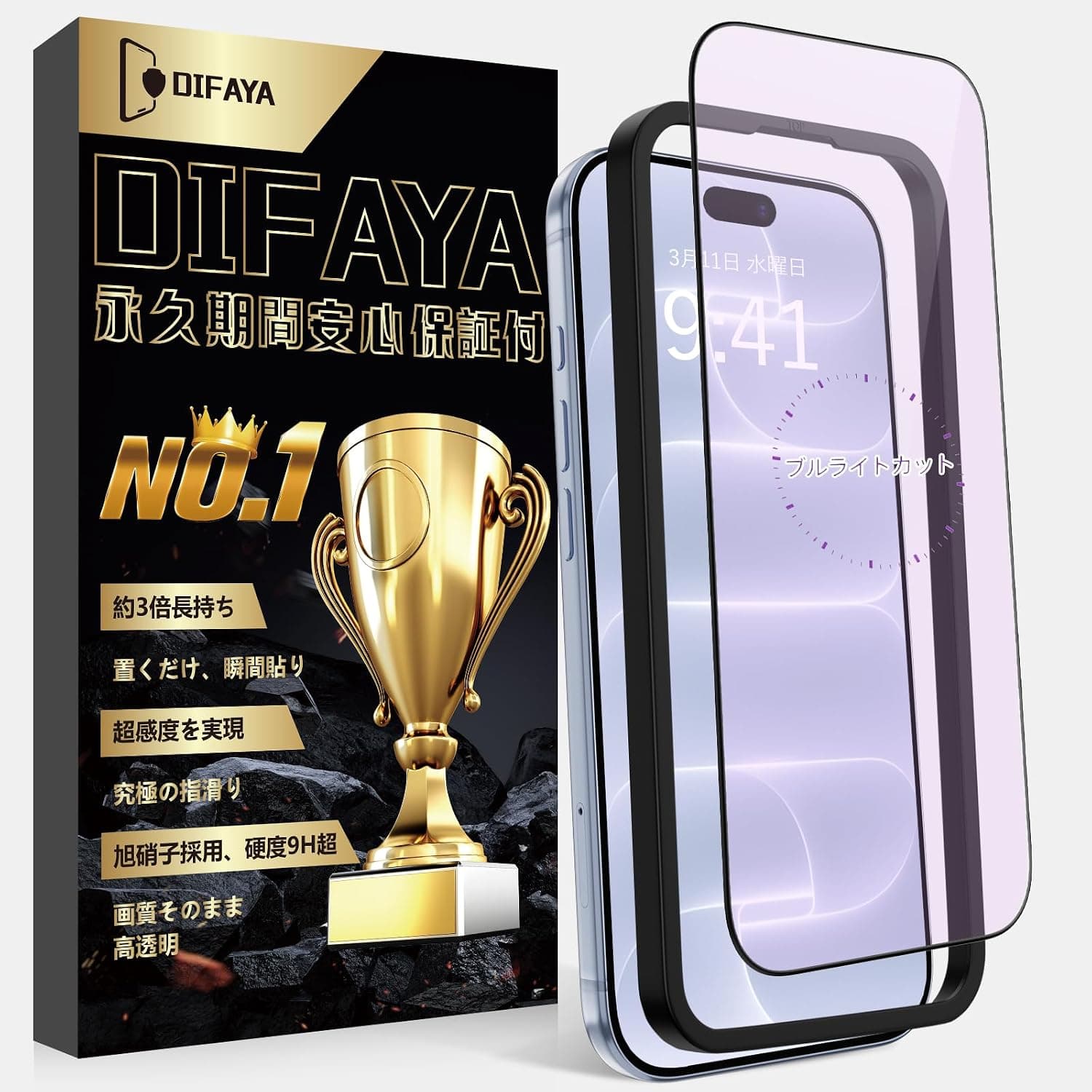
硬度9H 99%高透過率指紋防止飛散防止キズ防止気泡ゼロ自動吸着液晶保護フィルム Sj0225073994 is a tempered-glass screen protector that mounts directly onto flat laptop and monitor panels. The product name lists the usual selling points — 9H hardness, 99% transparency, anti-fingerprint, anti-scatter, bubble-free, auto-adhesion — and each of them means something more specific than it first appears.
This article works through what those numbers actually cover, where sizing goes wrong, and who should pick something else.
Overview
The protector covers the panel surface with tempered glass to resist scratches and fingerprints, and to hold fragments in place if the glass ever breaks. Six specifications are published: 9H hardness, 99% transparency, tempered glass construction, an anti-fingerprint coating, an anti-scatter layer, and bubble-free auto-adhesion.
Thickness, weight, panel sizes and a compatible-model list are not published, so fit has to be confirmed on the listing page rather than from the spec sheet.
It suits people who carry a laptop daily, or who want a frequently touched monitor to stay clean. It is not the right choice for curved displays, for precision pen work, or for anyone expecting drop protection.
What 9H and 99% Really Mean
9H is a pencil-hardness rating — the hardest graphite grade that will not leave a mark — and it is not the same as Mohs 9. In practice it means keys, zippers, fingernails and ballpoint tips are unlikely to scratch the surface.
It does not mean the glass is scratch-proof: quartz in ordinary dust is harder than glass, so wiping a gritty screen with a dry cloth can still leave fine lines.
99% transparency does not mean the image is untouched either. Any added glass layer adds a reflective surface, so glossy glass over a matte (anti-glare) panel will increase reflections regardless of the transparency figure.
Color and brightness stay essentially the same; glare behavior does not.
Compatibility Guide
The only compatibility information published is flat LCD panels. No model list and no panel dimensions are given, so you have to measure.
- Diagonal inches alone are not enough. Two 14-inch panels differ by more than a centimeter in height depending on whether they are 16:9 or 16:10. Measure the visible panel width and height in millimeters and compare against the listing.
- Check the bezel. Some laptops have a flush glass front; others have a raised bezel. On a raised bezel, an exact-size sheet catches the frame and lifts at the edges.
- Watch the webcam and sensors. Glass without cutouts can sit over the camera window or ambient-light sensor and affect the image or auto-brightness.
- Curved monitors are out. Glass does not bend. Anything specified as 1800R or 1000R should be treated as incompatible.
- On laptops, check lid closure. Glass protectors commonly run around 0.3 to 0.4 mm thick, which eats into the gap between keyboard and panel. On thin laptops this can leave key marks on the screen or add strain to the hinge.
- Touch and pen input. An extra glass layer can slightly change capacitive sensitivity and pen pressure response. Confirm suitability before buying if you draw or write on the screen.
Adhesion is silicone self-cling rather than glue, so the sheet can be lifted and repositioned — useful when dust gets trapped during installation.
Installation Without Bubbles
Large sheets are much harder to apply than phone-sized ones; above 13 inches the glass flexes under its own weight and cannot be positioned one-handed.
Work in a low-dust room, such as a bathroom shortly after a shower.
Wipe the panel dry, then use an alcohol wipe for oils and let it dry completely.
Lift remaining dust specks with the sticky side of clear tape.
Align one edge first, keep the opposite edge raised, and let the sheet settle from the center outward.
Push any remaining bubbles toward the nearest edge with the squeegee.
Small ones often disappear within a day.
A cleaning cloth and a squeegee are typically included, but confirm the bundle contents on the listing.
Product Info
Published specifications are 9H hardness, 99% transparency, tempered glass, an anti-fingerprint coating, an anti-scatter layer, and bubble-free auto-adhesion. Anti-scatter means a backing layer holds fragments together if the glass breaks; in a drop, the protector is a sacrificial layer that breaks instead of the panel.
This article deliberately does not quote the captured price. The listing behind the collected data carries registered details that do not match a screen protector at all (see below), so there is no confidence that the captured figure belongs to this product.
Prices also move frequently — check the current price on the product page. The entry collected as an overseas reference points at the same Japanese page, so it is not a useful international price either.
The listing showed a 4.5-out-of-5 rating from 81 reviews when the data was captured in September 2026.
That figure is attached to the same inconsistent listing, so it is worth reading a few review bodies to confirm they describe a screen protector rather than some other item.
How It Compares
| Type | Scratch resistance | Reflections | Repositionable | Best for |
|---|---|---|---|---|
| Tempered glass (this type) | High (9H pencil rating) | Tends to increase | Yes, with cling adhesion | Scratches, fingerprints, touch panels |
| PET / PMMA film | Moderate | Varies | Yes | Thin laptops, minimal added thickness |
| Anti-glare film | Moderate | Reduced | Yes | Bright rooms, windows behind you |
| Privacy filter | Moderate | Reduced | Often removable | Working in public spaces |
If lid clearance on a thin laptop worries you, a PET film is the safer pick. If your real concern is the passenger next to you on a train, a privacy filter matches the goal better than any hardness rating.
Glass earns its place when you touch the screen constantly and want the easy wipe-down and smooth finger glide.
Best Use Cases
- Daily laptop commuters. In a bag full of zippers and pens, the 9H layer absorbs the abrasion instead of the panel. Against the cost of a panel replacement, a sacrificial sheet is cheap insurance.
- Screens that get touched. Touch laptops, family monitors, shop displays — the oleophobic coating keeps oils from spreading and lets a dry wipe do the work.
- Color-sensitive work that still needs protection. At 99% transparency, day-to-day color and brightness shifts are negligible; plan around the reflections instead.
- Households with small children. The anti-scatter layer matters most where broken glass would be a hazard, or where gear travels by car.
Before You Buy
The listing details do not match the product. The reference page behind this article registers a manufacturer and seller from the food trade, which cannot be correct for a screen protector, so no manufacturer information is stated here.
You will see the same inconsistency on the page, so confirm the product images, title and size before ordering. Listing metadata is entered by sellers, and mix-ups like this are not rare — the price and review count on that page deserve the same scrutiny.
The wrong size is unrecoverable. Screen protectors are rarely returnable once applied.
Measure the panel and check the aspect ratio before ordering.
Do not over-trust 9H. It is a pencil-hardness figure, not an impact rating.
A dry wipe over grit will still scratch. Clean cloths and a dust-off before wiping protect a screen better than any hardness number.
Matte panels change character. Glossy glass over an anti-glare coating cancels the factory finish and produces mirror-like reflections.
Under a ceiling light or with a window behind you, this is not a small change.
Curved panels are excluded. Flat glass on a curved panel lifts at the center or the edges and can press hard enough to cause uneven brightness.
Big glass is heavy. Weight grows with area, adding hinge load on laptops and gradually loosening cling adhesion on monitors.
At 24 inches and above, a frame-mounted removable panel is often easier to live with.
FAQ
Q. Can I use it on a curved monitor? A.
No. Tempered glass does not flex, so it will lift or press unevenly.
Choose a PET film for curved panels.
Q. Can it be repositioned? A.
Yes. Silicone cling adhesion lets you lift and reapply, though each removal risks trapping new dust.
Careful first placement is faster overall.
Q. Which size should I order? A.
Do not choose by diagonal inches alone. Measure the visible panel width and height in millimeters, confirm 16:9 versus 16:10, and match those figures to the listing.
Q. Will it stop my screen cracking in a drop? A.
No guarantee. Anti-scatter means fragments stay together; in a drop the glass breaks in place of the panel.
For drop protection, use a sleeve or a rugged case.
Q. Does it work with touch and pen input? A.
Usually, but an extra glass layer can slightly alter sensitivity and pressure response. Confirm on the listing if precise pen work matters.
Q. What is in the box? A.
A cleaning cloth and a plastic squeegee are typical for this product type, but bundle contents vary by listing — check before ordering.