Game Overview
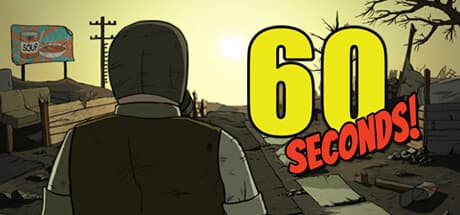
60 Seconds! Nuclear Apocalypse Survival Dash combines a frantic pre-impact scavenging run with a slower shelter-management game.
You control Ted and have only a brief window to carry family members, food, water, and tools out of the house. Capacity and travel time prevent you from saving everything, so every run begins with difficult priorities rather than simple item collection.
Once inside the shelter, you decide who receives supplies, how to answer emerging problems, and when someone should explore the surface. The people and objects rescued during the opening dash affect the options available later.
This connection between physical scavenging and long-term planning is the game's defining structure.
What to Prioritize During the Dash
Family members expand the group that can survive, but rescuing them consumes valuable time and carrying capacity. Food and water sustain the shelter, while tools can unlock responses to particular situations or help with expeditions.
Filling the shelter with only one type of resource is therefore rarely a complete plan.
Use early attempts to learn how to move through the house and avoid repeated trips to distant rooms. It is easier to make decisions if you enter the run with a rough priority, such as rescuing more relatives or securing basic supplies first.
Changing layouts and item positions still require you to adapt rather than follow a completely fixed route.
Life in the Shelter
Shelter play presents situations through text and asks you to choose a response with limited information. Some problems can be addressed by consuming an item, while others force you to accept risk to preserve supplies.
Uncertain outcomes mean this is less a puzzle with one permanent solution and more a game about containing losses.
Surface expeditions may replenish dwindling resources, but the chosen survivor can return injured, sick, or not at all. You must weigh immediate health against future shortages and decide who can be spared from the shelter.
Risk management matters more here than fast reflexes.
Why Repeated Runs Matter
The house arrangement, collected supplies, and sequence of events do not remain identical between attempts. A tool that rescued one run may occupy space better used for water in the next.
Reviewing why a family failed and adjusting the scavenging route or rationing policy provides the main sense of progress.
Randomness cannot be removed entirely, even when a choice seems sensible. That uncertainty supports the game's dark comedy and produces stories that are not fully under the player's control.
It works best when survival is treated as improvisation, not as a perfectly reproducible checklist.
PC Requirements
The listed minimum specification calls for Windows XP SP3 or later, an Intel Core 2 Duo at 2.0GHz or an equivalent AMD CPU, and 4GB of RAM.
The GPU baseline is a GeForce 8800 GT or Radeon HD 2900 XT with 512MB of VRAM. It also requires 3GB of available storage and DirectX 9.0c.
No recommended specification is included in the supplied data, so a higher performance target should not be invented. The listed hardware is from an older generation, suggesting that performance should not be a major barrier for many modern Windows PCs.
Owners of older systems or integrated graphics should still confirm OS and graphics compatibility before installing.
A keyboard and mouse are required according to the listed notes, while an Xbox 360 controller is optional. Because the opening scavenging phase is strictly timed, using the input method you handle most confidently can reduce missed pickups and navigation errors.
Reception and Player Expectations
The game has maintained a favorable reception over time, with its blend of rapid scavenging, resource management, and emergent misfortune forming a clear identity. Failed runs often become memorable stories rather than mere loss screens.
Its dark humor also makes a grim premise easier to engage with.
The divisive elements are randomness and repetition. Some outcomes cannot be prevented through careful planning alone, and familiar events may recur across many attempts.
Players expecting deterministic strategy or a large-scale simulation may find the scope restrictive, while those who enjoy adapting to bad circumstances are more likely to appreciate it.
Who Should Play It
This is a strong fit for players who enjoy prioritizing under pressure, stretching scarce resources, and watching choices create unexpected narratives. It also suits people who prefer multiple compact attempts over committing to one enormous campaign.
Discussing who to rescue and when to spend an item can make it entertaining as a shared or streamed experience, even though decisions belong to the active player.
Caveats and Who May Not Enjoy It
The opening demands quick movement, but most of the experience consists of reading events and selecting responses inside the shelter. Anyone seeking continuous combat or action should look elsewhere.
It may also frustrate players who need every failure to have a fully predictable, avoidable cause.
The game was released on May 25, 2015. Although its minimum requirements mention an older Windows version, confirm compatibility with your current OS and check the available languages on the store listing.
Older PCs should be checked for DirectX support as well as storage and input requirements.