Overview
The Gateron Ink Black V2 is a 5-pin linear switch built for custom mechanical keyboards, sold here in a 70-piece pack. The short verdict: this is a switch for people who want smoothness and a dense, planted keypress rather than featherlight actuation.
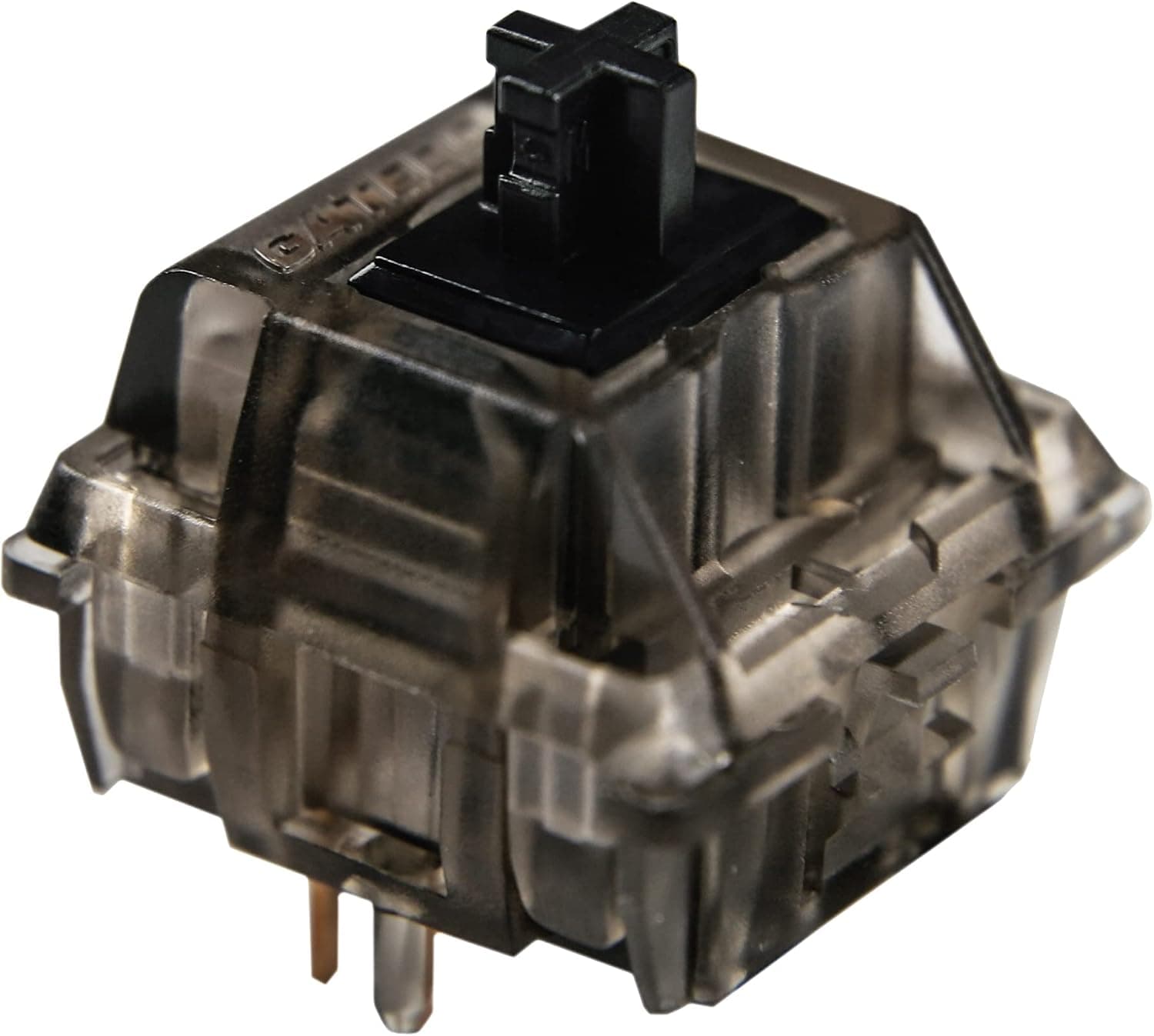
Specs are 60g actuation force, 70g bottom-out, 4mm total travel, a transparent smoke housing, and a 5-pin (PCB-mount) footprint.
Context for those numbers: 60g is noticeably heavier than typical red-style linears (around 45g), so fingers used to lighter switches will feel an extra stage of resistance. Because the gap to bottom-out is only 10g, though, the press doesn't hit a sudden wall — the travel stays even all the way down.
As captured on 2026-08-26, the Amazon.co.jp listing shows 76 reviews at 4.7 out of 5 stars (94% positive).
The sample size is small, but the rating is consistent.
Feel and Sound Profile
Linear switches have no click and no tactile bump, so the stroke runs straight from top to bottom. Ink-style housings are generally known for a lower-pitched sound signature, and while this is not a silent switch, it produces none of the sharp clicking of a blue-style switch.
If noise matters to you, remember that case material, plate choice, and foam usually influence the sound more than the switch itself.
One caveat: linear does not mean silent. Bottom-out impact and spring resonance remain.
In a quiet shared office or a recording setup, easing off your typing force, using a palm rest, or adding o-rings are the practical fixes. If you truly need near-silence, buy a silent-type switch from the start instead of trying to tame a standard linear.
Compatibility Guide
The form factor is MX-compatible, so any keycap with a cross-shaped MX stem fits directly. The switch uses a 5-pin footprint: a center pole plus two plastic stabilizer legs.
Five-pin switches sit more securely on plateless PCB-mount builds, keeping each switch upright during installation.
On a hot-swap PCB, the switch drops straight in as long as the socket area is drilled for 5 pins. The problem case is a 3-pin-only board, where the two plastic legs collide with the PCB and leave the switch sitting proud.
You then have two options: clip the side legs with flush cutters to convert the switch to 3-pin, or move to a 5-pin-compatible board or plate. Clipping is common practice but irreversible, so test-fit a single switch before committing all 70.
Soldered builds work equally well — arguably better, since the extra legs hold the switch square while you solder, which is a real advantage on a first solder build. The transparent smoke housing passes downward-facing RGB light reasonably well, but it is dimmer than a fully clear housing.
If dramatic lighting is your goal, accept that trade-off up front.
One more pre-install check: inspect each switch's pins. A bent pin forced into a hot-swap socket can destroy the socket, which often means replacing the whole PCB — far more expensive than the switches.
Straighten any bent pin with tweezers before inserting.
Product Info
To restate the specs: linear, 60g actuation, 70g bottom-out, 4mm total travel, 5-pin, transparent smoke housing, 70 pieces per pack. Seventy switches will not cover a full-size board (104–108 keys), and it falls just short of a TKL layout (around 87 keys) as well.
For 60%, 65%, or 75% layouts, one pack covers the board with spares to test with. Plan on two packs for a full-size build.
As captured on 2026-08-26, the Amazon.co.jp listing was ¥9,106 including tax.
Prices move often with stock and sales, so check the product page for the current figure before buying. That works out to roughly ¥130 per switch — mid-range to slightly above for custom switches.
If budget is the only criterion, cheaper domestic linears exist; the question is how much you want to invest specifically in smoothness.
Review data as captured on 2026-08-26 was 76 reviews at 4.7/5 (94% positive).
With a sample that small, the average can still shift, and small-sample scores are more sensitive to unit variance and batch differences.
How It Compares
| Aspect | Gateron Ink Black V2 | Light linear (e.g. 40gf class) |
|---|---|---|
| Actuation force | 60g | around 40gf |
| Best for | Long typing sessions, heavier feel | Rapid repeats, less finger strain |
| Accidental presses | Rare | More common |
| Finger fatigue | Higher | Lower |
A 20g difference in actuation force changes the experience completely. Light 40gf-class linears sink under the weight of a resting finger, which helps with fast repeated input but invites accidental presses.
The 60g Ink Black V2 rewards anyone who rests their hands on the keys while thinking — mispresses are almost nonexistent.
Neither is objectively better; it depends on your typing style. If you can't decide, a switch tester or a small sample pack costs far less than committing to 70 of the wrong switch.
Weight preference is one of the few things a review score genuinely cannot tell you.
Installation and Lubing
On a hot-swap board the process is simple. Pull the keycaps and old switches with a puller, check the socket orientation, and press each new switch straight down.
Angled force bends pins, so always push from directly above. Install a handful first and confirm they register in a key-test utility before doing all 70 — it keeps any mistake cheap to undo.
Lubing is optional here. Ink-family switches are already smooth out of the box, so factory-fresh use is perfectly reasonable.
If spring scratchiness bothers you, lubing only the springs makes a noticeable difference for far less effort. Fully disassembling and lubing 70 switches is a multi-hour job; start stock, then treat only what actually bothers you.
Planning a full lube session up front is how builds stall before they're finished.
Best Use Cases
- Long-form typists who hate mispresses: 60g means resting your fingers won't trigger input. Over long writing sessions, that weight reads as stability rather than fatigue.
- First-time keyboard builders: The 5-pin design keeps switches straight, and hot-swap boards need almost no tools. Seventy pieces build one compact board with spares.
- Office workers wanting a quieter linear: No click at all, which makes it far easier to justify in shared space — as long as you accept it isn't silent.
- Owners of prebuilt hot-swap boards: Swapping switches is a cheap, high-impact upgrade compared with replacing the whole keyboard.
Things to Check Before Buying
Quantity first. Seventy switches do not fill a full-size board, and they fall short of TKL too.
Buying one pack for a 104-key build and ending up a dozen switches short is the single most common mistake here. Count your layout's keys before ordering.
Then weight. Sixty grams looks moderate on paper, but coming from 45g reds it feels distinctly heavy.
If you prefer sub-40g switches, have weaker finger strength, or mainly play games demanding sustained rapid presses, this isn't your switch. Decide in advance that you'll switch to something lighter if it feels wrong, or 70 switches end up in a drawer.
Watch 3-pin boards. Clipping the legs works, but it's irreversible, costs you stability on future 5-pin builds, and you'll be doing it 70 times.
Confirm your PCB's socket cutouts before you order.
Verify the listing itself. This product page groups several switch variants — black, red, blue, silent black, yellow — under one listing.
Confirm that Black (Ink Black V2) is the selected option before adding to cart. Amazon listing metadata (manufacturer, model number, ASIN, quantity) can also disagree with the actual item, so cross-check the product images, title, and selected variant with your own eyes.
Don't over-expect the RGB. Smoke housing transmits light but never as brightly as milky or fully clear housings.
Treat lighting as a secondary trait and you'll be happier with the result.
FAQ
Q. Is 70 enough for a full-size keyboard? A.
No. Full-size boards need around 104 keys and TKL around 87, so plan on two packs.
One pack comfortably covers 60%, 65%, or 75% layouts with spares.
Q. Will these drop into a hot-swap keyboard? A.
Yes, if the sockets accept 5-pin switches. On 3-pin-only PCBs the plastic legs interfere, so you'll need to clip them or change boards.
Q. Are these silent switches? A.
They produce no click, but they are not silent switches. Bottom-out and spring noise remain; choose a silent-type switch if near-silence is the goal.
Q. Do I need to lube them? A.
Not required. They're smooth stock; lubing just the springs is the practical middle ground.
A full lube of 70 switches takes hours.
Q. Are they heavy coming from red switches? A.
Yes, noticeably. Typical reds are around 45g versus 60g here.
Try a switch tester first if you prefer a light touch.
Product Disclosure (Amazon)
- Manufacturer: GATERON
- Seller: BOBshop
- Fulfilled by: BOBshop
- ASIN: B09B4QQR8N
- Note: This article covers a manufacturer-made product based on Amazon listing details.