Overview
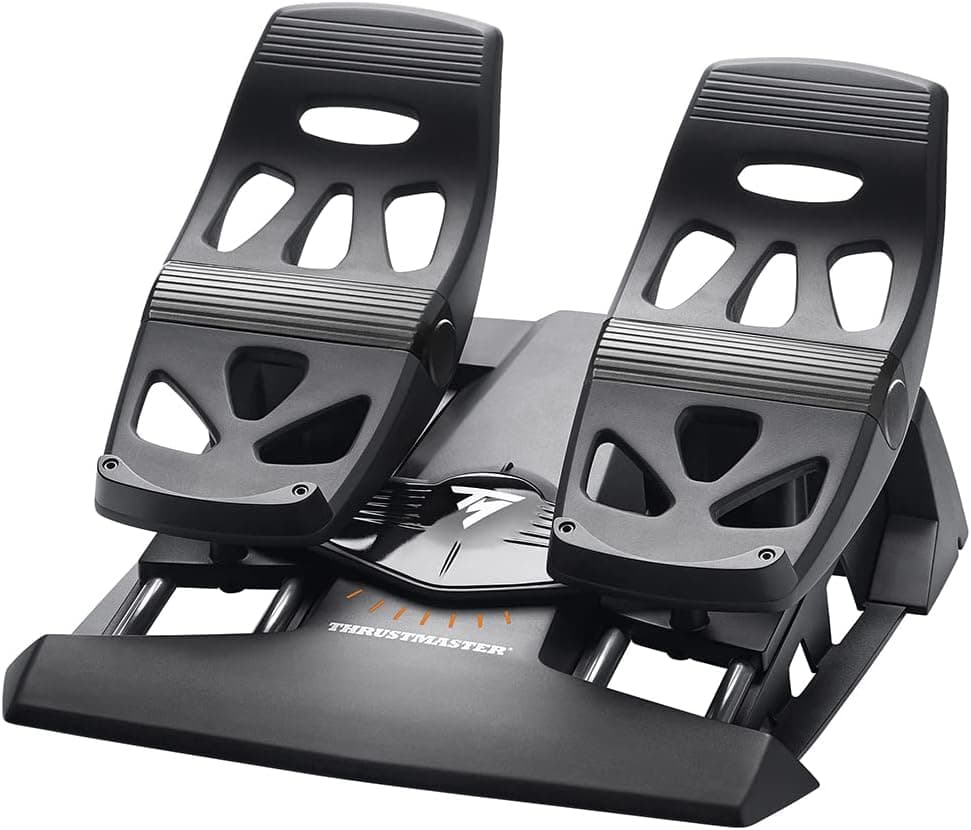
The Thrustmaster TFRP T.Flight Rudder Pedals target sim pilots who want to move up from twist-stick or keyboard rudder input without paying for a metal, load-cell rig.
If your goal is to build the habit of flying rudder with your feet at an accessible price, this is a strong pick. If you expect the rigidity and fine pressure modulation of a high-end set, it will feel light.
On Amazon.co.jp the pedals hold 4.4 out of 5 stars across 3,282 reviews (roughly 88% positive, captured 3 June 2026), which is consistent for this class.
The pedals use S.M.A.R.T (Sliding Motion Advanced Rail Tracks) rails, so each pedal slides fore and aft rather than pivoting around a single axis.
The 25 cm pedal faces support differential toe braking, and the large footrests let you keep your heels planted through long flights.
What the S.M.A.R.T Rails Actually Change
Because the motion is a slide rather than an ankle twist, large rudder inputs become far more repeatable — you move your whole leg instead of rotating your foot. The 15° travel range and 25 cm pedal width give enough room that you rarely need to reposition your feet mid-flight.
What the rails do not do is increase sensor resolution. They buy you smoothness, quiet operation and comfort.
At 2.55 kg the unit is light, so a hard press can slide the whole base forward on a hard floor.
It is fixable, but every new owner meets this behaviour once.
Compatibility Guide
On PC the pedals are plug-and-play over USB with no dedicated driver needed. Windows sees a generic game controller, and you assign the rudder and left/right brake axes inside your sim.
Any sim that supports a rudder axis will work, including setups built around non-Thrustmaster sticks. Run a full-travel calibration on first launch so both extremes register.
On PlayStation 4 the pedals must be connected to a Thrustmaster T.Flight Hotas 4 joystick (sold separately).
Plugging them straight into the console does nothing. Budget for the stick if PS4 is your target platform.
Xbox consoles are not officially supported; third-party adapters are outside any warranty, so pick a different product if Xbox is your main platform.
Physical fit matters too. At 34.9 x 31.4 x 20.6 cm you need roughly 35 cm of flat floor in both directions under the desk.
If you use a caster chair, check that the chair base does not collide with the pedals before committing to a position. The USB cable is fixed to the unit, so plan an extension cable if your tower sits far away.
Product Info
Key specs: 34.9 x 31.4 x 20.6 cm, 2.55 kg, 15° pivot range, 25 cm pedal width.
Construction is a plastic base with sliding rails — solid for the price, but without the heft of an all-metal set. The box contains the pedals and the attached USB cable; no software or mounting hardware.
A one-year manufacturer warranty is the norm, though retailer terms vary. This listing is the Japanese domestic authorised version.
On pricing, Amazon.co.jp showed ¥19,120 as captured on 27 August 2026, and ¥23,800 on the same page as captured on 3 June 2026.
That is a several-thousand-yen swing in about three months, so always check the live product page. A $395 marketplace figure also appeared in the collected data; that is an order of magnitude out of line for this class and most likely a resale or shipping-inflated listing, so it is not treated as a street price here.
One more listing quirk: the spec table shows a battery type entry (AAA). The pedals run on USB bus power and take no batteries.
Treat that field as a listing error.
How It Compares
Rudder pedals differ along four axes: motion type (tilt vs slide), sensing (potentiometer vs load cell), chassis material and weight, and whether damping or centring force is adjustable. The TFRP is slide-motion, plastic-chassis, potentiometer-based, with no adjustment — priced accordingly.
Metal, load-cell sets are clearly better for fine corrective inputs and pedal feel, but they sit several times higher in price. If you are still building the reflex of flying with your feet, the jump from twist-stick to TFRP is the bigger step.
Pairing it with other Thrustmaster flight gear also keeps feel and in-sim configuration consistent.
Best Use Cases
Helicopter pilots benefit most: anti-torque pedals demand constant small corrections that a twist grip cannot deliver comfortably. Taildraggers and warbirds that rely on differential braking during taxi and takeoff roll are the second big win.
Existing T.Flight HOTAS owners get a matching, easily integrated setup.
For a newcomer building a first serious flight sim rig, this is a high-priority second purchase.
If you fly airliners on autopilot and only touch rudder on takeoff roll and crosswind landings, the payoff is smaller. Competitive dogfighters chasing maximum precision should look at load-cell sets instead.
Before You Buy
1. PS4 requires a Hotas 4. The single most common complaint stems from expecting the pedals to work standalone on the console.
They do not.
2. The base slides. 2.55 kg is not enough to stay put on laminate or a chair mat under a firm press.
Use a non-slip mat, brace the unit against a wall or desk leg, and rest your feet on the footrests so part of your body weight holds it down.
3. Fine-input resolution has limits. Expect to tune deadzone and sensitivity curves in your sim before judging the feel.
Out of the box the response can read as coarse near centre.
4. Quiet, not silent. Rail noise is low, but hard inputs still transmit vibration through the floor — worth a rug in an apartment.
5. Do not trust every listing field. The battery-type entry and the outlier marketplace price show that product-page metadata can be wrong.
Confirm the product from the images and title, and compare price and contents per seller.
6. Check return terms and test immediately. Sweep both pedals to full travel and confirm independent left/right brake response as soon as you unbox, while any initial-defect window is still open.
FAQ
Q. Do I need to install drivers?
A. Not on PC. Plug in over USB, then map and calibrate the axes inside your sim.
Q. Do they work on PS5 or Xbox? A.
Official support covers PC and PlayStation 4 via the T.Flight Hotas 4.
Xbox is not officially supported. Check the manufacturer page for the current compatibility list.
Q. Can I use them with a non-Thrustmaster stick? A.
Yes, on PC they act as an independent USB pedal set; assign the axes across devices in your sim.
Q. Do they need batteries?
A. No. They are USB bus-powered despite the battery field in the spec listing.
Q. They slide when I press hard. What can I do?
A. Use a non-slip mat, brace against a desk leg, and keep your heels on the footrests.
Q. What should I expect to pay? A.
Amazon.co.jp recorded ¥19,120 on 27 August 2026 and ¥23,800 on 3 June 2026.
Prices move a lot — check the live listing.