Overview
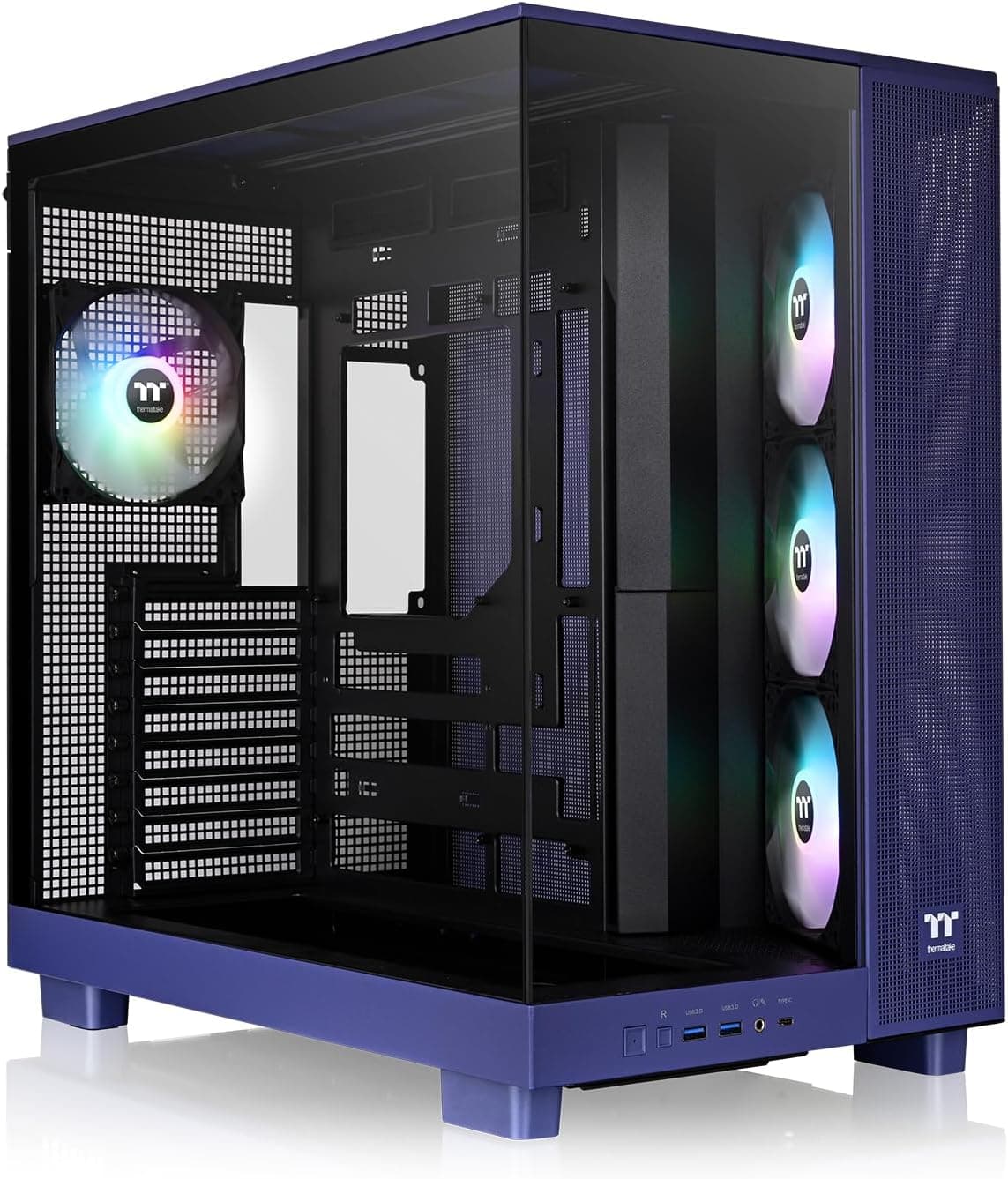
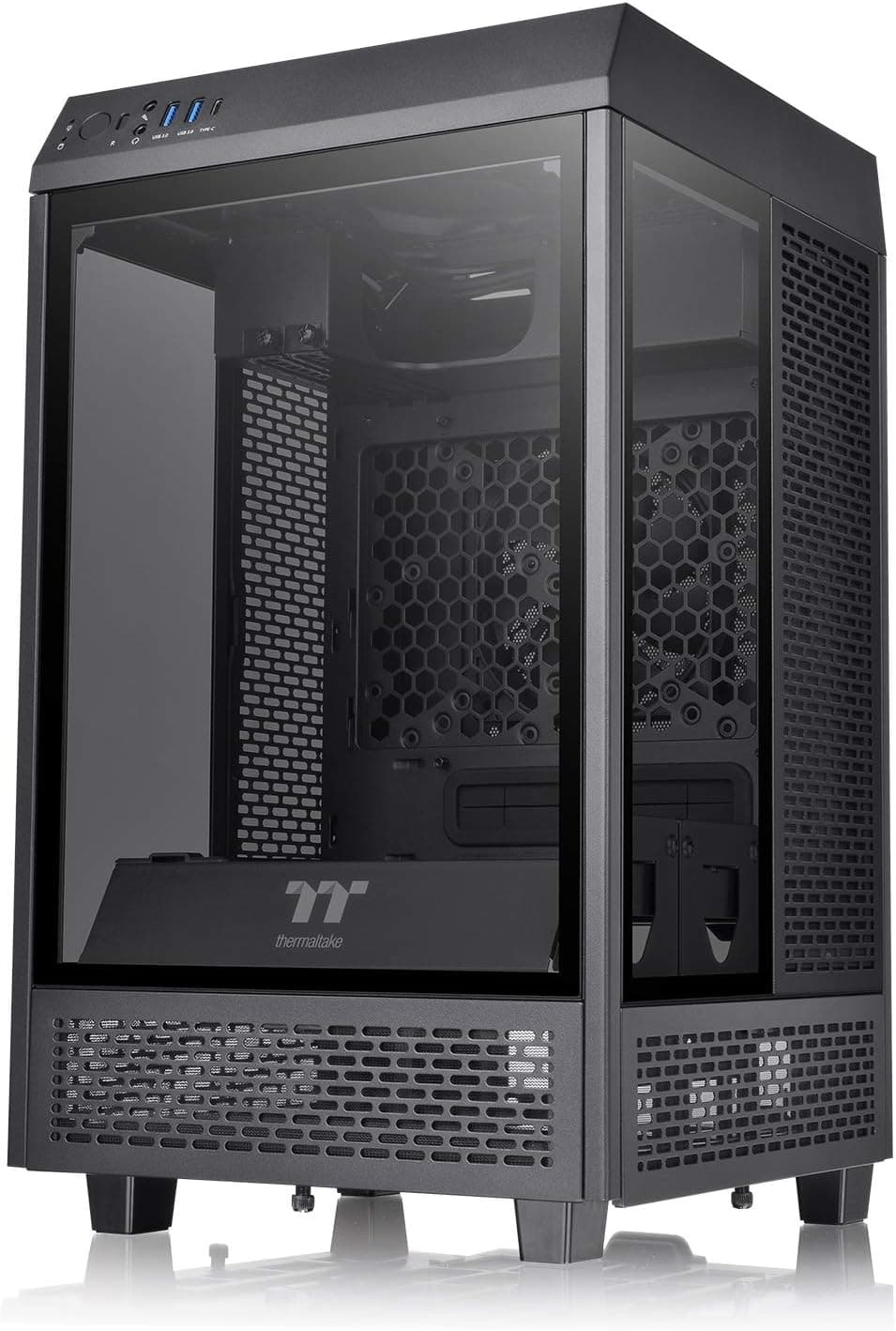
The Thermaltake The Tower 100 ミニタワーPCケース 3面強化ガラス is a Mini-ITX-only vertical chassis built around three 4mm tempered glass panels. Its entire design goal is to display the components inside.
If you want a small PC that sits on your desk and looks like a showcase, it is a strong candidate; if quiet operation, easy maintenance or future expansion matter more, it is the wrong case.
Despite the Mini-ITX limitation, it accepts expansion cards up to 330mm, so you rarely have to downgrade your graphics card just to go small. A front USB Type-C port covers modern peripherals.
On Amazon it held a 4.4 out of 5 rating from 407 reviews as of 26 May 2026 — an 88% positive score, which is stable rather than polarised.
That said, most of the praise is for looks and ownership satisfaction. With three sides sealed by glass, cooling and acoustics are structurally worse than a mesh-fronted case.
The sections below work through what the published specs actually mean in a real build, and where you will have to compromise.
The 30-second answer
| Question | Answer |
|---|---|
| Motherboard | Mini-ITX only (no Micro-ATX or ATX) |
| Max GPU length | 330mm |
| Max CPU cooler height | 190mm |
| Radiator | 240mm, top only |
| PSU | Standard ATX, up to 180mm |
| Drives | 2x 2.5-inch + 2x 3.5-inch |
| Fan mounts | Top 120mm x2 / rear 120mm x1 / side 120mm x2 |
| Panels | 4mm tempered glass, three sides |
| Colours | Black, white |
| Warranty | 2 years (Japanese distributor stock) |
| Rating | 4.4/5 from 407 reviews (May 2026) |
Every figure above is a published maximum measured with nothing else installed. In a real build the radiator, cables and drives compete for the same volume, so a configuration that sits exactly on two limits at once usually will not work.
Compatibility Guide
Mini-ITX and nothing else
This case takes Mini-ITX boards only. Micro-ATX and ATX will not physically fit, and no workaround changes that.
If you already own a larger board, switching to this case means replacing the motherboard too — check that before you buy.
Mini-ITX boards normally have a single PCI Express slot. Once a graphics card is installed, there is effectively no room for a capture card, sound card or 10GbE NIC.
Plan on using the board's onboard networking and audio, or choose a different platform.
Length is rarely the problem — thickness and connectors are
The 330mm clearance covers most current high-end cards. In small cases the real constraints are card thickness (slot count) and the orientation of the power connector.
Cards thicker than three slots, or with a connector standing vertically on the top edge, can foul the glass or the frame. Slot-width clearance is not published for this case, so measure your card and confirm whether an angled adapter is usable.
Cable bend radius matters just as much. Modern high-power cards use thick cables that need several centimetres of clearance above the connector.
"It fits but the cable cannot bend" is the single most common way a small-form-factor build fails.
180mm of PSU room, but shorter is better
The case takes standard ATX power supplies up to 180mm deep. A 180mm unit fits on paper, but every millimetre it uses is space that excess cables no longer have.
In practice a fully modular 140–160mm unit is far easier to route and leaves more room for airflow.
Cable length is its own issue. The vertical layout changes the run distance for the 24-pin and EPS 12V cables compared with a conventional mid-tower, so stock cables can be either too short or awkwardly long.
In a case designed to be seen, this is what decides whether the build looks finished.
The cooler and the radiator share the same space
Maximum CPU cooler height is 190mm and the top panel takes a 240mm radiator. Treat 190mm as the figure with no radiator installed: a radiator plus fans typically adds 50–55mm of thickness, so do not plan on a tall air cooler and a top-mounted AIO at the same time.
Memory height deserves a check too. Tall heat spreaders and RGB modules can clash with radiator or cooler fins.
Decide the cooling setup first, then pick memory that fits the space left over.
Four drives fit, but that does not make it pleasant
Storage support is two 2.5-inch plus two 3.5-inch drives.
Two spinning 3.5-inch drives transmit vibration into a glass-walled chassis and are easy to hear, and the extra SATA and power cables spoil both the view and the airflow.
For a showcase build, use M.2 storage internally and push bulk data to an external drive or a NAS.
Product Info
The Tower 100 launched in early 2021 as a Mini-ITX chassis with three 4mm tempered glass panels and a "Dismantlable Modular Design" intended to make assembly and cleaning easier. It comes in black and white, and Japanese distributor stock carries a two-year warranty.
The Japanese listing showed ¥12,100 when the price was captured on 26 May 2026. Prices move constantly with sales, exchange rates and distributor stock, so always check the product page for the current figure.
That places it mid-to-upper in the small-case bracket — a few thousand yen above plainer cases of similar size.
That premium buys panel material and frame design, not extra cooling capacity or sound damping. Whether it is worth paying depends entirely on how much you value the showcase construction; if you do not, it will look expensive for what it is.
How It Compares
Mini-ITX cases differ sharply in intent. If quiet, practical operation is the goal, a damped, closed-panel design such as the Fractal Design Define 7 Nano is the more straightforward answer.
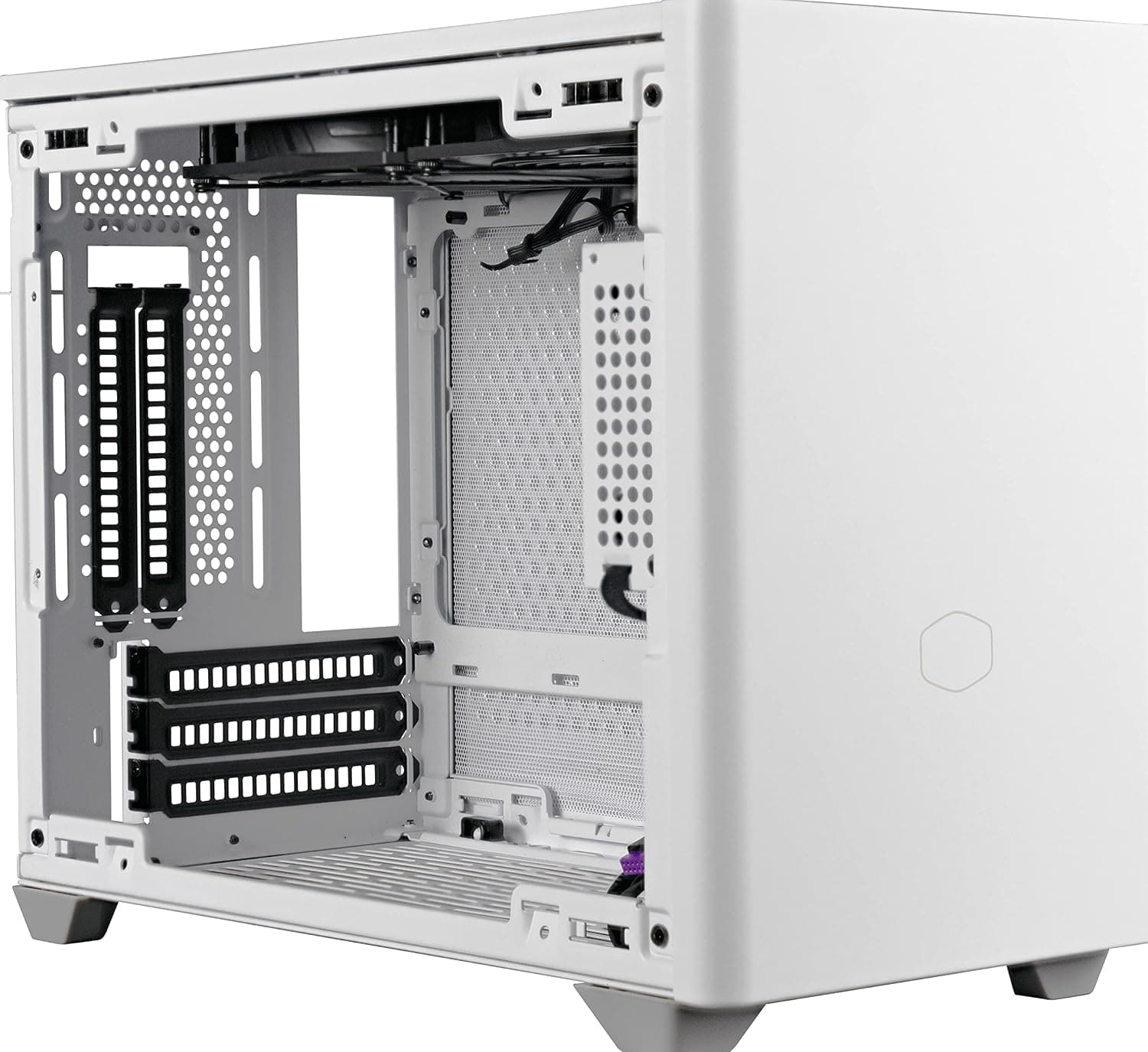
If the point is to display the hardware, three glass panels leave the Tower 100 with few direct rivals. The frequently compared Cooler Master NR200 family prioritises mesh airflow — better thermals, a different purpose.
The moment you need ATX or a second expansion card, this case drops out of contention. Thermaltake's own The Tower 600 keeps the three-panel tempered-glass look in an octagonal ATX mid-tower, which is the natural upgrade for anyone who likes the aesthetic but finds Mini-ITX too restrictive — at a significant size penalty.
If you want lots of drives, look elsewhere again: NAS-oriented cases with many 3.5-inch bays optimise for quiet bulk storage rather than visibility.
Decide which of "visible", "quiet", "capacious" and "compact" ranks first, and the choice becomes obvious. Here, "visible" is unambiguously first.
Thermals and Placement in Practice
Airflow runs sideways in and out through the top and rear, which matches the direction hot air wants to travel anyway. The logic is sound, but with three glass sides the open area cannot match a mesh case.
If you add fans, keep the direction consistent: intake at the sides, exhaust at the top and rear.
Put the case somewhere open — a desk, not a shelf cubby or a cramped under-desk rack — because top exhaust needs somewhere to go. There is intake on the underside as well, so floor placement pulls in dust quickly.
Standing it directly on carpet is the worst option.
Maintenance means fingerprints outside and dust inside. A case that shows off the build also shows every speck, so plan on removing the panels and cleaning filters and fans every few months.
The modular design makes disassembly easy, but the glass panels are heavy and a knocked corner can chip — work on a flat surface and lay panels down rather than leaning them.
Best Use Cases
- Mini-ITX showcase builders — three tempered glass panels at this price are unusual, and ARGB fans or custom loops pay off visually. The more you invest inside, the better the value.
- Desk-space-conscious users — the vertical layout keeps the footprint small compared with a wide mid-tower, which suits a tidy desk with a monitor arm.
- Builders who refuse to downgrade parts — 330mm GPU and 190mm cooler clearance let you reuse mainstream components instead of buying low-profile equivalents.
- AIO users — a 240mm top radiator handles a hot CPU, as long as you are not also planning a tall air cooler.
Things to Consider
The Mini-ITX restriction is the headline constraint. The word "mini tower" leads some buyers to assume Micro-ATX will fit — it will not.
Verify your motherboard's form factor first, because getting this wrong means rebuilding the whole system, not just swapping a case.
Set your acoustic expectations low. Glass is not damping material and the openings are limited, so this is a case that relies on fans doing work.
For a quiet room or long high-load sessions, a damped closed case will satisfy you more. If you want quiet here, start with a low-heat CPU and large, slow-spinning fans.
Watch out for conflicting price data. The domestic listing was ¥12,100 as captured on 26 May 2026, while an overseas marketplace listing showed $250.00 as captured on 10 July 2026 — roughly double, almost certainly reflecting shipping, import fees and reseller markup.
Judge by the current domestic price rather than the overseas figure.
Listing metadata itself is sometimes wrong. Manufacturer names, model numbers and supported form factors occasionally belong to a different product entirely.
When you open the product page, confirm from the images and title that it really is The Tower 100 — especially where colour variants or higher models share one listing, since the price and reviews may refer to a different model.
Three common misconceptions are worth naming. "Small means cheap" does not hold: compact cases are denser and cost more per litre than mid-towers.
"330mm support means any GPU fits" does not hold either — thickness and connector orientation bite first. And "Mini-ITX means low power" is simply wrong; this case uses a standard ATX supply, and consumption depends on the parts you install.
FAQ
Q. Will a Micro-ATX board fit?
A. No. Mini-ITX only; Micro-ATX and ATX cannot be installed.
Q. Will a large graphics card fit? A.
Up to 330mm long. Slot-width clearance is not published, so for cards thicker than three slots or with a vertical top-edge power connector, check the exact dimensions and connector orientation on the product page first.
Q. Can I install a 360mm radiator?
A. No. The top mount supports 240mm maximum. If you need more, choose a different case.
Q. Do I need an SFX power supply? A.
No — standard ATX up to 180mm is supported. A shorter fully modular unit is still much easier to route.
Q. Can I put it on the floor? A.
Not recommended. There is intake underneath, so it collects dust quickly, and the top exhaust works best in open air.
Treat it as a desktop case.
Q. Do black and white differ in specification? A.
Not in any published specification — form factor support and dimensions are the same. Choose by how it matches your components.