Game Overview
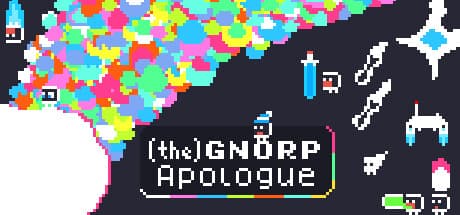
(the) Gnorp Apologue – Guide Your Gnorps to Riches in This Unique Incremental Game is an incremental strategy game developed and published by Myco. Released on December 14, 2023, it asks you to organize small creatures called gnorps around a mysterious rock and turn the resulting shards into a larger production system.
The basic loop connects damage, collection, and reinvestment. Some gnorps strike the rock to create shards, while other parts of the system must retrieve those shards so they can be spent on new gnorps, upgrades, and structures.
Producing more is not automatically useful when collection cannot keep pace.
Features and Systems
The key strategic problem is balancing output with retrieval. Investing heavily in attacks can cover the ground with uncollected shards, while excessive collection capacity may leave workers waiting for resources that have not yet been produced.
The most useful upgrade is therefore determined by the current bottleneck rather than by one universally best statistic.
Visual feedback makes that bottleneck readable. Watching where shards accumulate, where gnorps wait, and how quickly resources enter your usable stockpile gives you practical information about the next investment.
When progress slows, the cause may be an imbalance between connected systems rather than a simple lack of power.
New gnorps, structures, and upgrades expand the available combinations as the run develops. This creates a choice between immediate output and effects that become stronger after other systems are in place.
The result feels closer to assembling a compact engine than repeatedly buying the most expensive upgrade.
Early-Game Approach
At the beginning, alternate between checking shard production and collection speed. A growing pile on the ground usually indicates that retrieval is lagging, while idle collectors suggest that the rock is not producing enough.
The animation is not merely decorative; it serves as a live diagram of the economy.
When a new mechanic becomes available, test it with a modest investment before committing all available resources. Observe how it interacts with the existing setup, then expand it if it resolves a visible constraint.
This reduces wasted investment and teaches the system more clearly than following numbers alone.
What Kind of Idle Game Is It?
This is less about clicking without interruption and more about building a system, observing the result, and returning to adjust it. It can support short cycles of active optimization, but it is not best understood as a fully hands-off game that removes the need to inspect the screen.
Its presentation is closely tied to its mechanics. As more gnorps appear and the flow of shards becomes busier, improved efficiency produces a visible change rather than only a larger counter.
It resembles spreadsheet-style optimization translated into a lively scene of small workers and moving resources.
System Requirements
The listed minimum requirements are Windows 10, a 2.4 GHz dual-core processor, 2 GB of RAM, and a graphics solution with 512 MB of memory and OpenGL 3 support.
It also requires only 150 MB of available storage, so installation size should not be a major concern for most PCs.
A recent integrated graphics solution may be sufficient if it supports the required OpenGL version. On older machines, driver and API support may matter more than raw graphics performance.
Check the current graphics driver and confirm OpenGL 3 compatibility before buying.
No recommended specification is provided, so a particular CPU or GPU cannot be promised for late-game activity or high-resolution play. A machine that only barely meets the minimum may have less headroom as the number of visible objects increases.
Reception and Common Impressions
Players who enjoy the game tend to value the interaction between its systems and the way optimization becomes visible through the flow of shards. Its appeal comes from diagnosing inefficient production and discovering combinations, not from demanding controls or fast reactions.
It may feel repetitive to players who primarily want a story campaign, exploration, or reflex-driven combat. Enjoyment depends heavily on whether investigating a stalled economy feels like a puzzle or a chore.
Consult the live rating panel on the article page or the current Steam listing for up-to-date reception.
Who Should Play It?
(the) Gnorp Apologue is a strong fit for players who want to understand why their numbers are growing, not merely watch them increase. It particularly suits people who enjoy locating bottlenecks, combining upgrades, and observing small characters turn an abstract economy into visible activity.
It is also approachable for players who prefer learning through experimentation instead of studying a long control guide. Steam Achievements, Trading Cards, and Cloud saves add value for achievement hunters and players who continue across supported devices.
Caveats and Who Should Skip It
Resource optimization is the core experience. Players seeking frequent action, competitive multiplayer, or a large world to explore are likely to find that the game serves a different purpose.
It also rewards experimentation, so it may frustrate anyone who wants every next step to be explicitly directed.
Multiple languages, including English and Japanese, are listed, but language coverage and interface quality can change with updates. Check the current Steam listing if localization is essential.
The same precaution applies to platform features and system requirements, which may be revised after publication.