Overview
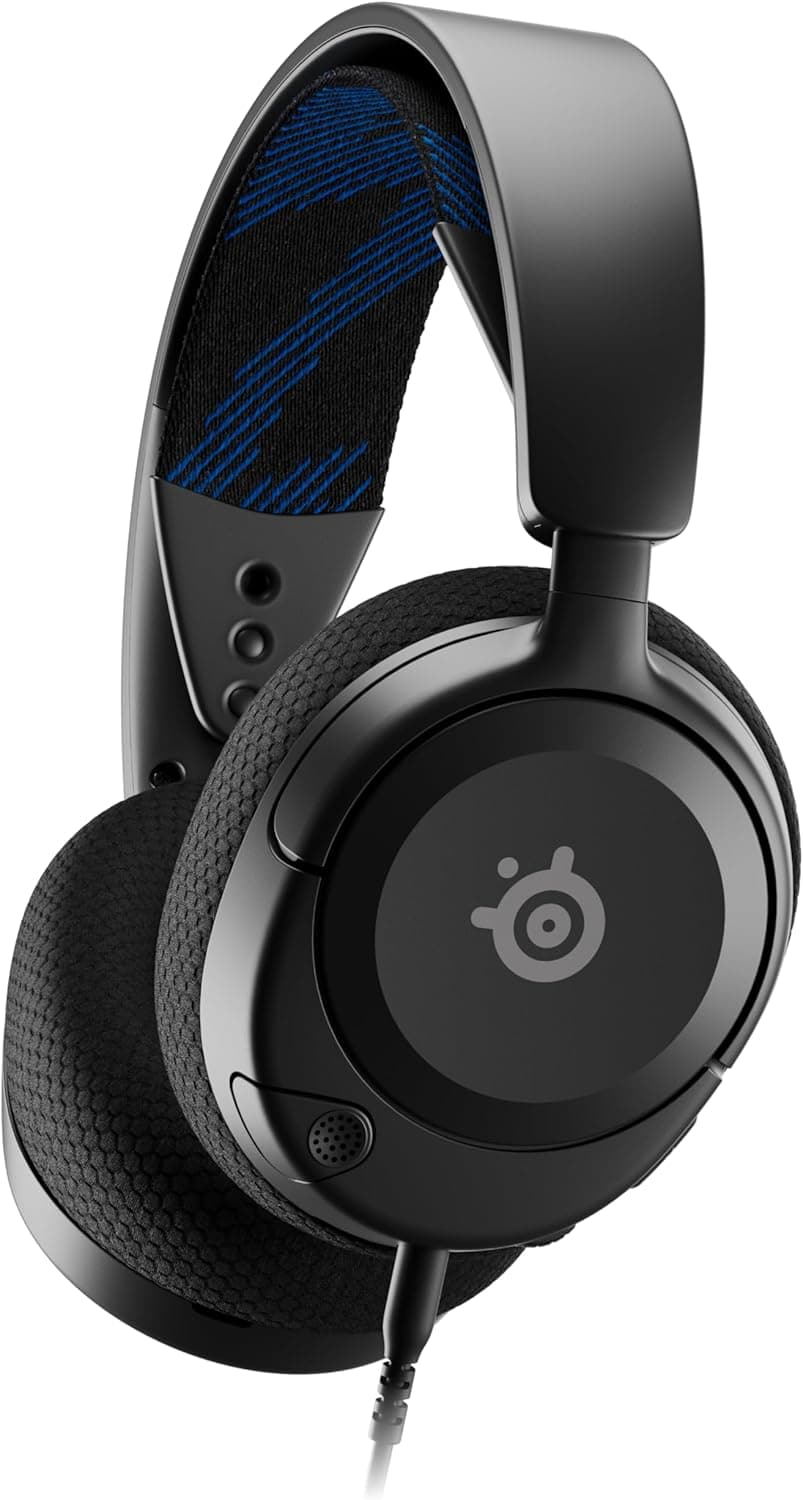
The SteelSeries Arctis Nova 1P is a wired 3.5mm gaming headset tuned for the PlayStation 5.
The short version: it suits anyone who wants to plug straight into a DualSense controller and get a clear step up in game audio and voice chat, with no pairing, no firmware updates and no battery to run flat. It is a poor fit if you want to game from the couch untethered, or if you constantly switch between PC and console.
Think of it as the upper Arctis Nova models (7P, Pro Wireless) with the wireless radio, battery and on-cup mixer stripped away, leaving the core audio parts. It weighs 236g, uses 40mm drivers, covers 20–22,000Hz, and sits at 32Ω.
That low impedance matters: it means a controller's 3.5mm jack can drive it to a useful volume without any external amplifier.
On Amazon.co.jp the headset held a 4.2-star average (84% positive) across 1,116 reviews as of the figures captured in late June 2026.
Holding that score over a thousand-plus reviews is a genuinely good result at this price tier.
Sound and Spatial Audio in Practice
The 40mm drivers are from the same family used across the Nova line, and the tuning avoids the usual budget-headset trap of drowning footsteps in inflated bass. The 20–22,000Hz figure looks identical to most competitors on paper; what actually distinguishes the Nova 1P is clarity in the mids and upper mids.
In shooters, positional information lives in footsteps, reloads and gear rustle rather than in deep bass, so that voicing works in a competitive player's favour.
Spatial audio comes in two separate forms, and confusing them is common. On PS5, the console's own Tempest 3D AudioTech does the work — nothing needs installing, and it is active the moment you plug in.
On PC, SteelSeries' Sonar software adds 360° spatial audio and a parametric EQ. In other words, the spatial experience differs by platform, and PS5-only owners have no reason to install Sonar at all.
The microphone is a bidirectional ClearCast Gen 2 unit, 100–10,000Hz, rated at -38dB sensitivity. A bidirectional pattern picks up sound from front and rear while rejecting the sides, which is why keyboard clatter and air-conditioning hum sitting off to one side tend not to reach your teammates.
Software processing can add to this, so on a bare PS5 setup the physical pickup pattern is doing most of the work.
Compatibility Guide
There is exactly one connection: a 3.5mm 4-pole (CTIA) plug on a 1.2m cable.
No battery, no dongle, no Bluetooth. Understand that and most compatibility problems disappear.
| Device | Works? | Notes |
|---|---|---|
| PlayStation 5 / 5 Pro | Yes | Straight into the DualSense; Tempest 3D AudioTech active |
| PlayStation 4 | Yes | Straight into the DualShock 4 |
| PC (4-pole combo jack) | Yes | Sonar adds EQ and spatial audio |
| PC (separate mic/headphone jacks) | Partly | Needs a 4-pole splitter adapter |
| Nintendo Switch / Switch 2 | Yes | Console 3.5mm jack |
| Smartphone | Yes | Needs USB-C or Lightning adapter if there is no jack |
| Xbox | Partly | Audio works via a controller jack, but it is not the tuned target |
The usual failure happens on desktop PCs. Many motherboard rear panels and case front panels still split microphone input and headphone output into two separate 3-pole jacks, and plugging a 4-pole connector into one of them gives you sound with a microphone that never appears.
A cheap 4-pole splitter fixes it. Laptops mostly use a combined headset jack, so they simply work.
The 1.2m cable is sized for the distance to a controller in your hands.
That is ample on PS5, but nowhere near enough to reach the back of a tower PC or a device beside a TV. If you extend it, you must use a 4-pole extension cable — a 3-pole extension will silently kill the microphone, which is the single most common complaint with any wired headset.
Physically, 236g plus the COMFORTMAX-style band means clamping force is moderate rather than tight, and it is reasonably kind to glasses wearers. The cushions are a fabric-type material: breathable in summer, but less isolating than sealed leatherette.
How to Think About the Competition
Rivals at this price split into two groups: wired sets that spend the budget on sound, and discounted entry-level wireless sets. Against the wired group, the Nova 1P's advantages are its low weight, its bidirectional mic pattern and SteelSeries' well-sorted cushions.
Against the wireless group, the Nova 1P wins on audio quality, latency and weight, while the wireless option wins on freedom of movement. That is the whole trade.
The decision reduces to one question: can you live with one cable? If yes, the same money buys noticeably better sound and voice quality than a wireless set at the same price.
If no, there is no reason to force it — the Arctis Nova 7P covers wireless, and the Arctis Nova Pro Wireless X sits at the top of the range.
Product Info
Key specifications: 40mm drivers, 20–22,000Hz frequency response, 32Ω impedance, 236g weight, 1.2m cable, wired 3.5mm connection.
The microphone is a bidirectional ClearCast Gen 2 at 100–10,000Hz and -38dB sensitivity. Spatial audio is supported through Sonar on PC, and through the console's own processing on PS5.
On Amazon.co.jp the price was ¥6,980 as captured on 26 August 2026.
The headset launched around the ¥10,000 mark, so this represents a well-settled street price. Headsets move a lot during sales, however, and nothing guarantees that figure still stands — check the current price on the product page before buying.
Overseas marketplace listings exist too, but parallel imports may not carry the same warranty handling as domestic stock.
In the box: the headset, a 1.2m 3.5mm cable and a product information guide, with a one-year manufacturer warranty.
Closely named variants (Nova 1, Nova 1P, Nova 1X) are sold alongside each other, so check the suffix carefully at checkout.
Best Use Cases
- PS5-first players — plug into the DualSense and Tempest 3D AudioTech is live; no pairing, no updates. On a console shared with family, swapping it between users is trivial.
- Long sessions — 236g is light for the class, and there is no battery to die mid-match. That failure mode simply does not exist here.
- Players who care about voice chat — the bidirectional pattern rejects side noise, so mechanical keyboard clatter is far less likely to reach your squad. It matters most in ranked play, where a call getting through decides rounds.
- First-time headset buyers — with few features, there is almost nothing to misconfigure.
It is not for you if you assume wireless, want Bluetooth for music, or expect fine on-cup control over volume mix and sidetone.
Things to Know Before Buying
First, a data warning. The Amazon listing metadata for this product has been observed carrying a manufacturer name and model number belonging to an entirely unrelated brand. Amazon registration details are maintained per seller, so this kind of mix-up is not rare.
Before ordering, confirm with your own eyes that the product images and title clearly say "SteelSeries Arctis Nova 1P", and check that the seller is one you trust. The same caution applies to prices: if a listing shows a figure that is an order of magnitude off for a headset in this class, it is probably pulling data from a different product.
The most frequent functional misunderstanding is assuming Sonar gives you 360° spatial audio on PS5. It does not — Sonar is PC software and will not run on a console.
Positional audio on PS5 comes from Tempest 3D AudioTech instead. The sound is still spatial, but if you like dialing in your own EQ curve, expect to have essentially no control when the headset is used on PS5 alone.
For tinkerers, that is a real compromise, not a footnote.
Second, the headset carries a volume wheel and a mic mute switch, and nothing beyond that. Sidetone level and game/chat balance are left to whatever the connected device offers.
If diving into PS5 settings menus for every adjustment sounds tiresome, a model with an on-cup or base-station mixer will make you happier.
The microphone is retractable but not detachable. If you stream with a separate desk microphone, the boom staying attached even when stowed is a matter of taste.
The fabric cushions breathe well in summer but isolate less than sealed leatherette, so buying this specifically to shut out air-conditioning noise or household sound will disappoint.
Finally, the cable. 1.2m is tidy but too short for a PC under a desk or a device across the room.
Extend it only with a 4-pole cable — a 3-pole extension leaves audio working while the microphone goes dead, and it is very often mistaken for a defective unit.
FAQ
Q. Does it work outside the PS5? A.
Yes. Any 4-pole 3.5mm jack works — PC, Mac, Nintendo Switch, phones.
That said, the "P" model is tuned for PlayStation; PC-first buyers should plan on Sonar, and Xbox-first buyers should look at another model.
Q. Is Sonar required? A.
No. It is not used on PS5, where the console's own Tempest 3D AudioTech applies.
Sonar is optional PC software for EQ and spatial audio.
Q. Can the microphone be removed?
A. No. It retracts into the earcup when not in use.
Q. What is the real benefit of going wired? A.
No charging, and no wireless latency or interference by design. At a given budget, more of the cost also goes into drivers and the microphone rather than a radio and battery.
Q. Is it comfortable with glasses? A.
Generally yes, thanks to the 236g weight and moderate clamping force, though comfort over many hours is personal — try it if you can.
Q. What about warranty? A.
One year from the manufacturer. Parallel-import units may fall outside domestic support, so check the seller's stated coverage.