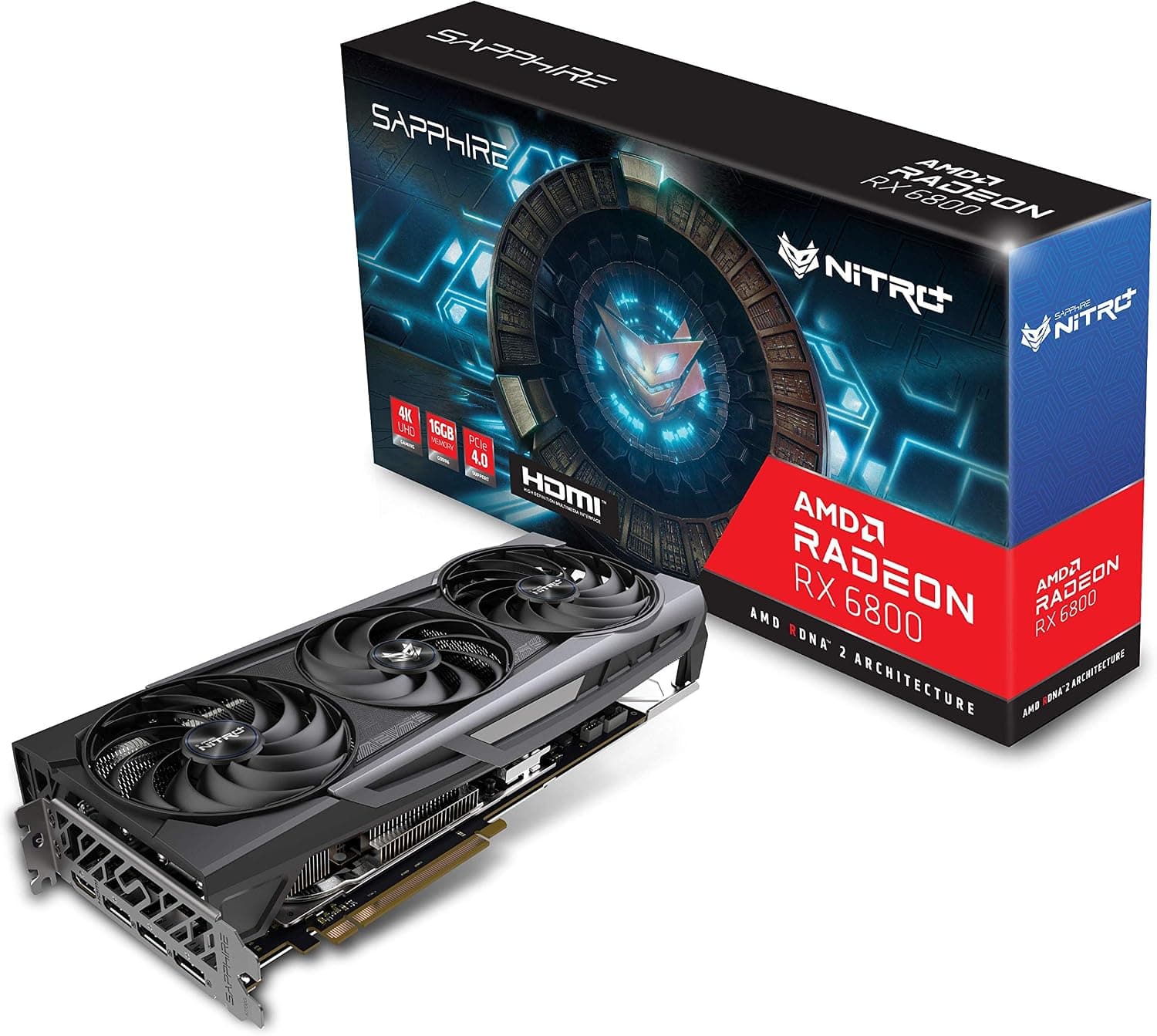
This article covers Sapphire 11305-01-20G Nitro+ AMD Radeon RX 6800 PCIe 4.0 ゲーミンググラフィックカード 16GB GDDR6付き.
Overview
Sapphire's Nitro+ series has long been known for its robust cooling and factory overclocking. The Sapphire 11305-01-20G Nitro+ AMD Radeon RX 6800 16GB GDDR6 is built on AMD's RDNA 2 architecture with the Navi 21 GPU, offering a Game Clock of up to 1980 MHz and a Boost Clock of up to 2190 MHz. With 16GB of GDDR6 memory across a 256-bit bus delivering 512 GB/s of bandwidth, this card is positioned as a strong contender for high‑resolution gaming. It competes directly with the GeForce RTX 3070 Ti and RTX 3080, often surpassing them in raw rasterization and VRAM capacity, making it an excellent choice for gamers who prioritize texture‑heavy 4K workloads without relying on ray tracing.
The Tri‑X triple‑fan cooling solution, combined with direct‑touch heat pipes and a massive heatsink, keeps temperatures and noise in check even under extended loads. The metal backplate adds rigidity, and the NITRO Glow RGB lighting can sync with mainstream motherboard ecosystems. Four display outputs (2x DisplayPort, 2x HDMI) support multi‑monitor setups up to 8K.
Compatibility Guide
The Nitro+ RX 6800 uses a PCI Express 4.0 x16 interface, but it works in PCIe 3.0 slots with negligible performance loss in most games. The card measures approximately 310mm in length and occupies 2.5 expansion slots, so ensure your case has enough clearance. It requires two 8‑pin PCIe power connectors, and a PSU of at least 650W is recommended – 750W or higher provides a comfortable margin for overclocking and high‑power CPUs. For AMD platforms with Ryzen 3000/5000 series, Smart Access Memory (SAM) can boost performance further.
Product Info
Launched in November 2020, the Sapphire Nitro+ RX 6800 originally carried a street price of around ¥60,000–¥70,000. Current market pricing hovers near ¥150,000 on Japanese online retailers due to supply constraints. The card comes with a standard two-year manufacturer’s warranty. Sapphire’s TriXX software allows fine‑grained tuning of clocks, fan curves, and RGB lighting. This GPU sits in the mid‑high to high‑end tier, ideal for 4K gaming at 60 fps or more, VR, and video editing with large textures.
Best Use Cases
- 4K AAA gaming at 60+ fps: The 16GB frame buffer ensures stable performance in texture‑heavy titles like Cyberpunk 2077 or Hogwarts Legacy. If ray tracing is crucial, consider an RTX 3080 instead; if you prefer raw speed and memory, the RX 6800 is a strong pick.
- VR enthusiasts: High shader count and memory bandwidth provide a seamless VR experience with headsets such as the Valve Index or Quest 2 (wired). Note that CUDA‑dependent workflows (e.g., 3D rendering) are better served by NVIDIA cards.
- AM4 platform upgraders: Pairing with a Ryzen 5000 or 3000 CPU unlocks Smart Access Memory, improving data transfers. Ensure your PSU meets the 650W minimum before proceeding.
Things to Consider
While the RX 6800’s 16GB VRAM is a major advantage over similarly priced 8GB cards, it lacks hardware ray tracing performance equal to NVIDIA’s Ampere architecture and does not support DLSS; FSR is an alternative but with narrower game support. The card’s physical size (310mm) prevents its use in compact or many Micro‑ATX cases. Current pricing is elevated compared to launch, so shop around. Also, older PSUs may not have two 8‑pin connectors or sufficient wattage headroom.
FAQ
Q: How does this card compare to the RTX 3080?
A: In raw rasterization performance the RX 6800 is competitive, but the RTX 3080 offers superior ray tracing and DLSS. If you play many ray‑tracing titles, lean toward the 3080; if you value 16GB VRAM and lower power draw, the RX 6800 is compelling.
Q: Will I notice a performance drop on a PCIe 3.0 motherboard?
A: In most games, the difference is negligible (1–3%). However, workloads that transfer large datasets frequently (e.g., some GPU compute tasks) may see a small penalty. For pure gaming, PCIe 3.0 is not a concern.
Q: What PSU wattage do I really need?
A: A quality 650W unit is officially recommended, but 750W gives peace of mind for overclocking and future upgrades. With a high‑end CPU (e.g., Ryzen 9, Core i9), 850W is safer.
Product Disclosure (Amazon)
- Manufacturer: SAPPHIRE
- Seller: Reg shop
- Fulfilled by: Reg shop
- ASIN: B08NXZSPMY
- Note: This article covers a manufacturer-made product based on Amazon listing details.