Game Overview
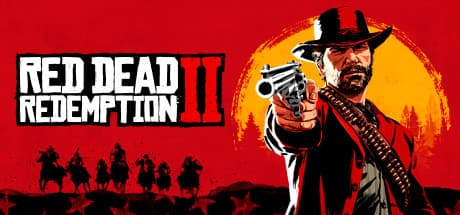
Red Dead Redemption 2 — An Epic Western Saga in a Vast Open World is an open-world action adventure set in America in 1899. You play Arthur Morgan, an outlaw traveling with the Van der Linde gang as law enforcement and bounty hunters close in.
Its core rhythm combines camp life, horseback travel, robberies, gunfights, and the gradual movement of the gang across the country.
The world ranges from snowy mountains and forests to plains, swamps, and growing towns. Hunting, fishing, poker, bounty work, treasure hunting, and chance encounters give players reasons to leave the direct route to the next mission.
The PC version arrived on Steam on December 5, 2019, and includes interface and subtitle support for Japanese alongside multiple other languages, while full audio availability varies by language.
What You Actually Do
Story missions cover infiltration, pursuit, escort work, robberies, and large shootouts. Combat is primarily third-person, though a first-person view is available, and the Dead Eye system lets Arthur slow the action and place precise shots.
This makes combat feel more deliberate than a fast competitive FPS, even when several enemies are involved.
Outside missions, Arthur eats, sleeps, maintains weapons, cares for his horse, and hunts for food and materials. Obtaining a good-quality pelt requires the right weapon and a clean shot rather than simply firing at every animal.
These routines make the setting convincing, but they also slow the pace for anyone who wants uninterrupted combat.
Systems That Shape the Experience
Honor reflects more than a few major dialogue choices. Helping strangers, threatening witnesses, and committing crimes all contribute to how Arthur is perceived.
Crime can also produce a local bounty, turning escape and eventual payment into part of the consequences rather than resetting the world after a mission.
Horses are more than interchangeable vehicles. Riding, calming, feeding, and caring for a horse builds a bond that affects handling and available actions.
Because long journeys are central to the game, choosing and looking after a favorite mount becomes a meaningful part of play.
NPCs respond to greetings, antagonism, weapons, and Arthur's conduct, while camp conversations change as the story advances. Players who rush from one yellow mission marker to the next can miss smaller scenes that add context to the gang.
Returning to camp and listening before advancing a chapter gives the character arcs more room to develop.
Useful Early-Game Advice
The opening in the mountains is a lengthy guided introduction. Broader exploration and optional activities become clearer after the gang establishes its first main camp, so the opening alone does not show the full structure of the game.
Players unsure about the pacing should at least reach the point where they can choose their own routes and activities.
Weapons need cleaning to maintain their condition, and long guns may remain stored on the horse unless selected before walking away. Check the loadout before entering a mission area instead of assuming every owned weapon is on Arthur.
In busy towns, it is also worth reading the current interaction prompt carefully, since an accidental weapon draw can turn a routine visit into a crime.
PC Requirements and Performance Targets
The minimum specification lists Windows 10 64-bit, an Intel Core i5-2500K or AMD FX-6300, a GeForce GTX 770 2GB or Radeon R9 280 3GB, and 8GB of RAM. Treat this as a baseline for running the game, not a promise of high settings or consistently smooth performance across every region.
Players near the minimum should expect to balance image quality, resolution, and performance.
The recommended specification lists an Intel Core i7-4770K or AMD Ryzen 5 1500X, a GeForce GTX 1060 6GB or Radeon RX 480 4GB, and 12GB of RAM. Both tiers require 150GB of available storage.
Leave additional working space for installation and updates, especially on a smaller SSD shared with other large games.
The PC version offers many graphics options, so maximizing every setting is rarely the best starting point. Begin with a preset, test demanding towns and landscapes, and then adjust resolution, textures, shadows, reflections, vegetation, and distance-related settings in stages.
The recommended hardware does not by itself guarantee maximum settings because the result also depends on resolution and the frame-rate target.
Player Feedback Trends
Red Dead Redemption 2 has maintained strong player sentiment over the long term. Its character writing, landscapes, environmental detail, and the evolving relationship between Arthur and the gang are frequent reasons players remain invested.
Optional routines also reinforce the main narrative instead of feeling entirely separate from it.
The same deliberate design can be divisive. Long rides, detailed pickup animations, weighty controls, and a slow opening may frustrate players who value immediate response and rapid progression.
PC players may also need to spend time checking settings and startup behavior, making an early performance test worthwhile.
Red Dead Online
Red Dead Online lets players create a separate character and pursue activities with or against other players. Its progression and priorities differ from Arthur's single-player campaign, so it should be viewed as another mode rather than a required continuation of the story.
It can provide a longer-term space for friends who want cooperative jobs and shared exploration.
Encounters with other players make the online experience less predictable than a solitary campaign journey. Decide whether cooperation, competition, or casual exploration is the goal before investing time in it.
Players interested only in the authored narrative can stay with the single-player mode without losing the core story.
Who Should Play It
This is a strong fit for players who enjoy Westerns, patient exploration, character-driven stories, and journeys where the events between destinations matter. It rewards people willing to hunt, speak with strangers, observe camp life, and let scenes unfold instead of treating the map as a checklist.
It also suits players looking for a long solo campaign with meaningful activities beyond shooting. The separation between the campaign and online mode provides options for both story-focused solo play and ongoing sessions with friends.
Caveats and Who May Not Enjoy It
Players seeking short sessions filled only with immediate firefights may find the pace too restrained. The controls distribute actions across weapons, inventory, horses, and context-sensitive NPC interactions, which can cause mistakes during the learning period.
Its detailed animations are both a major source of immersion and a source of friction.
The 150GB storage requirement is substantial, and systems close to the minimum specification may require visible graphics compromises. Anyone buying primarily for the scenery should compare the recommended hardware with their intended resolution and frame-rate target.
Language features also vary, particularly for full audio, so confirm the exact support needed on the current Steam product page.