Overview
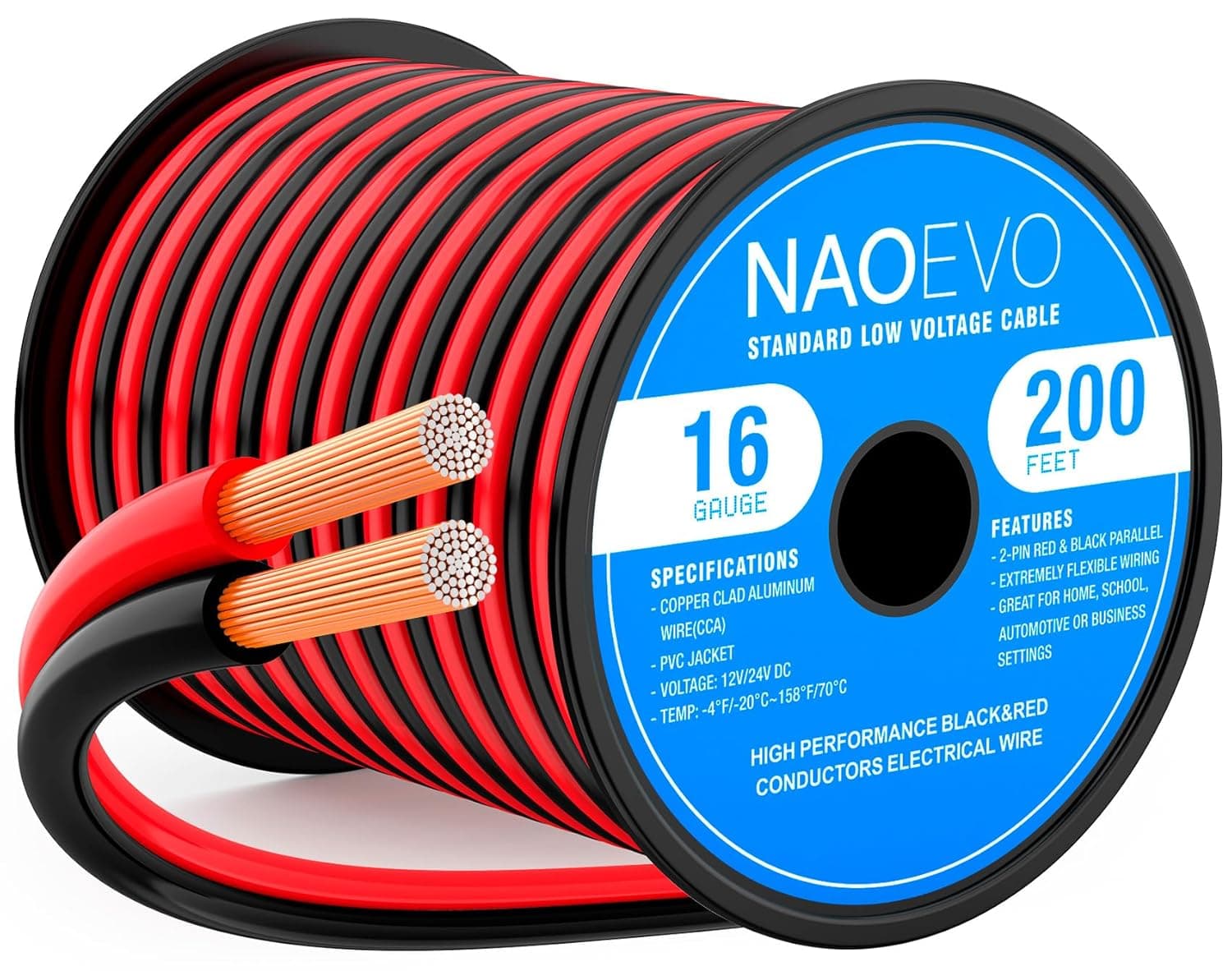
The NAOEVO 16 Gauge Wire 200FT is a two-conductor red/black parallel cable supplied on a 200 ft (about 61 m) roll, using 16 AWG copper-clad aluminum (CCA) conductors. The short verdict: this is bulk material for people who want to run low-voltage 12V/24V DC wiring without worrying about length — not a premium pure-copper speaker cable.
It is rated 12V/24V DC with PVC insulation, and its natural home is speaker runs, LED strip power feeds, and 12V automotive accessories.
On Amazon.co.jp it holds a 4.8-star average (96% positive) across 76 reviews, which is a solid showing for budget wiring stock.
With only 76 ratings, treat that figure as indicative rather than statistically firm.
Note that this article is filed under the "wifi_repeater" category in the source data, but the actual product is not a wireless networking device — it is general-purpose low-voltage wire. Everything below is written about the cable.
What CCA Actually Means
The single most important line in the spec sheet is "Conductor Material: copper-clad aluminum (CCA)". CCA is an aluminum core with a thin copper cladding: lighter and distinctly cheaper than pure copper (OFC), but only around 60% as conductive, so the same gauge carries more resistance.
In practice, 16 AWG (about 1.3 mm²) pure copper runs roughly 13 Ω per kilometer as a rule of thumb; assume CCA sits around 1.5–1.7× that.
So "16 AWG" here does not behave like 16 AWG copper — electrically it acts closer to one size thinner. The longer the run and the higher the current, the more that gap matters.
The second practical difference is termination. Aluminum oxidizes readily and does not take solder as willingly as copper, so crimp terminals are the more reliable choice.
Aluminum is also less ductile, which makes CCA a poor fit for moving joints or anywhere the wire gets tugged.
Compatibility Guide
Judge fit on four axes: voltage, current, distance, environment.
Voltage — Rated 12V/24V DC. It is not for AC mains (100V+) or any building power wiring.
That is a safety and code issue, not a performance trade-off, so there is nothing to weigh.
Current — 16 AWG is generally discussed for loads up to roughly 10A, but given CCA's higher resistance, keeping continuous current around 7–8A is the safer working limit. For anything above 10A — large amplifiers, banks of fans, winches — choose thicker pure copper.
Distance — This is where a 200 ft roll tempts you into trouble. Resistance accumulates over the full there-and-back conductor length, so a 10 m one-way run (20 m total) carrying 5A can drop roughly 0.4–0.5V with 16 AWG CCA — about 4% of a 12V supply.
That surfaces as dimmer LEDs at the far end, or relays that chatter under load. Plan a heavier gauge for runs you already know will be long.
Environment — PVC jackets are typically good for around 60–80°C. Keep the wire out of engine bays, away from exhaust components, and out of sealed downlight housings.
It is not weatherproof either, so outdoor routing assumes split loom or conduit.
Devices — It terminates normally at passive speaker binding posts, LED strip pads and connectors, and automotive fuse taps or bullet terminals. The red/black coding genuinely speeds up work on polarity-sensitive loads such as LEDs, DC motors, and car electronics.
Fit by Application
| Application | Fit | Comment |
|---|---|---|
| Bookshelf / surround speakers, under 10 m one-way | Excellent | Current is tiny at normal listening levels |
| LED strip power feeds | Excellent | Length is the selling point; watch far-end dimming |
| Cabin accessories (dome lights, dashcam, small fans) | Excellent | Color coding and easy routing pay off |
| Fog lights / DRLs | Good | Fine with a relay and proper fusing |
| Car amplifier power feed | Marginal | Depends on current; above 10A choose copper |
| Engine bay routing | No | PVC temperature rating is insufficient |
| AC mains wiring | No | Outside its rating — do not do it |
| Audiophile-grade speaker runs | No | Buy OFC instead |
The "excellent" rows all share the same profile: modest current, sensible distance, no heat or water. The "no" rows all run straight into CCA's weaknesses — resistance, heat tolerance, and mechanical strength.
Cheap wire in the wrong place costs more in rework than it saved.
Product Info
Key specs: 16 AWG gauge, 200 ft (about 61 m) length, copper-clad aluminum conductor, PVC insulation, 12V/24V DC rating. The package contains the cable only — crimp terminals, connectors, clips, and heat-shrink tubing are all separate purchases.
Running out of terminals mid-job is the classic way to lose an afternoon, so order them alongside the wire.
On pricing: Amazon.co.jp listed it at ¥7,134 as captured on 24 August 2026, and ¥7,337 as captured on 25 July 2026.
That is roughly a ¥200 swing in a month, so treat any figure here as a snapshot. Spread over 200 feet it works out near ¥120 per meter, clearly below equivalent-length pure copper.
Always confirm the current price on the product page before ordering.
Review data as captured on 1 August 2026: 76 ratings averaging 4.8 stars (96% positive).
For bulk wire, most of that feedback likely reflects practical points — the roll contained the stated length, the jacket routes easily.
Warranty follows the seller's return policy. As with any wire, cutting into the roll makes returns difficult, so inspect the length, the jacket for nicks, and the conductor color (CCA looks silver-white at the cut face) before you start.
Best Use Cases
Whole-home LED and accent lighting installs — 200 feet covers cross-room runs, ceiling voids, and baseboard routing without splicing. Fewer joints means fewer future failure points.
The flexible PVC handles corners well, and this is the application it suits best.
Adding 12V accessories to a vehicle — Dome lights, dashcams, USB outlets, and small fans all draw a couple of amps or less, which is comfortably within range. Red/black coding prevents polarity mistakes behind trim panels.
Permanently wiring a home theater — Passive speakers draw a few hundred milliamps to a few amps at normal levels; under 10 m one-way you are unlikely to hear or measure a problem. Pre-wiring every room in the walls is exactly where the cost difference shows.
Anyone who just needs a lot of cheap wire — Prototypes, temporary rigs, event setups, and garage projects that will be rebuilt anyway make CCA's compromises entirely rational.
If none of these describe you, read the next section before buying.
Things to Check Before Buying
Be skeptical of the eBay price. In the source data, Amazon.co.jp shows ¥7,134–¥7,337 while an eBay search under the same name returns $193.99 — nearly four times higher in yen terms.
That strongly suggests a different roll length, a different gauge, or an entirely different product. If you buy from an overseas marketplace, match gauge, length, and conductor material (CCA vs pure copper) line by line, not just the title.
Listing metadata itself can be wrong. Wire products usually bundle many variations — gauges, lengths, single vs two-conductor — onto one page, and the manufacturer name or spec table shown may not match the variation you actually selected.
Check the images, the title, and your selected option before ordering.
Do not treat "16 AWG" as if it were copper. This is the biggest trap.
Size up when runs are long or currents are high. If your job involves more than about 15 m one-way, or sustained draw above 8A, choose pure copper in 14 AWG or heavier instead.
Do not design around soldering. Solder wets aluminum poorly, and forced joints can develop rising contact resistance over time.
Crimp terminals plus heat-shrink is the safer path. Crimp carefully too: CCA crushes more easily than copper, so an over-tight crimp can sever strands.
Be cautious on always-on vehicle circuits. Fusing at the source is mandatory, and beyond that, avoid CCA anywhere constant heat, vibration, or flexing is present (door hinge looms, for example).
Aluminum fatigues under repeated bending, and broken strands stay invisible from outside.
If you care about audio purity, buy something else. Anyone who weighs conductor metallurgy in a listening system is not this product's audience.
The right answer there is OFC, not "CCA because it was cheap."
Installation Notes That Save Rework
What trips people up after buying wire is usually logistics, not electricity. Measure along the actual route — around corners, plus service loops at each device — rather than straight-line distance, and add about 20%.
Two hundred feet is generous, but cutting short forces extra splices.
Parallel two-conductor cable can be split by hand into single runs when needed. Split only as far as termination requires, and wrap the split point with tape so it does not creep further while you work.
Red is conventionally positive and black negative, but after pulling a bundle through a wall it is easy to lose track of which end is which. Marking both ends with matching tape makes future expansion and troubleshooting far easier.
FAQ
Q. Can you hear the difference versus pure copper speaker cable? A.
For passive speakers at normal levels over sensible distances (under 10 m one-way), the resistance difference is small enough that most listeners will not notice. On long runs, or where damping factor matters, the higher resistance works against you.
A practical compromise: copper for the main pair, this cable for surrounds and ceiling channels.
Q. Can I use it outdoors? A.
Not as-is. There is no waterproof rating, and PVC degrades under UV and temperature cycling.
Protect it in split loom or conduit and seal connections with waterproof connectors or self-amalgamating tape.
Q. Will a 20 m 12V LED run dim at the far end? A.
Quite possibly, depending on current draw. Voltage drop accumulates over the full circuit length.
Fix it by going heavier gauge, injecting power from both ends, or switching to 24V strips so the current itself drops.
Q. How many amps can it carry? A.
16 AWG is usually discussed up to around 10A, but with CCA conductors and typical bundled routing, treat 7–8A continuous as the practical ceiling. Leave more margin for inrush loads like motors and compressors.
Q. Can I solder it? A.
You can, but it is not recommended — the aluminum core oxidizes and resists wetting. Crimp terminals with heat-shrink insulation are the dependable choice.
Q. Isn't 200 feet more than I need? A.
For a single vehicle, yes, but the per-meter cost usually beats short rolls and the remainder carries over to the next project. If you know you only need a few meters, a short pure-copper cable will leave you happier overall.