Overview
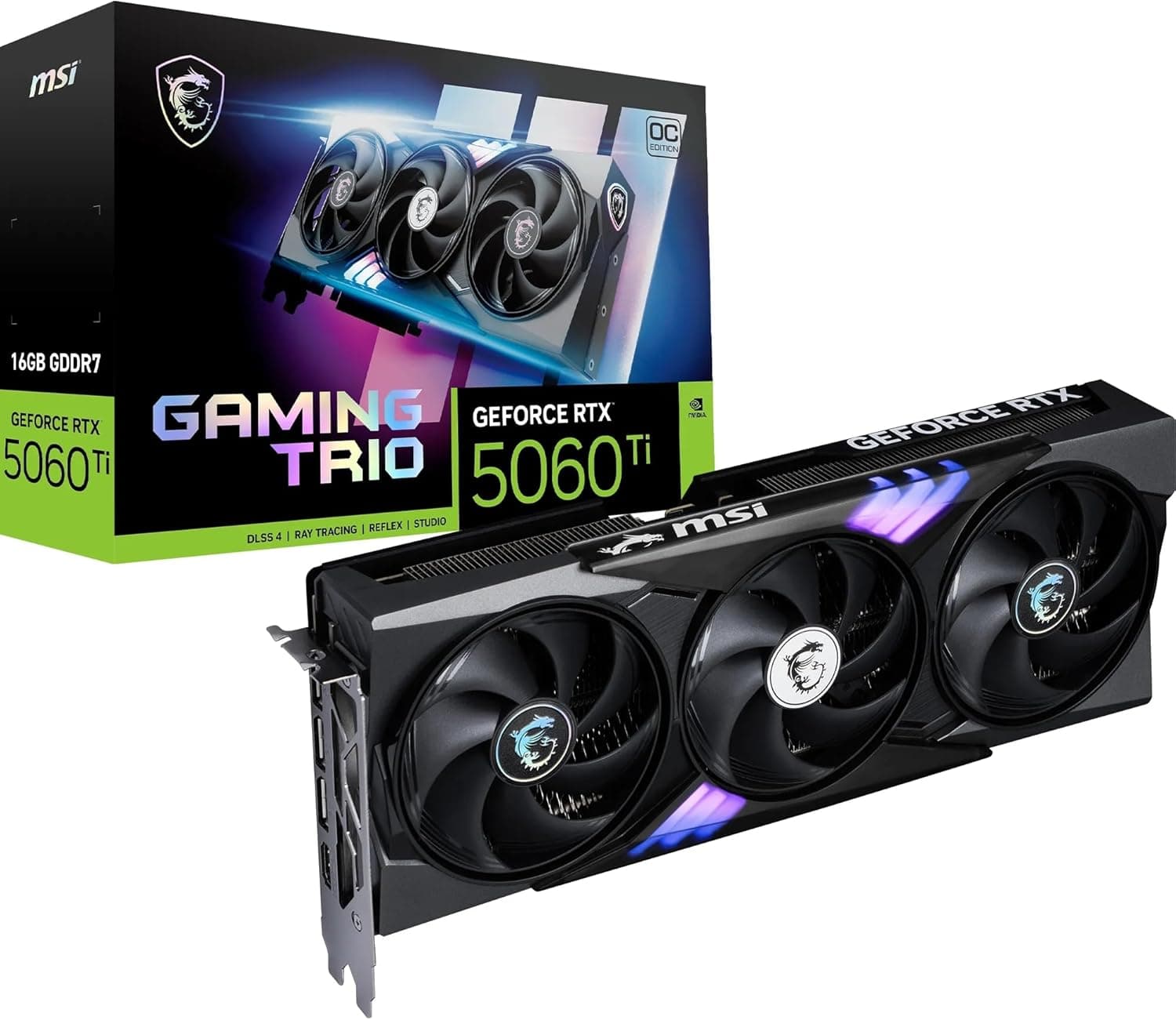
MSI's GeForce RTX 5060 Ti 16G GAMING TRIO OC is a mid-high end graphics card built on NVIDIA's latest Blackwell architecture. It packs 4608 CUDA cores, a boost clock of 2647 MHz, and 16GB of GDDR7 memory on a 128-bit bus running at 28 Gbps for 448 GB/s of bandwidth. This combination targets smooth WQHD and capable 4K gaming, with DLSS 4 and frame generation support to push frame rates further. The card sits in a competitive spot between the RTX 4070 and the RX 7800 XT, offering a unique blend of 16GB VRAM and next-gen features at a street price around ¥128,300 in Japan (as of June 2026). The TRI FROZR4 cooling system with three StormForce fans and a nickel-plated copper base keeps thermals in check even under sustained loads. MSI's GAMING TRIO OC variant comes with a mild factory overclock and a clean, dual-fan shroud that fits most ATX cases. It's a well-rounded choice for gamers and creators who need more VRAM than the typical 8GB or 12GB cards offer at this price tier.
Compatibility Guide
The card uses a PCI Express 5.0 x8 interface, but the slot is physically x16, so it works in any standard PCIe x16 slot. Backward compatibility with PCIe 4.0 and 3.0 is fine; gaming performance impact is negligible. Power comes from a single 16-pin (12VHPWR) connector; an included adapter (dual 8-pin to 16-pin) makes it compatible with older PSUs. MSI recommends a 650W power supply, though a 750W unit is safer for higher-end CPUs. Physical dimensions are 300×125×44 mm – compact enough for most mid-tower cases, but measure your case's GPU clearance beforehand. Display outputs include three DisplayPort 2.1b and one HDMI 2.1b, supporting up to four displays at up to 7680×4320 resolution.
Product Info
Released around mid-2025, the MSI GeForce RTX 5060 Ti 16G GAMING TRIO OC carries a 2-year warranty through authorized Japanese distributors. The street price in Japan is approximately ¥128,300. Total board power is rated at 180W, making it relatively efficient for its performance class. The card occupies two slots in your chassis and uses MSI's TRI FROZR4 cooler which includes three 100mm StormForce fans with a new blade design for better airflow and lower noise. Market positioning is mid-high tier, with the key differentiator being 16GB of GDDR7 memory – more than its direct competitors.
Best Use Cases
This card is ideal for WQHD (2560×1440) gaming at high refresh rates. With DLSS 4 and frame generation, you can comfortably run modern AAA titles at 144 Hz or higher without compromising visual quality. It's also a strong pick for creative professionals who work with video editing, 3D rendering, or AI workloads – the 16GB VRAM buffer handles large textures and complex scenes without swapping. For users who want to future-proof their build against growing VRAM requirements (e.g., upcoming game titles or texture-heavy mods), the 5060 Ti 16G offers a comfortable headroom over 8GB/12GB alternatives. ## Alternatives
NVIDIA's own RTX 4070 (12GB GDDR6X) is a direct rival, offering slightly higher rasterization performance in some titles but falling short on VRAM capacity and memory bandwidth. The RTX 5060 Ti's faster GDDR7 memory partially compensates for the narrower bus, and DLSS 4 gives it an edge in supported games. On the AMD side, the Radeon RX 7800 XT (16GB GDDR6) competes directly on VRAM size and often matches or beats the RTX 5060 Ti in pure rasterization, but it trails in ray tracing performance and lacks NVIDIA's superior upscaling ecosystem (DLSS 4 vs. FSR). If you prioritize ray tracing, NVIDIA features, or want the best upscaling quality, the MSI 5060 Ti is the better buy.
Things to Consider
The PCIe 5.0 x8 interface might be a concern for users planning to run multiple GPUs or very bandwidth-sensitive workloads, but for single-card gaming and most creative tasks, it's not a bottleneck. Ensure your power supply has a native 12VHPWR connector or use the included adapter; note that bending the adapter cable too sharply can cause issues, so plan your cable routing carefully. The card's 180W TDP is manageable, but pairing it with a high-core-count CPU and many drives may push total system power beyond 650W. Finally, while the 16GB VRAM is generous, some productivity applications (e.g., large-scale 4K video editing or AI model training) may still benefit from 20GB or more – if that's your use case, consider a step up to an RTX 5070 Ti or equivalent.
Product Disclosure (Amazon)
- Manufacturer: MSI
- ASIN: B0F32MF84M
- Note: This article covers a manufacturer-made product based on Amazon listing details.