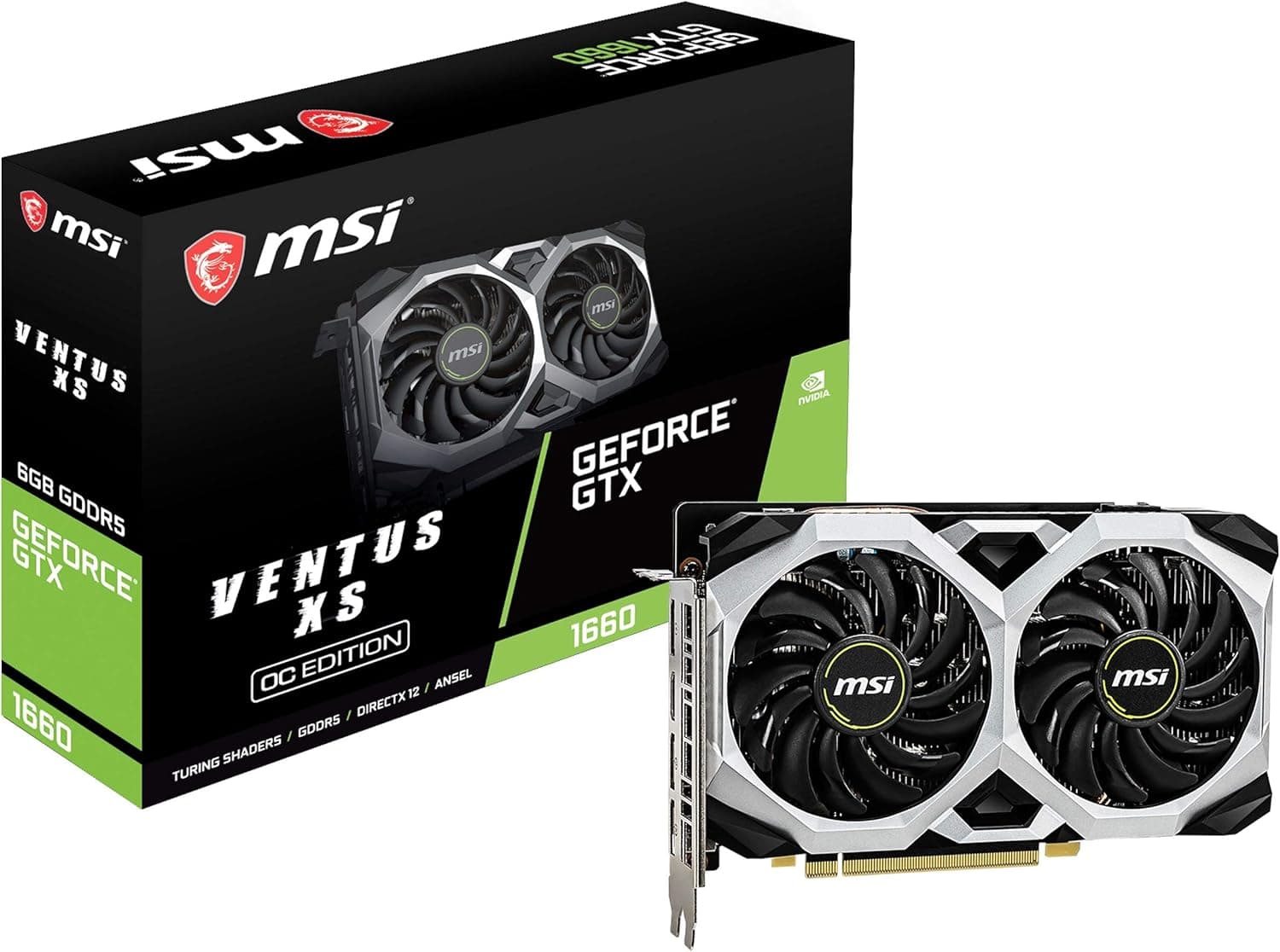
This article covers MSI GeForce GTX 1660 VENTUS XS 6G OC グラフィックスボード VD7292.
Overview
The MSI GeForce GTX 1660 VENTUS XS 6G OC VD7292 is an entry-mid-range graphics card built on NVIDIA's Turing architecture. It features the NVIDIA GeForce GTX 1660 GPU with a boost clock of 1830MHz and 6GB of GDDR5 memory on a 192-bit bus running at 8Gbps. This card is designed for gamers who prioritize cost-effectiveness while targeting smooth 1080p gameplay. Measuring just 204×128×42mm, the card is compact enough to fit into most mid-tower and even some smaller cases. Its power draw is a modest 130W, requiring only a single 8-pin PCIe power connector. For display output, it offers three DisplayPort 1.4 ports and one HDMI 2.0b port, supporting resolutions up to 7680×4320. Positioned below the RTX 2060, the GTX 1660 lacks dedicated ray tracing and DLSS hardware, but delivers solid rasterization performance. It's an excellent choice for gamers who want reliable frame rates at 1080p high settings without breaking the bank.
Compatibility Guide
The card uses a PCI-Express 3.0 x16 interface, which is fully backward compatible with PCIe 4.0 and 5.0 slots. Any motherboard with a physical x16 slot will work without issues. Power requirements are straightforward: a single 8-pin PCIe power connector is needed. A 450W or higher power supply is recommended for the whole system, though 500W-550W provides more headroom, especially with a power-hungry CPU. The 6GB GDDR5 memory with a 192-bit bus is adequate for 1080p gaming at medium to high texture settings. However, for 4K or heavy texture packs, the VRAM may become a bottleneck. Output options include three DisplayPort 1.4 and one HDMI 2.0b. DisplayPort 1.4 supports HDR and high refresh rates, while HDMI 2.0b handles 4K/60Hz. Multi-monitor setups with up to three displays are supported.
Product Info
The MSI GeForce GTX 1660 VENTUS XS 6G OC VD7292 was released in 2019 and comes with a one-year warranty from the official Japanese distributor. It is available through major online retailers like , with pricing typically around ¥30,000, though it fluctuates based on market conditions. This card occupies the entry-mid-range segment. By omitting RT and Tensor cores, MSI keeps the price lower than RTX models while still delivering a meaningful performance uplift over the previous-generation GTX 1060. It excels in traditional rasterization workloads and is ideal for gamers who don't need ray tracing. With a TDP of only 130W, heat output is manageable, and the dual-fan cooler runs quietly under typical gaming loads. The short 204mm length makes it a good fit for compact builds.
Best Use Cases
1080p Gaming Enthusiasts For gamers playing esports titles like Fortnite, Apex Legends, or VALORANT at 1080p high settings, the GTX 1660 delivers well over 100fps consistently. It's a budget-friendly way to enjoy smooth gameplay. However, if you want ray tracing enabled, you should look at RTX 2060 or higher. Budget-Conscious Builders This card offers excellent price-to-performance for those building a PC on a tight budget. The used market also has plenty of units available at attractive prices. But if you plan to play the latest AAA titles at max settings, consider stepping up to an RTX 3060 class card. Compact PC Builds With a length of only 204mm, this card fits easily into Mini-ITX and MicroATX cases. It's a great option for small form factor builds where space is at a premium. Just double-check the case's maximum GPU length before purchasing.
Things to Consider
The GTX 1660 does not support ray tracing or DLSS. Without dedicated RT and Tensor cores, enabling ray tracing in supported games will result in very low frame rates. If ray tracing is important to you, an RTX 2060 or newer is necessary. 6GB of VRAM is becoming tight for modern games, especially at higher resolutions. For 4K gaming or VR, this card is not suitable. You may need to lower texture quality in some newer titles. Since this model launched in 2019, new stock is limited. Always verify you're buying from an official distributor or a reputable seller when purchasing new. For used units, check for signs of wear and confirm warranty status. Competitors include the AMD Radeon RX 5500 XT and RX 5600 XT, which offer similar or slightly better performance in some titles. Your choice may come down to driver preference and ecosystem. ## FAQ
Q: What's the difference between the GTX 1660 and GTX 1660 Super? A: The GTX 1660 Super uses faster GDDR6 memory, boosting memory bandwidth to about 336GB/s compared to the GTX 1660's 192GB/s. In real-world gaming, the Super is typically 10-15% faster. If the price difference is small, the Super is the better buy. Q: Can this card handle 4K gaming? A: No, 4K gaming is not recommended. The 6GB VRAM is insufficient for high-resolution textures, and the GPU lacks the raw power to maintain playable frame rates at 4K. For 4K, consider at least an RTX 3060 Ti. Q: What power supply wattage do I need? A:
Product Disclosure (Amazon)
- Manufacturer: MSI
- ASIN: B07PBLDV3D
- Note: This article covers a manufacturer-made product based on Amazon listing details.