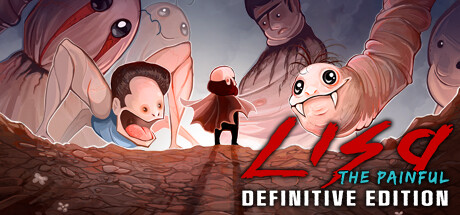
Game Overview
LISA: The Painful - A Grim RPG of Unforgettable Choices is a side-scrolling, story-driven RPG set in the ruined land of Olathe. Developed by Dingaling Productions and published by Serenity Forge, the Definitive Edition follows Brad as he crosses hostile settlements, recruits unusual companions, and fights through a collapsing society.
Its simple pixel art contrasts sharply with themes of violence, addiction, loss, and abuse.
Exploration involves moving through towns, caves, and hazardous outdoor areas, speaking with survivors, collecting supplies, and navigating dangerous platforms. Enemy encounters lead to turn-based battles fought with a party of distinct characters.
Decisions can affect resources, abilities, and the survival of companions rather than merely changing a line of dialogue.
Released on December 15, 2014, the game is more than a nostalgic pixel RPG. It rarely offers a clean answer that lets the player feel entirely heroic.
By forcing choices in which something valuable may be lost, it ties Brad's actions to the player's willingness to accept consequences. Its sudden shifts from absurd comedy to disturbing drama are central to its identity.
Features and Systems
Combat combines regular attacks, character skills, healing, support abilities, and status effects in a party-based turn system. Party members serve different roles, so building a dependable group requires more than selecting whoever deals the most immediate damage.
Some characters use sequences of directional inputs to trigger techniques, adding a more active element to otherwise menu-driven battles.
Scarcity is not only a story theme; it directly shapes the mechanics. You may need to decide who receives a limited resource or what you are willing to sacrifice to protect the group.
Brad can lose limbs, and companions can be removed permanently under certain circumstances. Such losses can alter later abilities and combat plans, creating tension that is absent from RPGs built around saving everyone.
Recruiting many allies does not automatically make the journey safe. Depending on one powerful companion can leave the party without a workable strategy if that person is lost, so testing substitutes with different roles provides useful insurance.
However, treating allies only as interchangeable statistics can mean missing their strange histories and conversations. Balancing tactical efficiency with curiosity about the cast is one of the game's more interesting pressures.
How to Approach Its Choices
LISA: The Painful is less concerned with presenting a huge number of branches than with making a limited set of decisions hurt. Outcomes are not always explained beforehand, and a solution that avoids every loss should not be expected.
Looking up every consequence during a first playthrough can weaken the fear of making an irreversible decision, so players interested in the story may prefer to accept their initial choices.
Players who find permanent losses excessively stressful can keep separate saves before important encounters. This does not remove the themes, but it lets each player decide how much regret they are willing to carry.
The experience changes significantly depending on whether irreversible consequences are accepted as part of the journey or treated as branches to examine.
Early-Game Priorities
Early on, identify companions who can heal, apply status effects, or provide a backup source of damage. Winning one battle by consuming every useful item can create problems in the next area, so consider whether maximum damage is necessary in routine encounters.
Save before investigating suspicious platforms or optional paths, since exploration can bring both valuable discoveries and costly mistakes.
A ridiculous-looking enemy is not necessarily harmless. When status effects work, preventing actions may preserve more supplies than simply absorbing damage.
It is also safer to develop alternative tactics than to invest everything in one favorite attacker, because the game's permanent consequences can disrupt a specialized party.
System Requirements
The listed minimum processor is an Intel Pentium 4 2.0 GHz equivalent or faster, with 512 MB RAM and 800 MB of available storage.
No specific GPU model is named; instead, the requirement lists a desktop resolution of 1024 × 768 pixels or higher. These demands are extremely light by modern gaming-PC standards, making compatibility and display behavior more important concerns than raw graphics performance.
The OS listing names 32-bit and 64-bit versions of Microsoft Windows XP, Vista, and 7, so the wording is clearly aimed at older systems. If you plan to play on a newer Windows release, check the current Steam listing and recent compatibility reports before buying.
Handheld PCs and unusual aspect ratios may also warrant a quick check of resolution, fullscreen behavior, and input settings.
The small installation size gives little reason to move the game to a high-end SSD solely for performance. It is more useful to test whether a controller or keyboard feels comfortable, especially for characters whose attacks involve repeated directional inputs.
Reception and Review Trends
Players commonly praise the way the game combines cruelty and comedy, along with its music, memorable cast, and the emotional weight of losing something because of a choice. Absurd jokes and bizarre characters keep the story from becoming uniformly bleak, while making later turns feel even harsher.
Its ability to make players reconsider their decisions after the ending has helped it maintain a strong reputation over time.
Criticism often focuses on abrupt punishment, deliberately uncomfortable situations, and movement or battle pacing that can feel rough. Inflicting discomfort is part of both the theme and the design, so players expecting consistently fair and convenient progression may find it hostile.
It is best judged as a work in which mechanical frustration and narrative intent are closely connected, not as a conventional power-fantasy RPG.
Who Should Play It
This is a strong fit for players who value bleak stories, black comedy, and meaningful sacrifice. It particularly rewards those who can accept failure and loss as part of their personal version of the journey instead of trying to preserve every character perfectly.
Players seeking ethical uncertainty and psychological pressure beneath a pixel-art presentation should also consider it.
Its modest hardware requirements make it accessible to people looking for a story-focused game on an older or less powerful PC. It also suits players who prefer dialogue, exploration, party planning, and turn-based encounters over a large 3D world or reflex-heavy action.
Warnings and Who Should Skip It
The story includes violence, bodily mutilation, addiction, and material associated with abuse. The pixel presentation does not make these themes mild, so players who need to avoid such content should skip it.
It may also be distressing for anyone who strongly wants to protect every companion and reach an outcome without regret.
Players seeking modern convenience, reversible decisions, clear moral divisions, or an uplifting heroic adventure are unlikely to enjoy its priorities. Japanese is included in the supplied language listing, though current language support should still be checked on the store before purchase.
The source data also labels the game as supporting multiplayer, but its core experience is a solitary story-driven journey. If storefront feature labels conflict, verify the product name, description, and current feature list before deciding.


