This article covers Intel X540-T2 Adaptateur Réseau Ethernet Convergé.
Overview
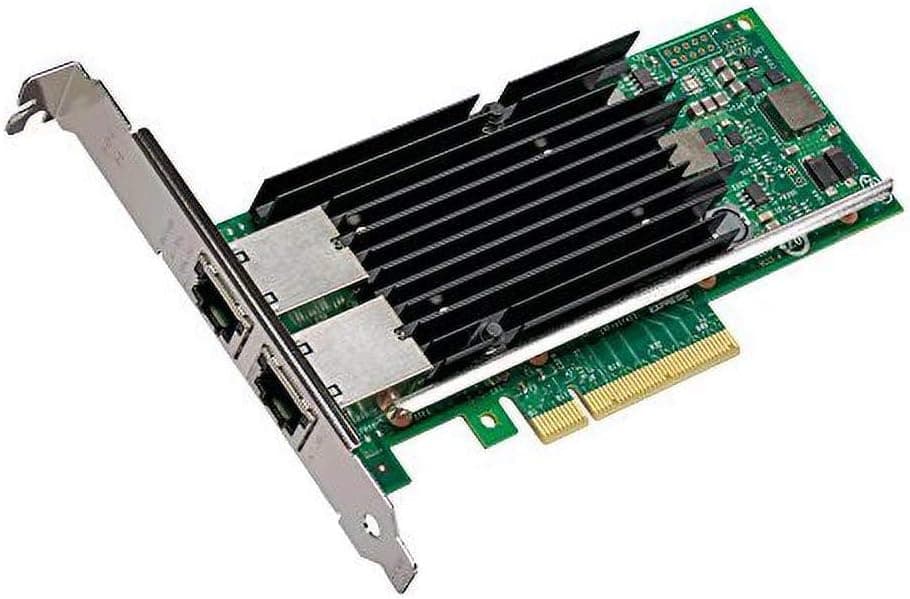
The Intel X540-T2 is a dual-port 10 Gigabit Ethernet converged network adapter designed for servers and high-performance workstations. It features Intel's second-generation 10GbE controller and connects via a PCI Express 2.1 x8 interface. This card is built for data centers and prosumer labs looking to upgrade from Gigabit to 10GbE without breaking the bank. What sets the X540-T2 apart is its dual RJ-45 ports, allowing link aggregation, failover, or direct-attach storage connections. As an Intel Ethernet Converged Network Adapter, it supports iSCSI and FCoE protocols, making it suitable for unified storage and networking environments. While it's an older design, its reliability and driver maturity remain strong selling points.
Connectivity & Compatibility
Interface: PCI Express 2.1 x8 (physically fits in x16 slots) Network standards: IEEE 802.3ae 10GBASE-SR/LR/CR, 10GBASE-T (RJ-45) Supported OS: Windows Server, Linux (major distros), VMware ESXi Connectors: 2x RJ-45 (10GBASE-T) * Cabling: Category 6A or higher recommended for full 10GbE speed The card requires a PCIe x8 or wider slot to deliver full dual-port throughput. Avoid using PCIe 2.0 x4 slots as they will bottleneck performance. For 10GBASE-T, Cat 6A cables are strongly recommended for reliable 10GbE links over longer distances.
Product Info
Released around 2012, the Intel X540-T2 is still available today through import channels. It sits in the mid-to-high-end tier of 10GbE adapters, offering better stability and driver support than budget alternatives. Pricing typically ranges from ¥16,000 to ¥20,000 for import units. Warranty varies by seller, usually 30 days to 1 year from the reseller. The package includes a standard bracket, a low-profile bracket, and a driver CD (or download instructions).
Best Use Cases
Home lab enthusiasts building a 10GbE network: The X540-T2 is one of the most affordable ways to get into 10GbE. Its dual ports let you connect a NAS directly to a PC or use a switch for a full network upgrade. Be aware of its heat output — good case airflow is essential. Small office or creative studio file server admins: If you regularly transfer large video files or RAW photo archives, upgrading from Gigabit to 10GbE can dramatically cut transfer times. Intel's driver ecosystem ensures stable long-term operation. * Virtualization users running VMware or Hyper-V: Two ports allow separate management and storage networks, or teaming for redundancy. However, for the latest OS and hypervisor versions, consider newer models like the X550 or X710 series for better power efficiency and UEFI support.
Things to Consider
The X540-T2 is over a decade old, so compatibility with modern motherboards can be tricky. UEFI-only systems may require enabling CSM (Compatibility Support Module) in BIOS for the card to be recognized. While it uses PCIe 2.1, this is sufficient for dual 10GbE throughput — even in a PCIe 3.0/4.0 slot, performance won't be limited. Heat is a real concern. The heatsink gets very hot even at idle, and inadequate case airflow can lead to thermal throttling. Position a case fan near the card if possible. Direct competitors include the Intel X550-T2 (PCIe 3.0, lower power, better compatibility) and cheaper Chinese 10GbE cards with Realtek chips. The X550-T2 is more expensive but offers better power efficiency and UEFI support. Realtek-based cards are cheaper but may have less stable drivers. If reliability is your priority, the Intel X540-T2 remains a solid, proven choice.
Product Disclosure (Amazon)
- Manufacturer: インテル
- Seller: イーストスクエア
- Fulfilled by: Amazon
- ASIN: B0077CS9UM
- Note: This article covers a manufacturer-made product based on Amazon listing details.