Game Overview
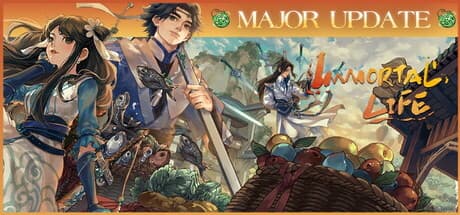
Immortal Life: Cultivate Your Way to Immortality in a Ruined Sect is a Xianxia-themed life-simulation RPG. You play a new disciple charged with restoring the ruined Guiyun Sect and the surrounding Misty Valley while pursuing spiritual cultivation and immortality.
Developed by YiFang Studio and published by 2P Games, the game was released on January 18, 2024.
Its core loop connects farming, gathering, cooking, and crafting to the recovery of the community and the growth of your character. Rather than managing a farm as an isolated business, you use everyday work to rebuild a damaged home for the sect.
Small tasks gradually produce visible progress in the valley, new interactions with fellow disciples, and further steps along the cultivation journey.
How Farming and Cultivation Fit Together
The life-sim activities include agriculture, cooking, fishing, mining, and crafting. These systems are not merely a collection of unrelated side activities: their resources and finished items contribute to restoration and progression.
A typical stretch of play can involve tending crops, collecting materials, preparing food, and making decorations before turning those results into improvements for the sect.
The narrative goal is not simply to run the most efficient farm. Rebuilding Guiyun Sect and advancing as a disciple give the routine tasks a distinct Xianxia context.
Players interested in cultivation, sects, and the pursuit of immortality are therefore more likely to find narrative meaning in activities that might otherwise feel like familiar farming-sim chores.
Disciples, Relationships, and Restoration
Restoring Misty Valley involves more than repairing its physical surroundings. You work beside other disciples, build relationships, and learn about their personal stories and motivations.
The community becomes more meaningful as its residents develop alongside the rebuilt environment.
This makes the game better suited to players who read dialogue and enjoy gradual character development than to those who skip every conversation in pursuit of maximum efficiency. Its progression is partly personal and partly communal: you improve your disciple, but you also help an entire group recover.
That distinction gives the game a different emphasis from an RPG focused only on combat power or individual loot.
A Practical Approach to the Early Game
Early on, it is sensible to sample farming, gathering, cooking, and crafting instead of committing every resource to one activity. Learning which materials feed into restoration and production makes later objectives easier to plan.
Keeping a modest reserve of useful materials can also reduce the need to interrupt a task and repeat a gathering trip.
The calmer life-sim routines and RPG progression support each other, so focusing exclusively on one side may leave another objective waiting. If one activity becomes repetitive, switching to a different task can keep the pace varied while still moving the settlement forward.
The game is easier to appreciate when daily progress is treated as part of the experience rather than as an optimization problem that must be solved perfectly.
PC Requirements
The listed minimum requirements are a 64-bit version of Windows 7 SP1, Windows 8, or Windows 10; an Intel Core i5-4590; an NVIDIA GeForce GTX 750 Ti; 8 GB of RAM; and 10 GB of available storage. These components indicate that the game does not require a recent high-end gaming PC merely to meet its minimum target.
Minimum requirements, however, do not guarantee a particular resolution, graphics preset, or consistently smooth performance in every scene.
No recommended specification is included in the supplied data, so a stronger CPU or GPU should not be presented as an official target. Systems close to the minimum may need adjustments to resolution, shadows, or effects.
If a PC uses integrated graphics, compare its actual performance and specifications with the GTX 750 Ti requirement instead of assuming that any newer graphics solution will automatically qualify.
Although the listed installation requirement is 10 GB, leaving additional free space is prudent for updates and temporary installation files. The OS list includes older Windows versions, but their support status and current driver availability are separate concerns.
Check the latest Steam listing and the hardware vendor's driver information when using an older operating system.
Languages and Steam Features
The listed languages are Simplified Chinese, English, Japanese, and Traditional Chinese. Language support matters here because character stories and Xianxia terminology are important parts of the experience.
For the exact coverage of interface text, subtitles, and audio, consult the current language table shown on the Steam product page before buying.
Steam Achievements and Trading Cards are supported. The supplied information also identifies multiplayer functionality, but it does not specify player limits, connection requirements, or how much of the campaign can be shared.
Anyone buying primarily for cooperative play should verify the currently listed modes rather than assuming that every farming or story activity is available to a group.
Reception and What to Check in Reviews
The game has maintained a generally favorable reception on Steam. Because reception changes over time, the current status is best checked in the live rating panel or on Steam rather than treated as a permanent figure in the article.
The more useful purchasing question is whether its combination of cultivation fiction and repeated life-sim routines matches your preferences.
When reading player feedback, pay particular attention to pacing, translation quality, controls, and the sense of progression later in the game. These qualities are subjective and cannot be inferred from the hardware requirements.
The same routine may feel soothing to one player and overly repetitive to another, so recent impressions from players with similar tastes are more informative than a broad label alone.
Who Should Play It
Immortal Life is a strong fit for players who want a farming and crafting routine inside a Xianxia cultivation story. It also suits those who enjoy watching a damaged settlement recover, learning about its residents, and building attachment to a community over time.
The structure favors steady, long-term progress over a constant sequence of immediate rewards.
Players who value cooking, fishing, mining, decoration, and relationship stories alongside character advancement should find more to appreciate. It may also appeal to farming-sim fans looking for a setting outside familiar rural or Western-fantasy conventions.
Thinking of it as a life-sim cycle guided by sect restoration and cultivation is a useful way to judge its focus.
Caveats and Who May Not Enjoy It
Players who dislike repeated farming, gathering, and production tasks may find the central loop tiring. Restoration advances through accumulated materials and many small goals rather than a single dramatic decision.
Enjoyment therefore depends on whether routine work feels like meaningful progress or an obstacle between story events.
The Xianxia setting can also require some adjustment from players unfamiliar with cultivation, sects, and immortality as narrative concepts. Those ideas are central rather than decorative.
If they hold little appeal, the setting may take longer to connect with than a conventional farming game; if they feel fresh, they are one of the title's clearest distinguishing features.
Store metadata and supported features can change. Verify the exact multiplayer format and the current scope of language support before purchasing.Check the review panel on this page or the Steam listing for the latest user review trend.