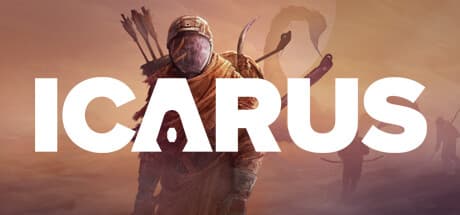
Game Overview
ICARUS: Survive a Savage Wilderness on Humanity's Greatest Mistake is a PvE survival game about descending from an orbital station to a failed terraforming project. As a prospector, you begin with limited equipment, gather wood and minerals, craft tools and weapons, hunt wildlife, and establish shelter before pursuing your objective.
The core loop joins reconnaissance, gathering, crafting, and preparation. Choosing what to bring and deciding how much infrastructure to build can matter as much as direct combat.
Released on December 3, 2021, the game supports solo play and online cooperation for up to eight players.
Missions and Open World
Mission-based scenarios give each descent a defined objective and a clear expedition structure. Players must work backward from that goal, decide which equipment is essential, and balance progress against the time and materials spent on safety.
A large base may reduce environmental risk, but it can also delay the actual assignment.
The persistent open-world mode is better suited to players who want to develop one base and continue exploring from it. It gives building and stockpiling more room to become long-term activities.
Offering both formats lets ICARUS serve players who prefer directed expeditions as well as those who want a lasting survival world.
Environmental Survival
The planet's toxic atmosphere means that food and weapons are not the only concerns. Dangerous wildlife and apex predators share the landscape with storms and forest fires that can disrupt a carefully planned route.
Venturing far from shelter without considering an escape route can turn a weather change into a serious setback.
A base therefore serves as protection, storage, and a platform for crafting better equipment. Building too much, however, consumes resources that could have advanced the expedition.
Judging how much shelter the current objective really requires is a meaningful part of the survival loop.
How Co-op Changes the Game
With up to eight players, a group can divide gathering, construction, hunting, scouting, and transport duties. Agreeing on the next objective and the materials it requires is usually more effective than having everyone collect the same resources.
Planning equipment and roles before departure becomes part of the cooperative challenge.
More players also consume more supplies, so a larger party does not remove resource pressure. Solo players gain complete control over pacing but must handle every task themselves.
Co-op is best viewed as a way to manage danger through coordination, not as a way to eliminate the game's survival demands.
System Requirements
The listed minimum calls for 64-bit Windows 10, an Intel Core i5-8400, an Nvidia GeForce GTX 1060 with 6GB of VRAM, 16GB of RAM, and DirectX 11. Installation requires 70GB of available storage.
Leaving additional free space for updates is sensible rather than planning around the exact minimum.
The explicit 6GB VRAM requirement matters because similarly named cards can have different memory capacities, while many integrated GPUs fall well below this performance class. These are minimum specifications, not a promise of high settings or high frame rates.
Systems close to the minimum should expect to reduce demanding options such as shadows, resolution, or view distance.
Reception and Common Impressions
Player sentiment is broadly positive, although the design is not equally suited to every survival-game fan. Its strongest appeal is the way gathering, crafting, construction, and hunting feed into a complete expedition.
In co-op, meaningful specialization gives groups a reason to communicate instead of merely sharing a map.
The repeated need to gather materials and prepare can feel laborious to players who want immediate combat or rapid mission progress. Weather and wildlife may overturn a plan, and enjoying that uncertainty is an important part of the appeal.
Since community sentiment can change, check the current store summary and recent player feedback before deciding.
Who Should Play It
ICARUS suits players who enjoy converting gathered resources into practical tools, safer shelter, and access to more dangerous areas. It is also a strong fit for groups that prefer cooperative PvE against wildlife and environmental hazards rather than direct PvP competition.
Players who like switching between structured objectives and long-term base development have a clear reason to consider it. If preparation itself feels like problem-solving, even a failed expedition can provide useful information for the next attempt.
Limitations and Who May Not Enjoy It
Players seeking short sessions focused only on combat or story may find the gathering and crafting workload too prominent. Unexpected disruption from storms, fires, or predators is central to the experience, so repeated setbacks can be frustrating if you dislike rebuilding a plan.
Those who want every structure to remain the center of their play should favor the persistent open-world mode over mission-focused sessions.
The listed languages include English, Japanese, French, German, Arabic, Russian, Latin American Spanish, Korean, Simplified Chinese, and Traditional Chinese. Confirm the exact interface and subtitle support shown by the store and in-game settings.
Because only a minimum PC specification is provided here, systems near that line should be evaluated against the image quality and frame rate you expect.


