Game Overview
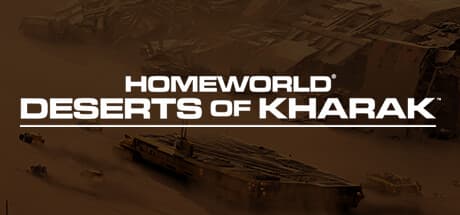
Homeworld: Deserts of Kharak — A Groundbreaking RTS Prequel is a real-time strategy game that brings the Homeworld universe down to the surface of Kharak. Released on January 20, 2016 and developed by Blackbird Interactive, it follows Rachel S'jet and an expedition traveling into the southern desert.
Each mission asks the player to scout hostile territory, collect resources, reinforce a mobile force, and complete objectives while keeping essential units alive.
Although the battlefield is terrestrial, the game preserves the series' emphasis on commanding a fleet across a large operational space. The carrier acts as the center of the force, while smaller vehicles screen, attack, scout, and support it.
New players can enter through this prequel story, while series veterans will recognize the ideas and history that lead toward the original Homeworld.
How Desert Combat Works
Dunes, ridges, and low ground influence visibility, firing opportunities, and the route a force can safely take. Securing elevation can improve battlefield awareness, while moving behind terrain can help units approach without exposing the entire formation.
This makes positioning more important than simply selecting every vehicle and sending it directly toward an objective.
Fast scouts, armored frontline units, and long-range attackers serve different purposes. A balanced formation is generally more dependable than relying on one unit type, especially when the enemy composition is unknown.
Players must watch flanking routes, incoming reinforcements, and the safety of the carrier while also managing the immediate firefight.
Managing the Carrier and Fleet
The carrier is both a production and support hub and a major unit that moves across the battlefield. Advancing it can shorten reinforcement routes and improve support for the front line, but doing so also exposes a critical asset.
Leaving it too far behind is safer in the short term, yet can make it harder to maintain pressure or recover from losses.
Resource use therefore matters beyond the current skirmish. Replacing every casualty immediately can leave the force without the right counter for a later threat.
Scouting before committing, withdrawing from an unfavorable position, and repairing damaged vehicles are often more efficient than repeatedly feeding fresh units into the same fight.
Campaign and Story
The campaign follows Rachel S'jet and the expedition as they move deeper into Kharak's southern desert. Mission dialogue and battlefield events carry much of the narrative, so the history of the planet is revealed through movement and combat rather than through detached exposition alone.
Vast landscapes, heavy industrial vehicles, radio traffic, and the soundtrack create the isolation associated with Homeworld even without a space setting.
This is a directed, story-driven campaign rather than an open-ended empire simulator. Its scenarios place more emphasis on using available forces well than on building an unrestricted economy for hours.
Players who enjoy an RTS with clear narrative momentum are likely to appreciate that focus.
System Requirements
The minimum specification lists Windows 7, 8, or 10, an Intel Core i3-2100 or AMD A10-5800K, 3GB of RAM, and either a GeForce GT 440 or Radeon HD 4890 with 1GB of graphics memory. It also calls for 8GB of available storage.
These requirements are best treated as a baseline for running the game rather than a guarantee of extra headroom during larger battles.
The recommended specification lists a 64-bit edition of Windows 7, 8, or 10, an Intel Core i7-950 or AMD FX-4300, 8GB of RAM, and a GeForce GTX 770 with 2GB or Radeon HD 7770 with 1GB. Recommended storage is 12GB.
Many current PCs can exceed this hardware level, but the officially listed operating systems are old, so users of newer systems should check current compatibility reports before purchasing.
Reception and Player Impressions
The game is commonly appreciated for its terrain-driven tactics, its connection to Homeworld lore, and the atmosphere produced by its art, music, and radio communication. Its mobile carrier and vehicle formations translate the identity of Homeworld into a ground campaign instead of merely copying space combat.
That makes it particularly appealing to players who prioritize authored campaigns and tactical positioning.
It is less suitable for someone expecting a vast economic sandbox or a traditional RTS built primarily around spreading structures across a map. Diplomacy, civilization management, and endless territorial expansion are not its focus.
The key buying question is whether you want a concentrated campaign about battlefield decisions or a strategy game designed for indefinite empire management.
Useful Early-Game Habits
Avoid sending the entire force forward before identifying enemy positions. Use faster units to inspect routes, occupy useful observation points when possible, and keep long-range support behind the frontline.
When contact occurs, check for reinforcements and alternate attack routes before chasing a retreating target.
Grouping units by role can also reduce the control burden. Separate scouting, frontline, and ranged-support elements instead of trying to manage every vehicle individually from the start.
Pulling damaged units back for repair conserves resources, and creating distance after a poor engagement is a valid tactical decision rather than a failure to attack.
Who Should Play It
Homeworld: Deserts of Kharak suits players who want to explore the origin of the series and those who prefer unit control over extensive economic management. It rewards players who enjoy combining reconnaissance, range, terrain, and timing to make a prepared plan work.
Its focused science-fiction presentation also makes it a strong fit for anyone who values atmosphere and music in a strategy campaign.
No previous series knowledge is required, and the prequel structure can serve as an introduction to the setting. Existing fans gain a clearer view of events on Kharak and the circumstances that eventually point the story toward space.
Limitations and Who May Not Enjoy It
The listed supported languages are English, French, Italian, German, Spanish, Russian, and Polish; Japanese is not included. Players who need Japanese text to follow mission instructions and story dialogue should verify the current language options before buying.
This is a significant limitation for readers who consider Japanese support essential.
The game is also a poor match for players seeking city building, diplomacy, long-term national development, or fully turn-based decision-making. Reconnaissance and unit counters must be handled in real time, so it still demands active control during combat.
Anyone expecting only the space-based fleet battles associated with the Homeworld name should understand that this prequel is centered on vehicle warfare across a desert planet.