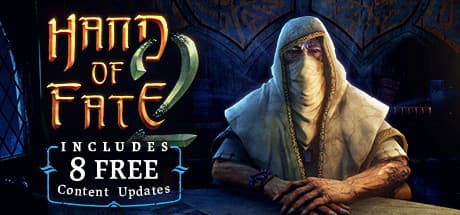
"Hand of Fate 2: Master a Living Boardgame of Dark Fantasy" combines deck construction, tabletop exploration, resource management, and real-time action combat. The cards you choose help define the encounters and equipment that can appear, while hostile encounters move the player from the table into a third-person battlefield.
Success therefore depends on both preparation and execution rather than on either deck strength or reflexes alone.
Set one hundred years after the original game, the story brings back the exiled Dealer as a guide in a campaign against a new master of the Game of Life and Death. The Dealer is more than a menu narrator: he deals the cards, comments on events, and gives the journey its distinctive tabletop atmosphere.
Game Overview
A typical run begins with selecting cards for a particular challenge. You then move a piece across the board, reveal encounters, manage resources, make choices, and fight when a card produces enemies.
Losing health or supplies early can change which risks are sensible later, so small decisions accumulate across a challenge.
Hand of Fate 2 contains 22 challenges with different objectives, including pursuing assassins and reuniting separated lovers. These are not merely identical dungeons with new layouts.
Each scenario asks the player to understand its goal and bring cards that support that goal, making adaptation more useful than relying on one universal deck.
How Deckbuilding Shapes the Adventure
The deck is not simply a hand of attacks used during combat. Encounter cards help determine which events may appear, while equipment cards shape the pool of weapons, armor, and other tools available during the journey.
Building a deck is therefore closer to designing the possible contents of an expedition.
A collection of individually powerful cards is not always the best answer. The challenge objective, expected enemies, and pressure on resources can make a specialized card more valuable than a broadly strong one.
When a run fails, revising the encounter and equipment mix may help more than repeating the same route unchanged.
Card order introduces uncertainty, so even a sensible plan will not unfold exactly as expected. However, the game is not governed by luck alone because deck selection changes the range of outcomes you may face.
The central rhythm is to improve the odds through preparation and then respond intelligently when the draw disrupts the plan.
Real-Time Combat
Enemy encounters shift from the board to third-person action. The player must attack, defend, evade, and use acquired equipment while reading enemy behavior.
A well-built deck creates better opportunities, but it does not remove the need to execute during combat.
This is also not a game concerned only with demanding mechanical combat. Equipment choices, health, supplies, and earlier event decisions influence how manageable a fight becomes.
If an enemy type repeatedly causes trouble, changing the available weapons or defenses can be more productive than forcing another attempt with the same setup.
Avoiding greedy attack strings and reducing the most dangerous opponents first can make crowded battles more controlled. The need to engage with both preparation and action is one of the game's main strengths, but it can also be a drawback for players interested in only one side of that combination.
A Practical Approach to Early Challenges
On a first attempt, prioritize learning the objective and failure conditions instead of expecting a flawless completion. Notice which encounter drains supplies, which enemy defeats the current equipment, and which decision creates trouble later.
Treating failure as information makes the repeat-and-rebuild structure much more satisfying.
New cards should be judged by where they are useful, not only by whether they appear powerful in isolation. A challenge that steadily drains resources demands a different answer from one blocked by a difficult battle.
Adding too many marginal encounters can also make desired outcomes less consistent, so removing cards can matter as much as unlocking them.
System Requirements
The listed minimum requires a 32-bit or 64-bit version of Windows Vista, 7, 8, 8.1, or 10, a 2.4 GHz Intel Core 2 Duo or equivalent, and 4 GB of RAM.
Listed graphics options include Intel HD Graphics 4600, NVIDIA GeForce GT 630, and Radeon HD 5670. DirectX 11 and 4 GB of available storage are also required.
These figures describe minimum access, not guaranteed high settings or a fixed frame rate. Systems close to the minimum, especially those using integrated graphics, may need reduced resolution and visual settings.
No recommended specification is present in the supplied data, so compare the current Steam requirements with your exact hardware, operating system, and graphics driver before purchasing.
Reception and Common Review Themes
Hand of Fate 2 has maintained a strong reputation for combining deckbuilding, a living board, and action combat within one coherent loop. The Dealer's performance and the physical-table presentation give the campaign a personality that a conventional stage-selection screen would not provide.
Players who enjoy adjusting a build after failure are especially likely to appreciate its challenge structure.
Criticism commonly follows from the same hybrid design. Uncertain draws and chance-based events can interrupt a carefully prepared route, while players seeking uninterrupted action may find the tabletop movement and event resolution slow.
Its variety is most valuable when the player wants all of these systems rather than one genre in isolation.
Who Should Play It
This is a good fit for players who enjoy building a deck, observing the result, diagnosing failure, and returning with a better plan. It also suits those who like roguelike uncertainty but want defined scenario goals and narrative context.
The dark-fantasy table, card animations, and the Dealer's presence are meaningful attractions rather than superficial decoration.
Players who prefer preparation and resource management alongside reflex-based combat should also consider it. Because the 22 challenges vary in purpose, enjoyment depends heavily on whether rebuilding for a specific problem sounds rewarding.
Limitations and Who May Not Enjoy It
Players who strongly dislike random draws or chance-driven event outcomes may become frustrated. Careful preparation can improve the situation but cannot make every run identical.
Anyone who wants a fixed challenge governed only by mechanical execution should account for that uncertainty.
Combat is important, but it is separated by deck editing, event text, decisions, and movement around the board. Those seeking a continuous stream of fast fights may find the pacing fragmented.
The story takes place a century after the first game, although newcomers can still follow the immediate objectives by paying attention to the Dealer and his relationship with the new ruler.
The supplied information lists support for English, Japanese, and Simplified Chinese, together with multiplayer, Steam Achievements, Trading Cards, and Steam Workshop features. Platform features and availability can change, so verify the current Steam listing if any particular function is essential.
Hand of Fate 2 works best when treated as a conversation between preparation and improvisation. It is neither a pure deckbuilder nor a pure action RPG, and that hybrid structure should be the deciding factor for prospective players.


