Game Overview
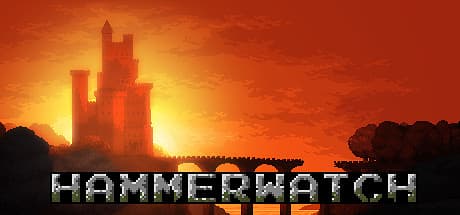
Hammerwatch: Hack and Slash Through a Pixelated Castle is a top-down action adventure built around fighting enemy hordes, avoiding traps, solving puzzles, and finding secrets inside Castle Hammerwatch. The core loop is straightforward: explore the castle, survive each combat space, and strengthen a chosen class through unlocks and upgrades.
It emphasizes positioning and quick reactions more than lengthy dialogue or story-driven decision making.
The journey covers four distinct environments rather than a single uninterrupted corridor. Combat is broken up by hazards, hidden areas, and puzzles, so progress depends on observing the room as well as defeating its enemies.
Hammerwatch was released on August 12, 2013, developed by Crackshell, and published by Team17.
Six Classes and Progression
There are six playable classes, each with its own skills and abilities. The choice affects more than appearance: different ranges and tools change how a player approaches crowds and maintains a safe position.
Unlocks and upgrades expand those options, giving players additional ways to handle sections that were difficult earlier.
For a first run, consider attack range and ease of positioning instead of choosing on damage alone. In co-op, a group can manage crowded rooms more clearly when players cover different roles and directions.
The best choice still depends on party size and difficulty, so it is sensible to test how a class controls before committing to a preferred playstyle.
Difficulty and Cooperative Play
Hammerwatch offers easy, medium, and hard settings, plus modifiers that further customize the challenge. Players who mainly want to explore can lower the pressure, while those interested in precise dodging and enemy prioritization can choose a harsher setup.
This flexibility is especially useful when a group contains players with different levels of action-game experience.
Co-op supports up to four players through online, LAN, or local play. A larger party can divide its attacks, but it also places more characters and effects on screen and demands clearer coordination.
Rushing ahead alone can expose that player to traps or enemies approaching from another direction, so regrouping at doors and corners is usually the safer habit.
Anyone planning local co-op should prepare enough input devices before starting. Controller support is included, but it is still worth testing device detection and button layouts in advance.
That small check prevents configuration problems from interrupting the opening session.
System Requirement Guidance
The listed minimum requirements call for a 1.8 GHz processor, 1 GB of RAM, OpenGL 1.4-compatible graphics, and 300 MB of available storage.
These are modest requirements compared with modern large-scale 3D games, making Hammerwatch a plausible option for older hardware. They remain minimum specifications, however, and should not be interpreted as a guarantee of consistently smooth performance.
The OS field lists Windows XP, Vista, 7, and 8. That wording reflects the game's age, so players using a current Windows release should check recent compatibility information before buying.
Because the graphics requirement specifies an API rather than a GPU model, very old integrated graphics may also require a driver-compatibility check.
Mac and Linux are listed as supported platforms, but the supplied data does not include separate requirements for either one. Users on those systems should compare their OS version against the current store information.
For online or LAN co-op, connection quality across the whole group can matter alongside PC performance.
How to Read the User Reception
Hammerwatch has maintained a broadly positive reception over time. When judging whether that sentiment applies to you, focus on the rapid alternation between combat and exploration, the opportunity to replay with different classes, and the shared-screen coordination of co-op.
Its pixel-art presentation may look approachable, but reacting to crowds and hazards remains central to the experience.
Players expecting elaborate cinematic presentation or heavily branching storytelling may find that its strengths lie elsewhere. More participants do not automatically make every encounter easier, either; poor movement and role coordination can make a busy room harder to read.
When browsing current feedback, prioritize comments from players using a similar mode, operating system, and input setup.
Early-Game Priorities
Avoid attracting too many enemies at once, and keep an open route for retreat whenever possible. In rooms with traps, inspect floors and narrow passages before committing fully to an attack.
Since hidden secrets are part of the design, suspicious walls and apparent dead ends are also worth examining.
In co-op, keep the party together instead of allowing one player to disappear beyond the visible area. Agree on a direction at branches and briefly discuss roles before spending upgrades.
There is no need to move to a higher difficulty until everyone understands enemy attacks and the abilities of their selected classes.
Who Should Play It
Hammerwatch suits players who enjoy retro pixel art and prefer repeated combat, exploration, and character improvement over dialogue-heavy role-playing. It is particularly appealing to groups seeking local co-op on one setup or online dungeon crawling with active coordination.
Three difficulty levels and additional modifiers also give players room to alternate between a relaxed run and a more demanding replay.
Mod support offers another route for players who want to expand the experience after the standard content. Mod requirements and current installation methods can vary, so compatibility should be checked before adding community content.
Caveats and Who Should Skip It
Players primarily seeking realistic visuals, cinematic conversations, or a modern RPG with extensive narrative choices may want a different game. The action relies on recognizing attacks and traps, and repeated attempts can be part of overcoming a difficult area.
Small pixel-art characters and hazards may also be less comfortable for players who prefer strong visual separation.
The listed Windows versions are dated, and no recommended specification is present in the supplied data. Check the current store information before relying on compatibility with a recent Windows release, Mac, Linux, or online services.
Solo play is supported, but players interested mainly in the cooperative side should also consider whether they have a regular group available.