This article covers GravaStar リストレストテンキーレスキーボード疲労軽減低反発クッション手首パッドメモリーフォーム滑り止めベース人間工学デザイン Wrist Rest サイズ30572.520mm ホワイト (referred to below as the GravaStar Wrist Rest).
The short version: whether this pad helps you depends far less on build quality than on whether its 20mm height and 305mm length match the keyboard already on your desk.
Overview
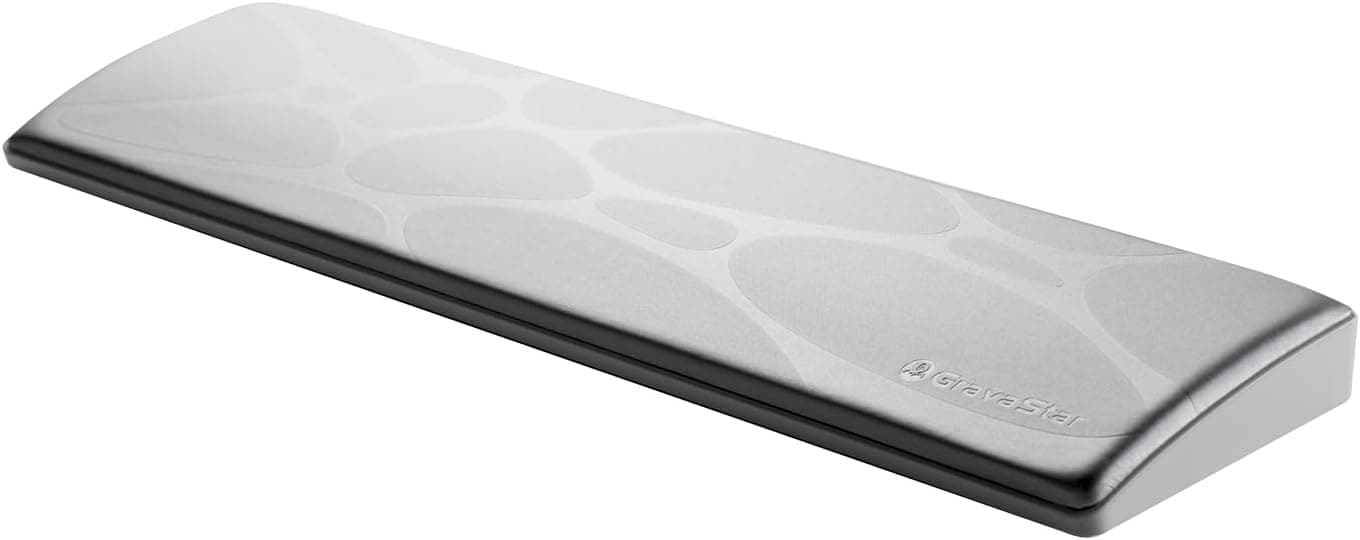
The GravaStar Wrist Rest is a standalone pad measuring 305mm long, 72.5mm deep and 20mm tall, finished in white.
Inside is low-rebound polyurethane foam, the surface is a PU leather-style material, and the underside is a rigid plastic base with non-slip feet. The aim of the ergonomic design is simple: fill the step between the desk and the keyboard so the wrist stays close to neutral instead of bending upward.
As of the data captured on 23 May 2026, it held 4.5 out of 5 stars across 352 reviews, a 90% favorable score.
That is a solid sample size for an accessory at this price, which suggests consistent units rather than a lottery. Still, strong ratings for any wrist rest mostly reflect value for money, not fit, and fit is what decides whether your hands actually feel better.
So the questions worth answering before buying are not about brand quality. They are: is the front edge of my keyboard roughly 20mm off the desk, and is 305mm wide enough for the way I type?
Compatibility Guide
There is nothing to connect and nothing to power, so compatibility here means physical dimensions, which is exactly where people get it wrong.
At 305mm, the pad is slightly narrower than a typical tenkeyless keyboard, which usually measures somewhere around 355-365mm across. Centered, it covers the home-row area where your hands actually sit, but expect a few centimeters of keyboard to overhang at the far left and far right.
For 60% and 65% boards (roughly 290-305mm) the widths line up almost exactly. On a full-size board of about 440mm the pad clearly runs out before the numpad.
The 20mm height is the bigger variable. Ideally the top surface of the wrist rest sits level with the front edge of your keyboard, measured from the desk to the top of the spacebar.
Too high and the wrist bends backwards, too low and it drops. Twenty millimeters is on the thick side, which suits standard mechanical keyboards with the tilt feet extended, or high-profile cases.
It is too much for low-profile mechanical boards, scissor-switch slim keyboards and laptop keyboards. Measure with a ruler before ordering, because there is no other reliable check.
| Setup | Fit | Why |
|---|---|---|
| Tenkeyless (TKL) | Excellent | The intended use; 305mm covers the main key area |
| 60% / 65% | Good | Widths match closely, minimal overhang |
| Full-size (approx. 440mm) | Fair | Too short, the numpad side is unsupported |
| Low-profile / laptop | Poor | 20mm is too tall and bends the wrist back |
| Mouse-side rest | Good | Longer than needed, but supports the forearm |
The rubber feet and plastic base grip well on wood or laminate desktops. The one placement to avoid is resting half the pad on the edge of a thick cloth desk mat: the base does not flex, so any step underneath tilts the surface and undoes the height you just matched.
Put the keyboard and the pad fully on the same mat. On glass desktops the rubber feet can lose some of their grip.
Product Info
| Item | Value |
|---|---|
| Dimensions | 305mm x 72.5mm x 20mm |
| Color | White |
| Inner material | Low-rebound polyurethane |
| Surface material | PU leather-style |
| Base material | Plastic |
| Feature | Ergonomic design with non-slip base |
The listed price was ¥1,980 on a major Japanese online retailer as of the capture on 6 September 2026. Prices move with sales and coupons, so confirm the current figure on the product page before ordering.
For the overseas marketplace (eBay) only a search listing was captured, with no confirmed figure; imported listings often end up above the domestic price once shipping is added.
Nothing else is in the box, no tools and no extra parts. Unpack it, set it in front of the keyboard, and installation is done.
The PU surface wipes clean with a dry or well-wrung cloth.
Getting the Most Out of It
Rest the heel of your palm on it, not the wrist joint itself. Pressing the underside of the wrist into a firm surface compresses the tendons and nerves that run through it, which is the opposite of what you want.
Just as important, do not park your hands on it while you type. A wrist rest is a place to set your hands between bursts of typing; anchoring them and reaching with the fingers alone narrows your range of motion.
Float while typing, rest while thinking.
Push the pad right up against the keyboard. A gap of even a few centimeters lets the wrist drop into it and cancels the benefit.
One more quirk: memory foam firms up when it is cold, so on a chilly morning it will feel harder for the first few minutes until body heat softens it. That is normal, not a defect.
How It Compares
Material changes the feel more than branding does. Low-rebound foam sinks and supports over a broad area, which is comfortable over long sessions but can feel soft if you like a firm platform, because the harder you press the lower the support point goes.
Gel pads sit firmer, sink less and stay cooler in summer. Neither is objectively better, so if you are unsure, compare against a gel model before committing.
If a flat pad in front of the keyboard is not enough, there are tilting keyboard stands with an integrated rest, and cushions that attach to the desk edge instead. People who want to support the whole forearm are often better served by a desk extender with an armrest.
And if the mouse hand is the real problem, a mouse pad with a built-in rest usually works better than repurposing a keyboard pad.
Who It Is For
It suits anyone typing for several hours a day on a tenkeyless or 75% mechanical keyboard with the tilt feet up: the higher the front edge of the board, the more that 20mm thickness earns its place. Programmers, writers and spreadsheet users, whose hands barely move from one position, notice the difference most.
Long gaming sessions with the left hand parked on WASD also benefit, and 305mm is long enough to shift to one side if you only want to support one hand. At this price it is a sensible first step for anyone reviewing their desk ergonomics on a budget.
If you already have pain in your wrists or fingers, however, do not try to fix it with an accessory. A wrist rest is a fatigue-reduction and prevention tool, not a medical device, so see a professional.
Before You Buy
Height is the main trap. Twenty millimeters is plainly too tall for low-profile keyboards and laptops, and almost every complaint of worse wrist pain comes from that mismatch rather than a defect.
Measure desk-to-spacebar height before you order.
Width is the second point. Since 305mm is shorter than a full TKL, do not expect edge-to-edge coverage.
It covers where your hands go, not the whole keyboard.
White shows everything: skin oils, grime, dye transfer from denim cuffs. The PU surface wipes clean, but PU finishes generally degrade and start to peel after a few years, so treat this as a consumable you replace rather than a lifetime purchase.
With foam inside and a plastic base underneath, do not submerge it; wipe it with a well-wrung cloth instead.
Firmness is a matter of taste. Low-rebound foam supports by sinking, so if you want a firm platform under the palm it may feel soft.
In that case a gel or high-density foam pad in the same price range will satisfy you more.
Finally, check the listing itself. Product pages for accessories like this sometimes carry manufacturer names, model numbers or dimensions that do not match the item shipped, and several sizes, including shorter mouse versions, are often bundled under a single page.
Confirm from the images, the title and the selected variation that you are ordering the 305 x 72.5 x 20mm white version, and treat every price quoted here as a snapshot from its capture date.
FAQ
Q. Can I use it with a full-size keyboard? A.
Yes, but 305mm does not span a full-size board of around 440mm. You will support the main typing area only.
If you use the numpad heavily, add a second pad or choose a longer model.
Q. Is it suitable for a laptop? A.
Not really. Laptop keyboards sit low, so a 20mm pad pushes the wrist into extension.
Look for something around 10mm instead.
Q. Can I wash it? A.
Do not submerge it. The low-rebound foam and plastic base hold water and dry slowly, which leads to deformation and peeling.
Wipe the surface with a well-wrung cloth.
Q. Does it work as a mouse wrist rest? A.
It does, and the extra length lets you rest more of the forearm. But mousing involves side-to-side wrist movement, so a mouse pad with an integrated rest is the cleaner solution if that is your main use.
Q. Will the foam flatten over time? A.
Memory foam loses rebound with use; it is a consumable. If you use it for long hours every day, plan on replacing it every few years.
At ¥1,980 as of the 6 September 2026 capture, that is an easy cost to accept.