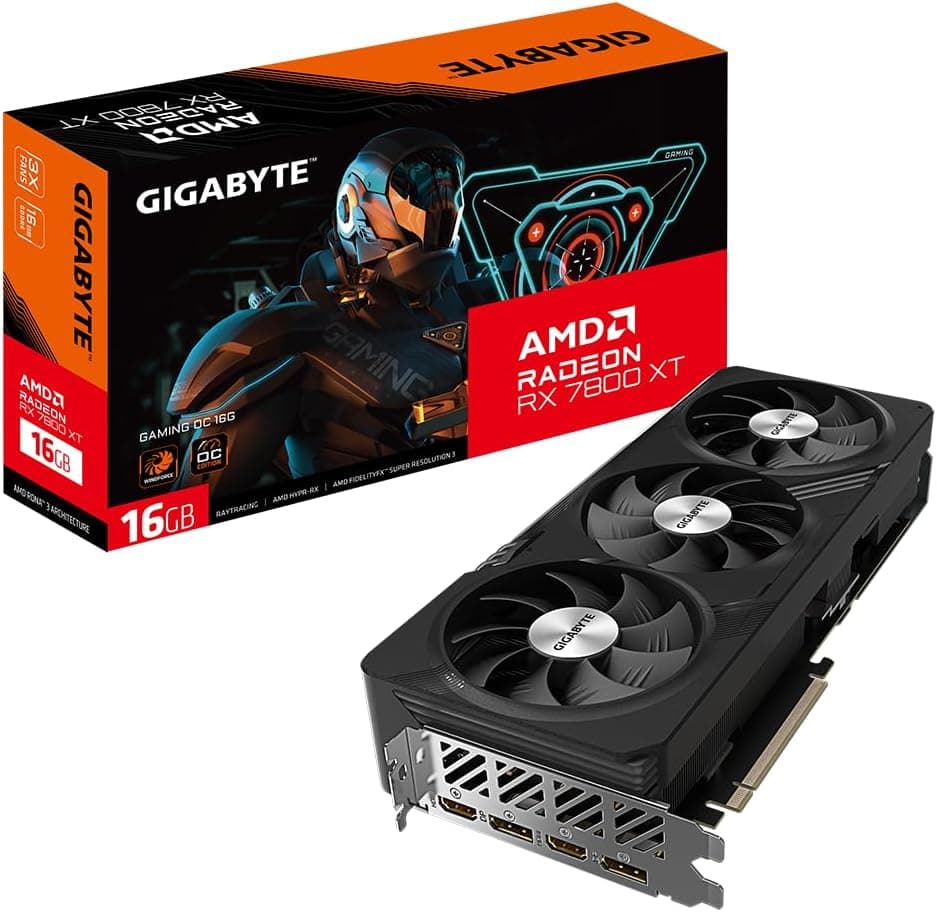
This article covers Gigabyte Radeon RX 7800 XT GAMING OC 16GB グラフィックカード.
Overview
The Gigabyte Radeon RX 7800 XT GAMING OC 16GB (model GV-R78XTGAMING OC-16GD) is a mid-high-end graphics card built on AMD's RDNA 3 architecture. Powered by the AMD Radeon RX 7800 XT GPU, it packs 16GB of GDDR6 memory on a 256-bit bus, making it an excellent choice for high-refresh-rate 1440p gaming. The factory overclock pushes the boost clock to 2565MHz, surpassing reference specifications. Cooling is handled by Gigabyte's proven Windforce system, featuring three 90mm blade fans, seven composite copper heat pipes, and a large copper base plate that makes direct contact with the GPU die. A metal backplate reinforces the PCB and adds rigidity. The card occupies three expansion slots and measures roughly 30cm in length, so case compatibility should be checked beforehand. Connectivity includes two DisplayPort 2.1 and two HDMI 2.1 outputs, supporting up to 8K resolution and high refresh rates on modern monitors. The PCIe 4.0 x16 interface ensures full bandwidth with current motherboards.
Compatibility Guide
This card uses a PCIe 4.0 x16 interface but is backward compatible with PCIe 3.0 slots. However, some bandwidth-sensitive scenarios may see a slight performance drop on older platforms. Memory is 16GB GDDR6 on a 256-bit bus, providing ample VRAM for 1440p gaming and even some 4K workloads. The card requires two 8-pin PCIe power connectors; it does not support the 12VHPWR connector. A 700W or higher power supply is recommended, with 750W+ preferred for systems with high-end CPUs. The form factor is triple-slot, so ensure your case has enough clearance for both length and width. Most mid-tower and full-tower cases will fit, but compact or Mini-ITX builds may struggle.
Product Info
Released in September 2023, the Gigabyte Radeon RX 7800 XT GAMING OC 16GB sits in the mid-high tier, directly competing with the NVIDIA GeForce RTX 4070. Its key advantage is 16GB VRAM versus the RTX 4070's 12GB, offering better future-proofing for texture-heavy titles. Key specifications: GPU: AMD Radeon RX 7800 XT (Navi 32, 5nm process) Boost clock: 2565MHz Memory: 16GB GDDR6, 256-bit, 624.1 GB/s bandwidth API support: DirectX 12 Ultimate, Vulkan Outputs: DisplayPort 2.1 x2, HDMI 2.1 x2 Recommended PSU: 700W * Warranty: 3 years The Windforce cooler supports semi-fanless operation, stopping fans entirely at idle for silent operation. Under load, the three fans spin up to maintain temperatures while keeping noise reasonable.
Best Use Cases
1440p High-Refresh Gamers This card excels at 1440p with high frame rates. Competitive titles like Call of Duty or Fortnite can easily exceed 144fps, while demanding single-player games like Cyberpunk 2077 can maintain 60fps+ with adjusted settings. It's a sweet spot for gamers who want smooth performance without jumping to 4K. VRAM-Conscious Creators With 16GB of VRAM, this card handles video editing, 3D rendering, and AI image generation comfortably. Large textures and high-resolution projects benefit from the extra memory compared to 12GB alternatives. If you work with 4K video or complex 3D scenes, this is a strong choice. AMD Ecosystem Builders Pairing this card with a Ryzen CPU enables Smart Access Memory (SAM) for a free performance uplift. AMD's FSR upscaling and Fluid Motion Frames further enhance gaming experiences. If you prefer AMD's software stack and driver philosophy, this card fits perfectly. Light 4K Gaming While not a native 4K powerhouse, the RX 7800 XT can handle 4K at medium settings with playable frame rates. For occasional 4K gaming or older titles, it's sufficient. However, for consistent 4K ultra settings, consider stepping up to an RX 7900 XT or RTX 4070 Ti Super.
Things to Consider
The triple-slot design and ~30cm length mean this card won't fit in many small form factor cases. Always measure your case's GPU clearance before purchasing. Power supply requirements are 700W minimum, but a quality 750W+ unit is recommended for stability, especially with a high-end CPU. Ensure your PSU has two separate 8-pin PCIe cables (not daisy-chained). Compared to the RTX 4070, ray tracing performance is noticeably weaker. If ray tracing is a priority, NVIDIA's offering may be a better fit despite the smaller VRAM pool. PCIe 3.0 users may experience minor performance penalties in some titles due to bandwidth limitations. Upgrading to a PCIe 4.0 platform is advisable to fully unlock this card's potential. ## FAQ
Q: Can this card handle 4K gaming? A: Yes, but not at max settings in the most demanding titles. With FSR enabled and settings turned down, you can achieve 60fps in many games. For native 4K ultra, consider a higher-tier card. Q: RX 7800 XT vs RTX 4070 – which should I buy? A: Choose the RX 7800 XT if you value raw rasterization performance, 16GB VRAM, and AMD features like SAM and FSR. Choose the RTX 4070 if ray tracing, DLSS, or NVIDIA's ecosystem (Broadcast, CUDA) are more impo
Product Disclosure (Amazon)
- Manufacturer: GIGABYTE
- Seller: Reg shop
- Fulfilled by: Reg shop
- ASIN: B0CGRMJF6C
- Note: This article covers a manufacturer-made product based on Amazon listing details.