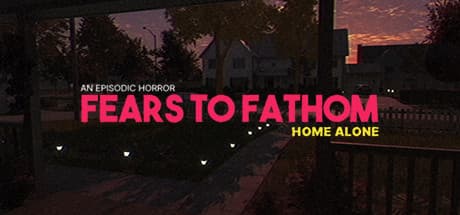
Game Overview
Fears to Fathom: Home Alone - A Psychological Horror Experience is an episodic first-person horror story presented as the recollection of a survivor. In Home Alone, you play Miles, a 14-year-old boy left at home while an ordinary evening gradually becomes unsafe.
The core loop is not about fighting monsters: you move through the house, complete mundane tasks, read messages, and watch for signs that something is wrong.
The familiar residential setting makes hallways, windows, and apparently empty rooms the main sources of tension. Its compact structure also makes it a practical introduction to the wider series.
Developed and published by Rayll, this single-player episode was released on July 2, 2021.
Features and Systems
The story advances through first-person exploration and text messages from NPCs. These conversations provide context, establish Miles's relationships, and often help the player understand what to do next.
By making routine actions interactive, the game gives the later danger a more personal and believable foundation.
VHS-like noise and color treatment give the photorealistic house the unstable quality of recovered footage. The horror is not limited to sudden loud scares; small sounds and changes at the edge of the screen encourage careful observation.
Headphones can make directional cues easier to notice, while the Steam requirements suggest using a microphone for an enhanced experience rather than listing it as mandatory hardware.
How to Approach the First Playthrough
Read incoming messages and objective prompts before rushing through the house. Learning the locations of rooms and exits early also makes it easier to interpret later events.
When a sound or movement seems suspicious, checking what has changed can be more rewarding than immediately running toward the next objective.
If progress appears to stop, review the latest messages and revisit objects or destinations connected to the current task. Some interactions are deliberately ordinary, so the required object may not look like a conventional game objective.
If darkness prevents you from identifying interactive areas, a modest brightness adjustment can help without removing the intended atmosphere.
PC Requirements
The minimum specification lists Windows 7 or later, a 2.6 GHz quad-core processor or similar, and 4 GB of RAM.
Graphics requirements are a GeForce GTX 950 or Radeon HD 7970, with DirectX 11 support and 4 GB of available storage. The installation footprint is modest, but no recommended specification is supplied, so the minimum list alone cannot promise high-resolution or high-frame-rate play.
On hardware close to the GTX 950 tier, begin with a conventional resolution and moderate settings, then reduce shadows or overall quality if performance is uneven. Laptop versions and thermally limited systems can behave differently even when their product names appear comparable.
For a PC relying only on integrated graphics, compare the exact GPU model with the listed minimum before assuming it will run well.
Reception and Common Impressions
Players have continued to respond well to the believable domestic setting, sustained tension, and compact storytelling. Text conversations reveal both personal context and warning signs, helping the episode feel like an incident the player is experiencing rather than a cutscene being observed.
The VHS presentation also supports the survivor-testimony format instead of serving as decoration alone.
Potential drawbacks follow from the same focused design. The playable area and narrative are limited in scope, and players seeking combat, elaborate puzzles, or a long campaign may find it slight.
The deliberate pace of household tasks and occasional uncertainty about the next interaction can also divide opinion. It is best approached as a self-contained opening episode, not as the entire series in one package.
Who Should Play It
Home Alone suits players who enjoy plausible intruder horror, slow escalation, and short stories built around observation. It is especially effective for those who prefer tension inside a restricted location over collecting weapons or exploring a huge map.
It also offers a low-commitment way to decide whether Rayll's visual style and storytelling approach appeal to you.
Cautions and Who May Not Enjoy It
This is a single-player experience, not a multiplayer or co-op horror game. Anyone looking for teamwork, combat roles, or repeatable group sessions should expect a very different format.
The themes of stalking, an unsafe home, and a young person facing a possible intruder may also be uncomfortable for some players.
The supplied data does not confirm language support, so check the Steam language section before installing if localized text is essential. Microphone use is suggested for a stronger experience, but it is not stated as a mandatory requirement.
Store tags and metadata can occasionally be misleading, so confirm the single-player format and system requirements against the product description before playing.