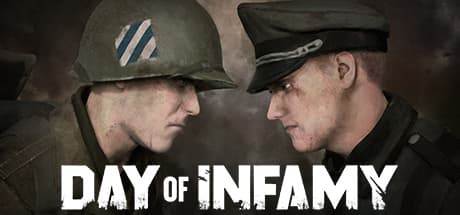
Day of Infamy: WWII Hardcore FPS with Teamwork Focus is a first-person shooter set in World War II where coordinated objective play matters more than individual kill totals. Developed and published by New World Interactive, it was released on March 23, 2017.
Its high lethality makes careless movement costly, so spotting threats, controlling lines of fire, and moving with the team are central to success.
Game Overview
A typical match has players establish a front, capture positions, destroy enemy equipment, or eliminate key officers before advancing into the next area. Winning is not simply a matter of taking every direct gunfight.
Players must identify enemy sightlines, use cover, and time their movement with a larger push.
The game includes 14 levels inspired by World War II battles, covering fortified beaches, damaged villages and cities, forests, and snowy terrain. Each environment changes the practical problem.
Open approaches punish exposure, urban spaces demand careful checks of windows and corners, and wooded areas make visual identification more difficult.
Nine Classes and Team Roles
Players choose from nine specialized classes. The class structure is more than a selection of different weapons: it encourages the squad to divide responsibilities for advancing, supporting, and protecting important positions.
A player who creates a safe route for the team may have a greater impact than someone who survives alone away from the objective.
New players should initially follow the direction of the main push and cover a nearby angle instead of attempting a long solo flank. Gunfire and the locations where teammates fall can reveal possible enemy positions.
When selecting a class, consider the current objective and what the squad lacks, not only which firearm feels most appealing.
PvP and Cooperative Play
There are seven player-versus-player modes, with priorities that include securing ground, destroying equipment, and removing officers. Human opponents can wait, rotate, and flank, so the dangerous route through a map can change from one match to another.
Reflexes help, but coordinated pressure from multiple angles is often more useful than repeatedly attacking a strong defensive lane.
Three cooperative modes pit the team against AI. They provide a useful setting for learning weapon behavior, map layouts, and objective flow before entering competitive matches.
Cooperation remains important, however: a player separated from the group can be overwhelmed without anyone close enough to respond.
Single-player support is also listed, but the defining appeal of Day of Infamy comes from divided roles and a shared effort to move the front. Playing alone and coordinating with human teammates produce meaningfully different experiences, so the preferred mode should match what you want from the game.
System Requirements in Practice
The minimum specification lists Windows 7, an Intel Core 2 Duo E6600 or AMD Phenom X3 8750 processor or better, and 4GB of RAM. Graphics hardware must support DirectX 9 and Pixel Shader 3.0 with 1024MB of VRAM.
The game also requires DirectX 9.0c and 12GB of available storage, while the stated minimum resolution is 1280x720.
These components belong to an older hardware generation, so many modern gaming PCs should clear the minimum threshold. However, no recommended specification is supplied in the provided data, and a minimum requirement does not guarantee a particular frame rate or high-resolution experience.
On an older system, begin at 1280x720 and reduce demanding options such as shadows or view distance while checking stability.
Network quality matters alongside local hardware in multiplayer. Because a brief delay can be costly in a high-lethality shooter, players experiencing inconsistent wireless latency may benefit from checking their connection or using a wired network.
Reception and Review Patterns
Day of Infamy has maintained broadly positive user sentiment over time. Its World War II atmosphere and demanding combat are recurring parts of its appeal.
Players who enjoy consequences for poor positioning are more likely to value the tension than those seeking a forgiving run-and-gun shooter.
The same qualities create a steep entry point. Newcomers may die without identifying the shooter, struggle until map routes become familiar, or fail to reach an objective when the team is fragmented.
These experiences are closely tied to the intended design, so expectations matter: this is not primarily a game about producing rapid solo kill streaks.
Practical Advice for New Players
At first, prioritize understanding the objective and the direction of the friendly advance over chasing eliminations. Before crossing exposed ground, inspect windows, ridgelines, and the far ends of streets.
If a teammate is hit ahead of you, treat that event as information instead of immediately following along the same route.
Do not remain at one firing position indefinitely after revealing it. An opponent may have located the muzzle flash or sound, making a nearby piece of cover safer for the next engagement.
Small changes in angle can also prevent the enemy from pre-aiming the exact position you previously used.
At an objective, sending every player through one entrance makes the defense's job easier. Creating more than one line of pressure can divide its attention, but an elaborate flank is wasted if it arrives after the team's main attack has ended.
Timing a modest move with allies is often more valuable than completing a clever route alone.
Who Should Play It
Day of Infamy suits players interested in World War II equipment and environments who also enjoy careful observation and objective-based matches. It rewards those willing to communicate, learn dangerous sightlines through experience, and treat deaths as information.
The cooperative modes also make it relevant to groups that would rather fight AI together than play only against other people.
It is especially worth considering if you want an FPS where terrain, positioning, and role coverage influence the outcome. The central satisfaction comes from helping a formation advance and completing a shared task, rather than displaying constant individual heroics.
Caveats and Who Should Skip It
Players looking for fast movement, forgiving survivability, and uninterrupted solo action may find the pacing frustrating. The lethal combat and importance of map knowledge can make early sessions feel harsh.
Enjoyment depends on having the patience to identify why a route failed and gradually learn safer alternatives.
The supplied language listing includes English, French, Korean, Arabic, Russian, Simplified Chinese, and Traditional Chinese, but does not list Japanese. Check the current store information before purchase if Japanese menus or instructions are essential.
As this is an older multiplayer release, it is also sensible to verify activity in your preferred region and play hours before relying on competitive matchmaking.