Overview
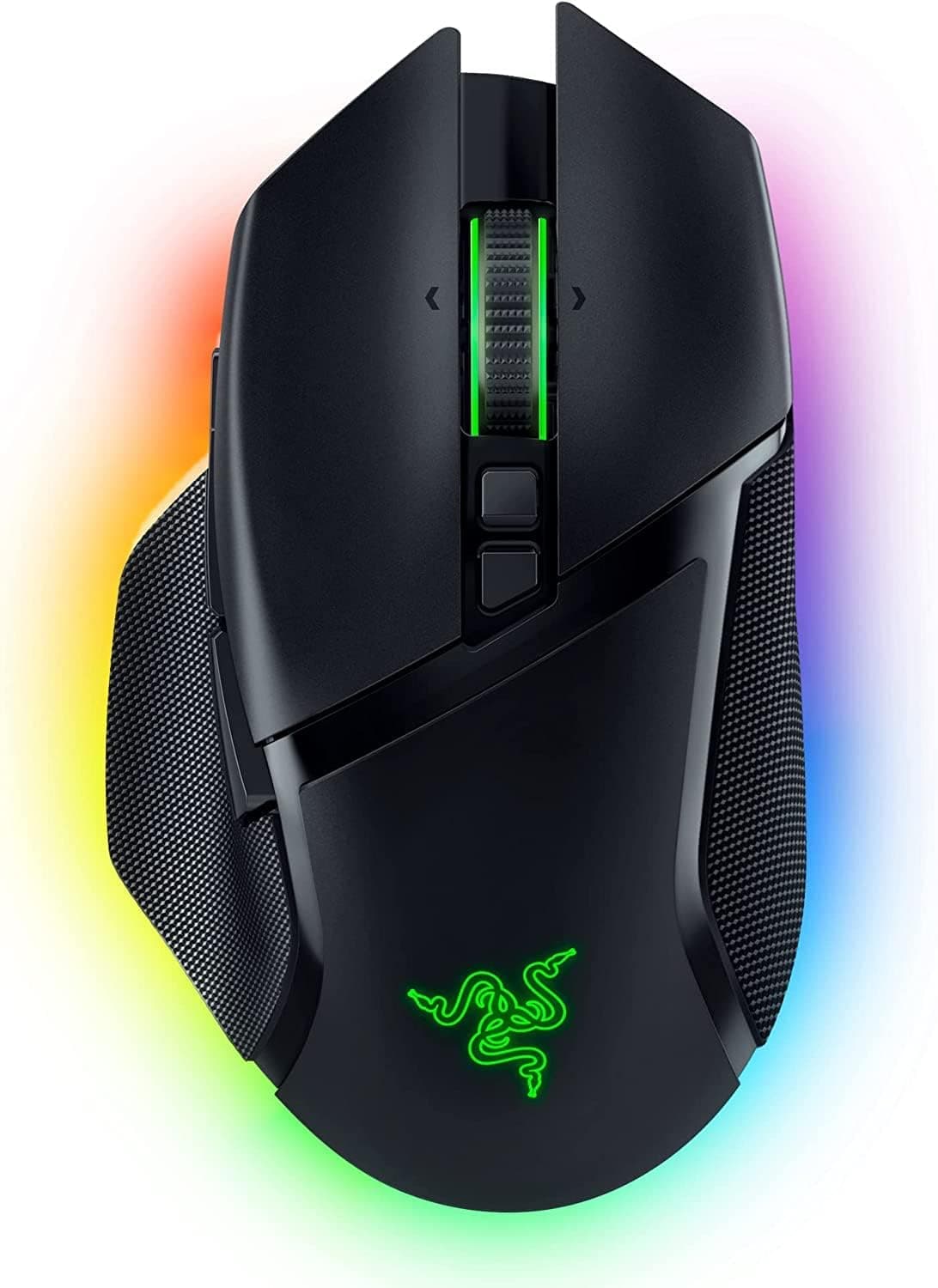
The Razer Basilisk V3 Pro Wireless Gaming Mouse (HyperScroll Tilt Wheel) is Razer's ergonomic flagship, launched in 2022. The short verdict: it suits right-handed palm and claw grippers who genuinely use side buttons and the scroll wheel outside of games too. If your priority is raw lightness for competitive FPS, today's 50-65g class fits you better. The 112g weight and 10+1 buttons point in a deliberately different direction from the weight-reduction race.
On Amazon.co.jp the mouse sits at 4.5 out of 5 stars across 1,425 reviews (90% positive) as captured on 13 June 2026.
Holding that score and that review count years after launch is indirect evidence that there is no widespread design flaw or early-failure pattern.
| Item | Spec | Where it actually matters |
|---|---|---|
| Sensor | Razer Focus Pro 30K (30,000 DPI) | Lift-off distance and surface tracking matter more than peak DPI |
| Switch | Razer Optical Gen-3 (90M clicks, 0.2ms) | Resistance to double-click faults over years of use |
| Connectivity | HyperSpeed 2.4GHz / Bluetooth 5.0 / wired USB-C | 2.4GHz at the desk, Bluetooth on the road |
| Polling rate | 1000Hz stock, 4000Hz with optional dongle | 4kHz costs extra money, not just a setting |
| Buttons | 10+1 programmable | MMO binds, editing shortcuts |
| Battery | Up to 90h (HyperSpeed), up to 24h (Bluetooth + Chroma) | Drops the more lighting you run |
Those are manufacturer figures. Battery life in particular swings with how many zones you light and how bright, so treat 90 hours as a dimmed-lighting best case.
The HyperScroll Tilt Wheel in Practice
Despite the sensor headline, the wheel is what defines this mouse. It switches between a tactile, notched mode and a free-spin mode that keeps coasting after a flick, with adjustable resistance. Free-spin is for long documents, Steam libraries and asset folders; tactile is for weapon swaps and precise value nudges.
Tilt clicks map neatly to horizontal scrolling in browsers, column movement in spreadsheets and timeline scrubbing in video editors. As a pure gaming device the 10+1 buttons are overkill, but if the same mouse does your work too, the wheel alone justifies stepping up.
The flip side: if you only game, you will leave the most expensive part of this product unused.
Compatibility Guide
It supports Windows 10/11 and macOS 10.14 or later, with three connection paths: Razer HyperSpeed Wireless (2.4GHz), Bluetooth 5.0, and wired USB Type-C, so you can keep playing while charging. Bluetooth makes tablets and phones viable, but polling drops in that mode, so treat 2.4GHz as the only option for competitive play.
The places people actually trip up:
- 4kHz is not stock. Rated polling is 1000Hz; 4000Hz requires the separately sold HyperPolling Wireless Dongle or the Mouse Dock Pro. Budget for it up front if that is why you are buying.
- Receiver connector shape. 2.4GHz receivers are typically USB-A, so a USB-C-only ultrabook needs an adapter or hub. Check the bundled parts on the product page.
- USB 3.0 proximity. The 2.4GHz band is vulnerable to USB 3.0 radiated noise; plugging straight into a rear port can cause cursor jumps. An extension cable that brings the receiver near the mouse fixes most cases.
- Surface. Focus Pro 30K claims glass tracking, but behaviour varies with glass thickness and clarity. A cloth pad is the safe choice.
- Hand size and grip. This is a right-hand-only ergonomic shell; left-handed users are excluded. Button placement assumes palm or claw grip, so fingertip users should check reach in person first.
How It Compares
Among wireless multi-button mice, the Logicool G G502 X LIGHTSPEED is the closest rival, with 13 programmable buttons and a HERO 25K sensor. It is the same philosophy of piling on features, so compare the two if button count drives your choice.
The lightweight camp is a different animal entirely. The Logitech G PRO X Superlight 2c is 53g with five buttons, the ATTACK SHARK RS6 ULTRA is 63g with 8kHz support, and the Pulsar CrazyLight Series is 38g.
All of them strip features to cut mass, and the Basilisk V3 Pro is roughly double their weight. For low-sensitivity players who sweep the whole forearm, that gap shows up as fatigue.
Even inside Razer the split is clear: the Viper 8K Hz is 71g with 8000Hz polling for competition, while the DeathAdder V2 is a 112g wired right-hand ergonomic shape. If you like the shape but want to spend less, starting with a wired ergonomic model is a sound move.
Product Info
The specs are in the table above: Focus Pro 30K sensor, Razer Optical Mouse Switch Gen-3 rated for 90 million clicks with 0.2ms actuation, 10+1 programmable buttons, and 13-zone Chroma RGB with underglow. The box includes a USB Type-C cable, the wireless receiver and swappable side grips, with a stated two-year warranty.
Captured prices, each a snapshot that sales and third-party sellers move constantly:
- Amazon.co.jp: JPY 45,356 (captured 27 August 2026)
- eBay US: USD 89.99 (captured 13 July 2026)
Notice how far apart those two are for the same product. No exchange rate explains a Japanese listing several times the US figure, and it is high even for a flagship mouse.
That pattern usually means a thin-stock third-party or grey-import listing rather than a normal retail price, so do not read JPY 45,356 as the going rate. Compare several sellers at the time you buy.
Recommended Users
- MMO, MOBA and action-RPG players who lean on binds. The 10+1 buttons pay off most here.
- People who want one mouse for games and work. Tilt and free-spin earn their keep daily in spreadsheets, browsers and editors.
- Right-handed palm or claw grippers who like a mouse with volume. More support means you can relax your hand on it.
- Anyone cutting cables but not tolerance for latency. HyperSpeed 2.4GHz is practically indistinguishable from wired in use.
- Desk-aesthetic builders. Thirteen zones plus underglow is on the flashy end.
Before You Buy
Coming from a lightweight mouse takes adjustment. At 112g this is roughly twice the 50-70g competitive class. High-sensitivity players who move in small arcs will not care, but hours of low-sensitivity aiming will tell. If you can handle one in a store, check the weight before anything else.
4000Hz support is not an out-of-the-box feature. Stock is 1000Hz and 4kHz needs the separate dongle.
Miss that and you discover the extra cost after purchase. The Mouse Dock Pro is likewise sold separately.
Battery numbers are conditional. The 90-hour figure is for HyperSpeed; Bluetooth with Chroma is rated up to 24 hours, and lighting all 13 zones brightly cuts it further.
If you run lighting constantly, keep the USB-C cable on your desk.
Left-handed users are out. The shell is right-hand-only with none of the flexibility of an ambidextrous design.
Razer Synapse is part of the deal. Profiles save to onboard memory, but detailed remapping and Chroma settings happen in the software.
If you avoid background utilities, count that against it.
Verify the price and the seller. As noted, the captured Japanese price sits in the high JPY 40,000s, far from the US record.
On top of that, marketplace listings sometimes carry registration details (manufacturer, model number, bundled items) that do not match the actual product. Confirm the item from the photos and product name, and check whether the listing carries official domestic distributor warranty coverage, because that changes what happens when something fails.
FAQ
Q. Can I get 4000Hz polling with just the mouse?
A. No. Stock polling is 1000Hz; 4000Hz requires the separately sold HyperPolling Wireless Dongle or the Mouse Dock Pro.
Q. Is 112g too heavy? A.
It depends on use. It reads as stability for MMO and everyday work, but it is a handicap in low-sensitivity competitive FPS.
If lightness comes first, look at the 50-65g class.
Q. Does it work on a Mac? A.
macOS 10.14 or later is supported, though some gaming features are built around Windows, so the range of settings available on macOS may be narrower.
Q. Can I use it directly on a glass desk? A.
Focus Pro 30K advertises glass tracking, but results vary with thickness and clarity. A cloth pad is the reliable answer.
Q. Can it run wired?
A. Yes. The bundled USB Type-C cable charges and operates it at once, so a flat battery does not end your session.
Q. Why do the listed prices differ so much? A.
Seller, stock levels and grey-import status all move the number. JPY 45,356 (27 August 2026) and USD 89.99 (13 July 2026) are both point-in-time records, not a guarantee of what you will pay.