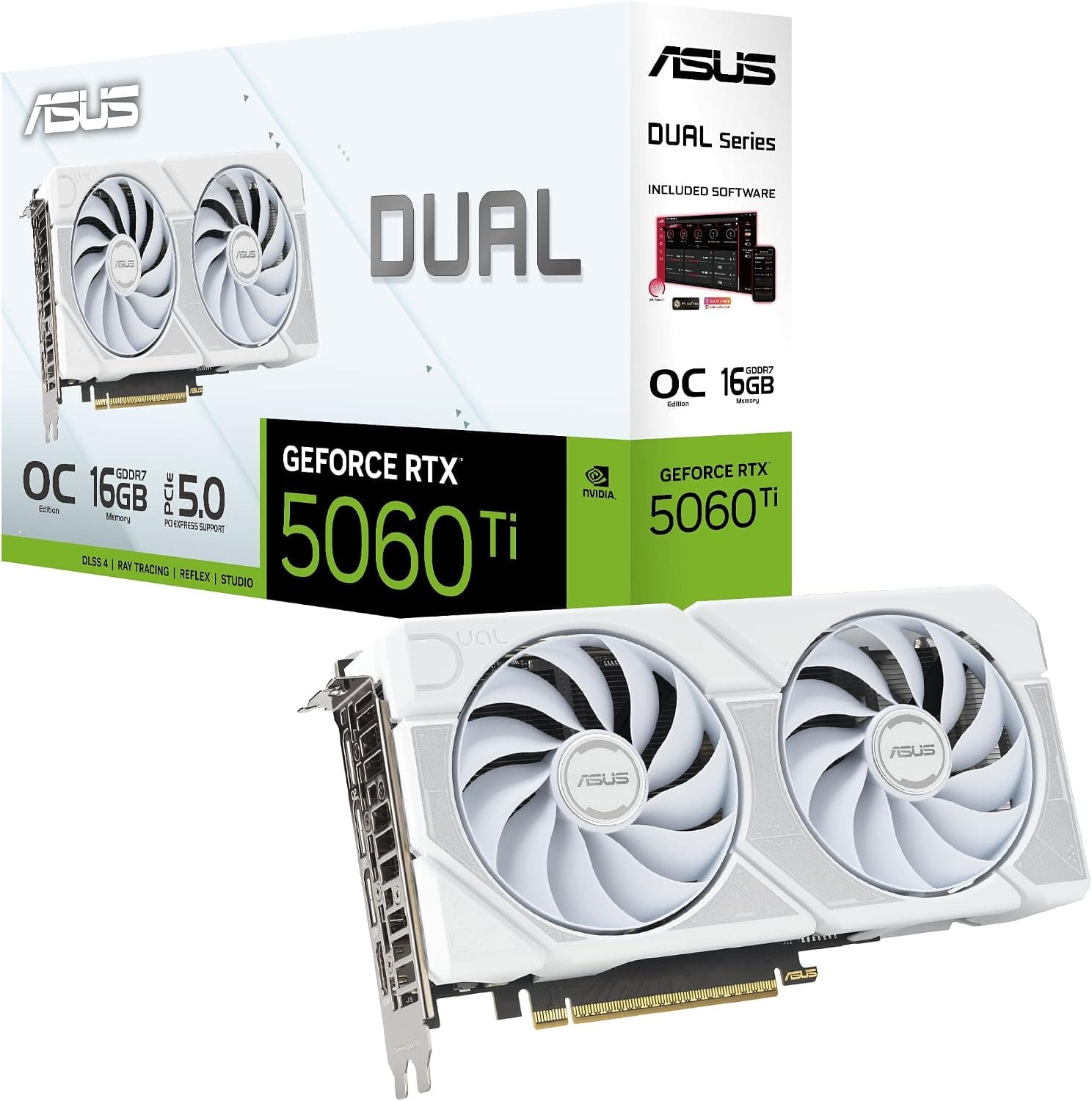
This article covers ASUS NVIDIA GeForce RTX 5060 Ti オーバークロック 16GB GDDR7 ビデオカード DUAL-RTX5060TI-O16G-WHITE 国内正規代理店品.
Overview
The ASUS DUAL-RTX5060TI-O16G-WHITE is a white-colored graphics card built around the NVIDIA GeForce RTX 5060 Ti GPU. It packs 16GB of GDDR7 memory and an out-of-the-box overclock with a boost clock of 2632 MHz in OC mode. This model targets gamers and creators who want a reliable mid-range card with a clean white aesthetic. Supporting PCI Express 5.0, the card is future-ready yet fully backward compatible with PCIe 4.0 systems. The compact 2.5-slot design features an upgraded Axial-tech fan with dual ball bearings and a vented backplate that improves heat dissipation. The 0dB technology stops the fans completely under low load, keeping the system silent during everyday tasks. Priced around ¥139,800 (as of late 2026), the DUAL-RTX5060TI-O16G-WHITE sits comfortably in the mid-range graphics card segment. It comes as an official ASUS Japan authorized product, ensuring warranty and support peace of mind.
Compatibility Guide
The card uses a PCI Express 5.0 x16 interface and works in any PCIe 3.0/4.0 slot. It occupies 2.5 expansion slots, so be mindful of adjacent slots if you need space for other cards. Dimensions are 229 x 120 x 50 mm, fitting most mid-tower and full-tower cases. For small form factor (SFF) cases, check clearance carefully. Power is supplied via a single 8-pin PCIe power connector (typical for this class). We recommend a 600W or higher power supply for a typical gaming system with this card. Video outputs include one HDMI 2.1a and three DisplayPort 2.1b ports, supporting up to four displays simultaneously at up to 8K resolution.
Product Info
Released in mid-2026, the ASUS DUAL-RTX5060TI-O16G-WHITE is an overclocked variant with 16GB GDDR7 memory. The GPU features 4608 CUDA cores, a 128-bit memory bus, and effective memory speed of 28 Gbps. The OC mode boosts to 2632 MHz, while the default mode runs at 2602 MHz. Warranty is standard three years for ASUS Japan authorized products. This card positions itself as a mid-range option offering more VRAM than the 8GB version, appealing to users who need extra memory for creative workloads or future-proofing.
Best Use Cases
High-refresh 1080p gaming: The RTX 5060 Ti handles most modern titles at 1080p ultra settings with frame rates well above 100 fps. eSports games will easily hit 144+ fps. Entry-level 1440p gaming: For less demanding titles, or with settings adjusted to high, 1440p 60+ fps is achievable. Not ideal for maxed-out AAA games at 1440p. Content creation with moderate VRAM needs: Video editing in 4K, photo editing, and AI image generation benefits from the 16GB VRAM. The 128-bit bus can be a bottleneck for heavy 3D rendering, but for most creative tasks it's sufficient. White-themed PC builds: The white shroud and backplate make it a perfect match for builds that aim for a clean white or two-tone look. Who should avoid this card? Users targeting native 4K high settings, or those who need high memory bandwidth for compute-heavy workloads, should look at higher-tier cards like RTX 5070 or above.
Things to Consider
While the 16GB VRAM is a plus, the 128-bit memory bus limits bandwidth. In some scenarios, the slightly more expensive RTX 4070 with a 192-bit bus and similar VRAM may offer better performance. Also, the OC is modest; you may not notice a significant improvement over the standard version. No official TDP is listed, but based on the RTX 5060 (145W), this card should be around 150-160W. Ensure your power supply has a free 8-pin connector and adequate wattage headroom. The white color may show dust and discoloration over time. The card does not include RGB lighting, so if you want customizable lighting, consider other models like the ASUS ROG Strix series. ## FAQ
Q: Can I use this card with a PCIe 4.0 motherboard? A: Yes, PCIe 5.0 cards are backward compatible with PCIe 4.0 slots. Performance difference is negligible in current games. Q: Is the 16GB version worth the extra cost over the 8GB version? A: For most gamers, the 8GB version is sufficient. Choose the 16GB if you do AI work, video editing with large timelines, or plan to keep the card for 4-5 years as future games may use more VRAM. Q: Does this card fit in ASUS Prime AP201 or similar SFF cases? A: The card is 229mm long, which fits most SFF cases that support 2.5-slot GPUs. Check GPU length clearance of your case—if it's under 240mm, you should be fine.
Product Disclosure (Amazon)
- Manufacturer: ASUS
- Seller: 良品ストア オンライン支店
- Fulfilled by: 良品ストア オンライン支店
- ASIN: B0FQS5HKLS
- Note: This article covers a manufacturer-made product based on Amazon listing details.

![NZXT H5 Flow ミドルタワーケース [ White ] CC-H51FW-01](/_next/image?url=https%3A%2F%2Fm.media-amazon.com%2Fimages%2FI%2F71Z8n1YKqoL._AC_SL1500_.jpg&w=1920&q=75)