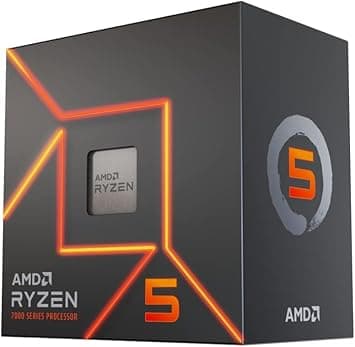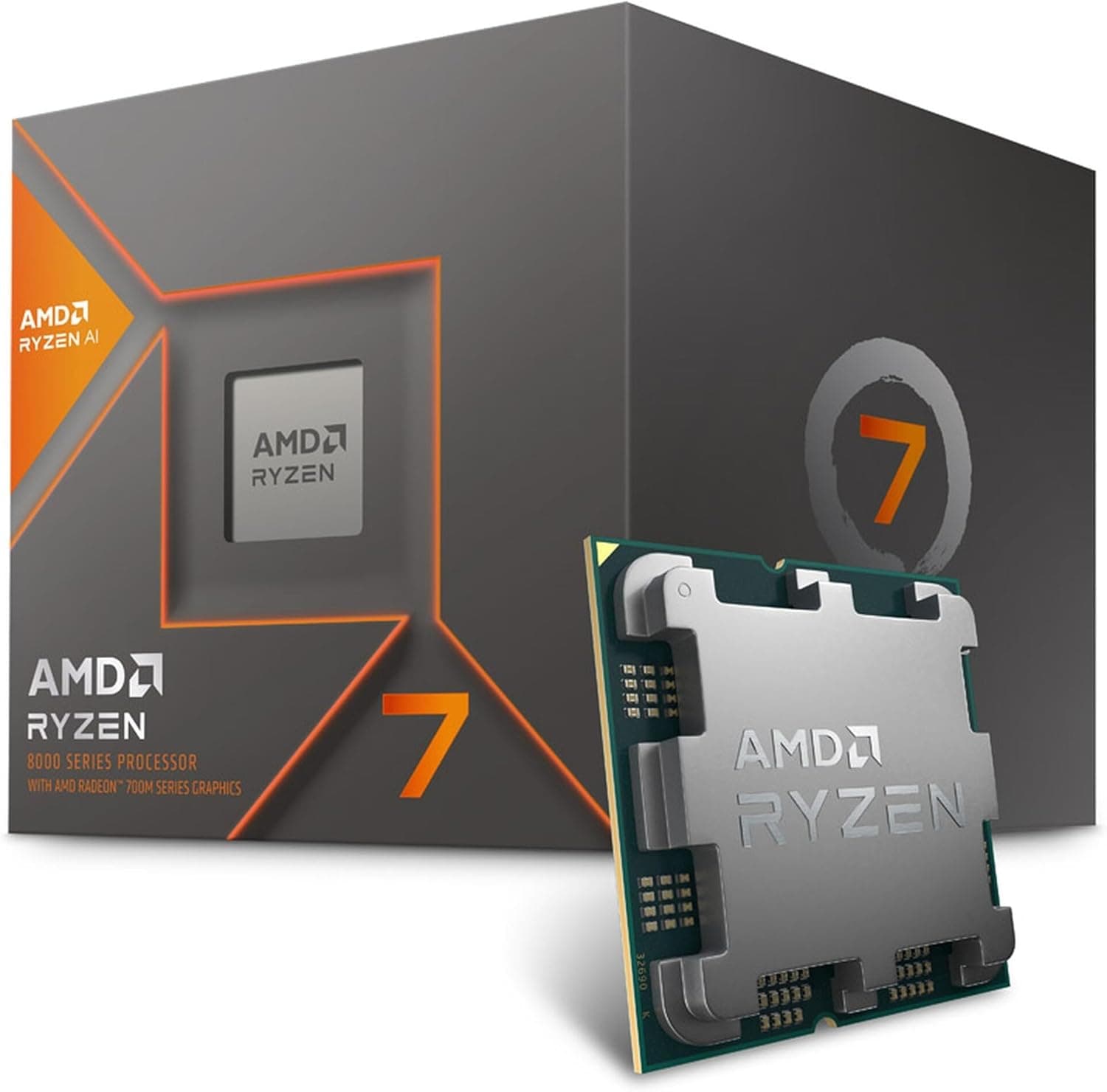
This article covers AMD Ryzen 7 8700G Desktop Processor.
Overview
The AMD Ryzen 7 8700G is a desktop APU launched in January 2024 for the Socket AM5 platform. It combines 8 cores and 16 threads with a base clock of 4.2 GHz and a boost clock of 5.1 GHz, all within a 65W TDP. Its standout feature is the integrated Radeon Graphics based on the RDNA 3 architecture, making it an excellent choice for entry-level gaming, light creative work, and office builds without a discrete graphics card. Built on TSMC's 4nm process, it packs 8MB L2 cache and 16MB L3 cache for a total of 24MB. The included Wraith Spire cooler handles thermal requirements out of the box, so no additional CPU cooler purchase is needed.
Compatibility Guide
Socket: AM5, compatible with A620, B650, X670, and X870 chipsets. Memory: Dual-channel DDR5-5200 (native), up to 128GB max. Note: DDR5 only, no DDR4 support. PCIe: CPU provides PCIe 4.0 x16 for graphics and PCIe 4.0 x4 for NVMe SSD. Additional lanes via chipset. Power: Recommended PSU wattage of 450?550W for a typical system without discrete GPU. Add headroom if adding a dGPU. * Case: Standard mid-tower cases accommodate the Wraith Spire cooler without issues.
Product Info
The Ryzen 7 8700G was released in January 2024 with a market price around ¥48,000 (~$320 USD) as of June 2026. AMD provides a 3-year warranty. The integrated GPU runs at 2,900 MHz and uses RDNA 3 architecture. Positioned in the entry to mid-range segment, it targets users who want competent integrated graphics for gaming and productivity without a separate GPU.
Best Use Cases
Entry-Level Gaming: Play eSports titles like Valorant, Fortnite, and CS2 at 1080p low settings achieving 60+ fps without a discrete GPU. Great for budget gaming PCs. Low-Power / Quiet Builds: With a 65W TDP and bundled Wraith Spire cooler, the system runs cool and quiet. Ideal for small-form-factor cases or always-on home servers with light graphical needs. * Office / Light Creative: Handles web browsing, office suites, basic photo and video editing. The APU eliminates the need for a separate graphics card, simplifying the build. ## Alternatives
Key competitors in the same price bracket include the Intel Core i5-14600K and Core i7-14700K. The 8700G wins decisively on integrated GPU performance (Radeon vs UHD 770), making it better for GPU-less builds. However, the Intel chips deliver higher raw CPU throughput (especially the i7-14700K), so if you plan to always use a discrete GPU, Intel may offer better value. For pure CPU performance, the Ryzen 7 8700G is slightly behind the i5-14600K in multi-threaded tasks.
Things to Consider
While the integrated GPU is strong, pairing the 8700G with a high-end discrete GPU (e.g., RTX 4070 SUPER or above) may cause a PCIe bottleneck due to limited CPU lanes. The APU relies heavily on memory bandwidth; running single-channel DDR5 dramatically reduces iGPU performance?always use dual-channel. Additionally, the AM5 platform only supports DDR5, which is more expensive than DDR4. Finally, for those who will never use the iGPU, a traditional CPU like the Ryzen 7 7700X may offer higher CPU performance at a similar price.
Product Disclosure (Amazon)
- Manufacturer: AMD
- Seller: デザイナーズ アクア
- Fulfilled by: Amazon
- ASIN: B0CQ4JBKW3
- Note: This article covers a manufacturer-made product based on Amazon listing details.