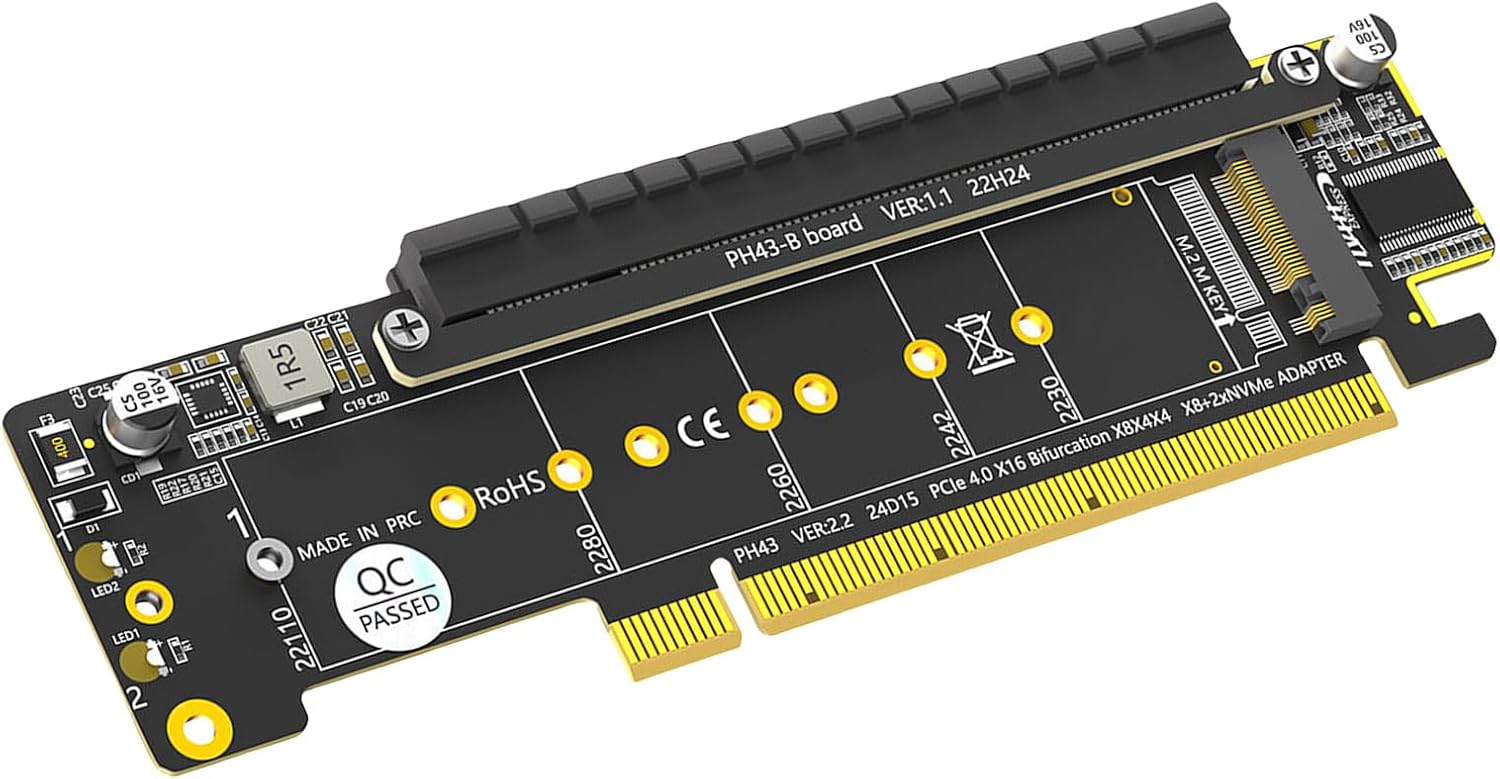
This article covers PCIe4.0 拡張カード スプリッタ X16 スロットを 2 つの 4X 接続 PCIe X16 (8X) アダプタ NVMe ディスク用複数デバイス NVMe ディスク拡張カード.
Overview
This expansion card allows you to add two NVMe M.2 SSDs to your desktop PC using a single PCIe slot. It plugs into a PCIe x16 slot and splits 8 lanes into two x4 connections, providing dedicated bandwidth to each NVMe drive. Supporting PCIe 4.0, it is also backward compatible with PCIe 3.0 systems. Ideal for gamers, content creators, and data scientists who need high-capacity, fast storage without replacing their motherboard.
Key Features
PCIe 4.0 x8 interface: Delivers up to 16 GT/s per lane, maximizing NVMe SSD performance. Works in PCIe 3.0 slots with reduced bandwidth. Dual M.2 NVMe slots: Accommodates two NVMe SSDs simultaneously, enabling RAID configurations or simple capacity expansion. Channel splitting design: Divides 8 lanes into two independent x4 connections, ensuring each drive gets consistent bandwidth even under concurrent access. Easy installation: No additional drivers or complex setup required; simply insert into a compatible PCIe slot and the system recognizes the drives.
Connectivity & Compatibility
The card requires a physical PCIe x16 slot with at least x8 electrical lanes. For full PCIe 4.0 speeds, the motherboard must support PCIe 4.0. It is backward compatible with PCIe 3.0, but bandwidth will be halved. Only M.2 NVMe SSDs (M-key) are supported; SATA M.2 drives are not compatible. Be mindful of physical clearance: the card may block adjacent PCIe slots or interfere with large graphics cards.
Product Info
This product is sold on by seller YanFangBeauty. It is a generic unbranded PCIe expansion card. Pricing typically ranges from ¥3,000 to ¥5,000, subject to market fluctuations. Warranty is provided by the seller, usually 30-day return policy. The package includes only the card itself; no cables or brackets are included. Availability is primarily through .
Best Use Cases
Gamers: Add a fast NVMe SSD for game installations to reduce load times and improve texture streaming. Video editors and creators: Use two NVMe drives in RAID 0 for high sequential read/write speeds when working with 4K/8K footage or large project files. * Data scientists and developers: Expand storage for large datasets, virtual machine images, or container workloads without upgrading the motherboard.