Overview
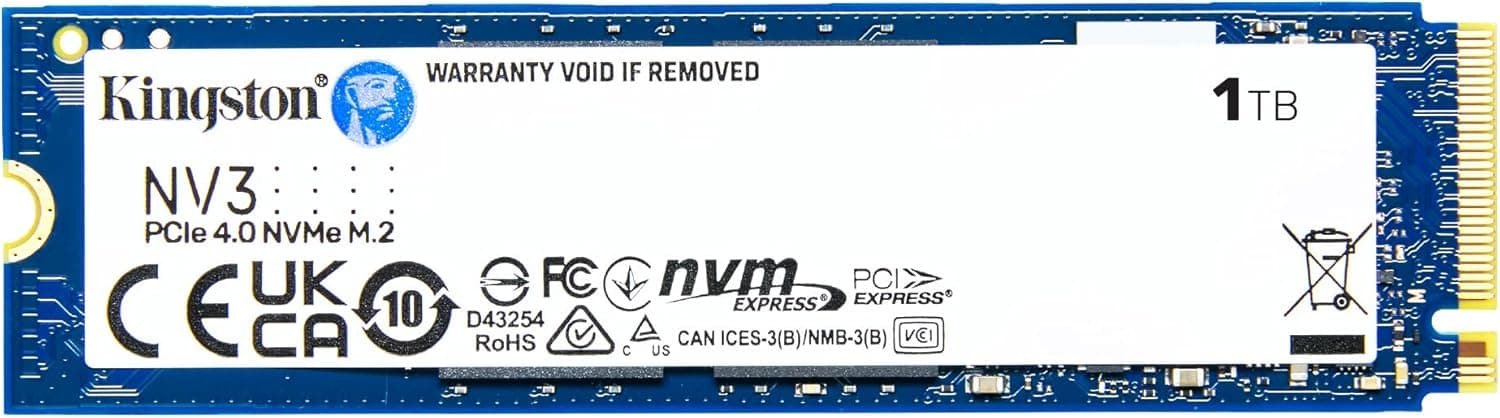
Kingston's NV3 line targets buyers who want PCIe 4.0 NVMe speed without paying flagship prices. The SNV3S/2000G is the 2TB member of that family, built in the M.2 2280 form factor with a rated sequential figure of up to 6,000MB/s. It is the kind of drive that can serve as a primary system disk or as a roomy second drive for a game library, and the capacity-to-speed balance is clearly the point of the design.
Under the label sits a TC2201 controller paired with Kioxia 162-layer QLC NAND. There is no dedicated DRAM cache; instead the drive relies on 64MB of HMB. That combination tells you where the NV3 sits in the market: it trades peak benchmark bragging rights for a lower cost per gigabyte, which is exactly what most real builds actually need.
The 2280 length is the most widely supported M.2 size, so it drops into desktop boards and into many slim laptops and compact systems that expose an M.2 slot. Two terabytes is enough to keep several large titles installed while still leaving room for photo and video working files.
Compatibility Guide
The interface is PCIe 4.0 x4 with NVMe, and the form factor is M.2 2280. Any motherboard with an M.2 slot that accepts NVMe drives should physically take the drive, but the rated 6,000MB/s only materializes on a Gen 4.0 platform. On a PCIe 3.0 board the link caps the drive well below its rating, so pair it with a Gen 4.0 CPU and chipset if throughput matters to you.
Cooling depends on the host. If your board ships an M.2 heatsink, check clearance against the drive's label side before tightening screws. Laptop upgrades deserve a look at the slot length and screw position under the bottom cover first, since machines with a 2230-only slot cannot accept a 2280 drive.
As an upgrade target it is flexible: it works as the first drive in a fresh build, and equally well as an added game drive alongside an existing boot SSD. Just confirm how your board allocates PCIe lanes, because some M.2 slots share bandwidth with SATA ports.
Product Info
The SNV3S/2000G arrived in August 2024 and sits in the middle-to-upper part of the NV3 capacity range, which runs from 500GB up to 4TB. By going DRAM-less with QLC NAND while keeping a PCIe 4.0 x4 link, Kingston positions this drive in the entry-to-mid tier of large-capacity NVMe storage. It will not match Gen 5 flagships in synthetic throughput, but for everyday boot times and game loading the gap is hard to feel. Buyers who weigh capacity per yen heavily and still want NVMe responsiveness are the intended audience.
Best Use Cases
- Players consolidating a scattered game library onto one drive: 2TB holds several large installs at once, and the 2280 stick adds no cabling inside the case. Anyone chasing maximum sequential scores should look at a Gen 5 drive instead.
- Photo and video editors keeping source material local: NVMe read speed keeps timeline scrubbing responsive, though heavy sustained-write workflows are better served by a drive with a DRAM cache.
- Owners of slim laptops or small-form-factor PCs adding internal storage: the 2280 size is widely supported, so you can skip carrying an external drive. Machines with a 2230-only slot are out of luck.
Things to Consider
Because the drive uses HMB rather than a dedicated DRAM cache, sustained large transfers can slow down once the cache is exhausted. If you regularly export video or copy huge file sets, compare against DRAM-equipped models before committing. QLC NAND also leaves less write-endurance headroom than TLC alternatives.
You need a Gen 4.0 platform to see the rated speed, and older Gen 3 systems will leave performance on the table. Watch for boards that share M.2 lanes with SATA ports, since adding the drive can disable a SATA connector. Running without a heatsink is fine for light use, but long sustained workloads can push temperatures up, so case airflow is worth a thought.
FAQ
Q: Will this work on a PCIe 3.0 motherboard?
A: Yes, as long as the M.2 slot supports NVMe. The link will be limited to Gen 3.0 bandwidth, so you will not reach the rated 6,000MB/s.
Q: Does a heatsink come in the box?
A: The provided product information does not list a heatsink. Plan on using your motherboard's M.2 heatsink or supplying your own.
Q: Can I use it to expand a PS5?
A: The supplied information is not enough to confirm console requirements. Check the console's expansion criteria before installing.
Product Disclosure (Amazon)
- Manufacturer: Kingston
- Model: SNV3S/2000G
- ASIN: B0DBR6TRZQ
- Note: This article covers a manufacturer-made product based on Amazon listing details.