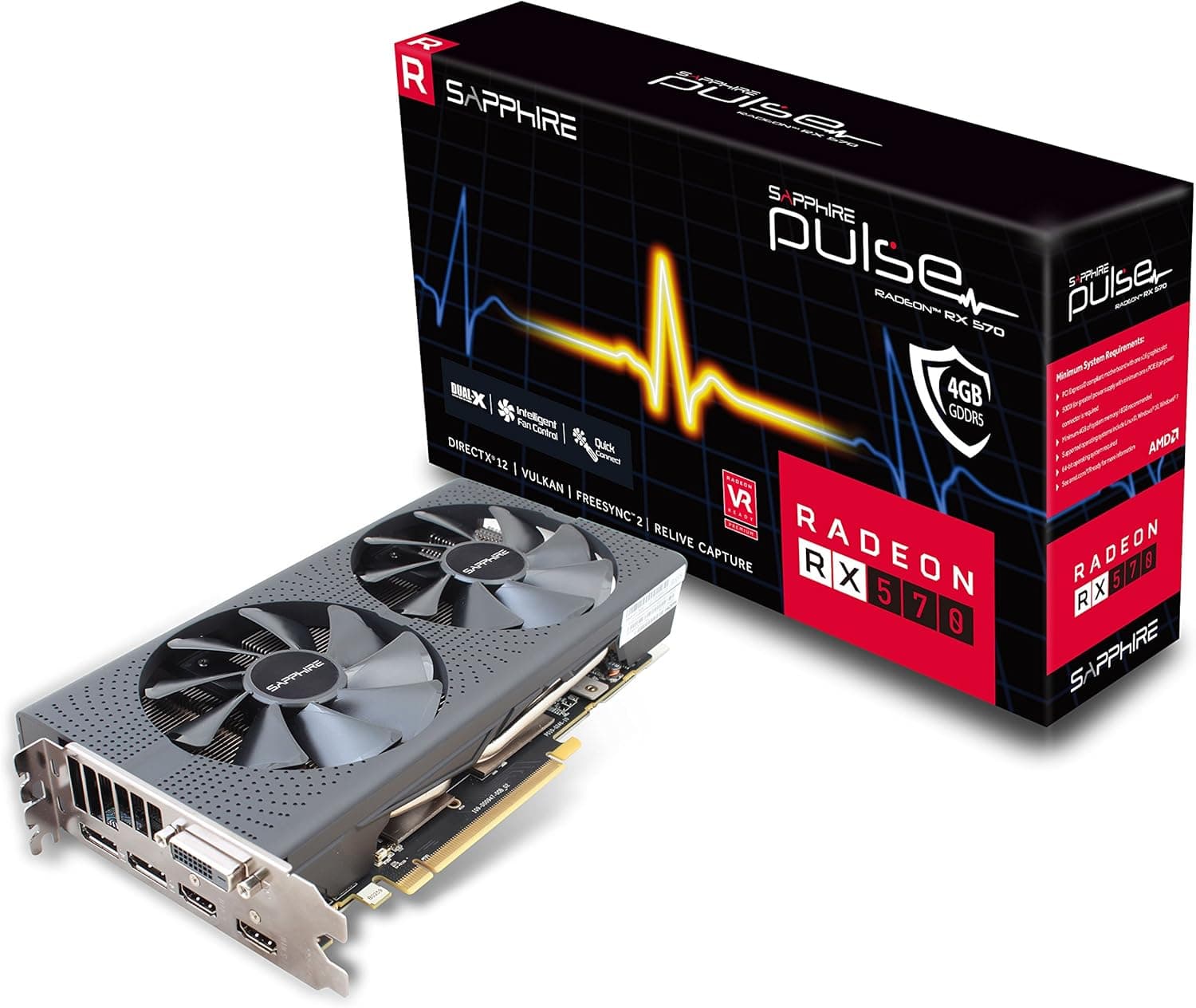
This article covers サファイア11266-04-20G Radeon Pulse RX 570 4GB GDDR5バックプレーン(UEFI)PCI-Eグラフィックスカード付きデュアルHDMI.
Overview
SAPPHIRE Technology's PULSE series Radeon RX 570 4GB model, part number 11266-04-20G, is a solid entry-level graphics card aimed at budget-conscious gamers who want a smooth 1080p experience. The GPU is an AMD Radeon RX 570 with 2048 stream processors, a boost clock of 1284 MHz, and 4GB of GDDR5 memory running on a 256-bit bus at an effective 7000 MHz. The card features a dual-fan cooler and measures 230mm in length, making it compatible with most mid-tower cases. Output options include two DisplayPort, two HDMI, and one DVI-D port, supporting up to five displays. It requires a single 8-pin PCIe power connector, and the recommended system power supply is 500W. Positioned in the entry-level to lower-mid-range segment, this card handles e-sports titles and older AAA games comfortably at 1080p with medium to high settings. It is not designed for maxed-out 4K or ray-traced gaming, but for its price point, it delivers reliable performance for everyday gaming.
Compatibility Guide
Interface: PCI-Express 3.0 x16. Backward compatible with PCIe 2.0, though bandwidth limitations may slightly reduce performance on older platforms. Physical size: 230mm length, 125mm width, 40mm height. Fits most mid-tower cases; check clearance in compact or small-form-factor builds. Power: One 8-pin PCIe power connector required. Ensure your PSU has at least one 8-pin cable. Recommended system PSU: 500W or higher. Display outputs: 2x DisplayPort, 2x HDMI, 1x DVI-D. Supports multi-monitor setups with up to five displays. DVI-D is useful for legacy monitors. * Operating system: Windows 10/7, Linux (with AMD open-source drivers).
Product Info
Released around 2017, the SAPPHIRE PULSE RX 570 4GB is now available through and other retailers as new old stock or imported units. Pricing fluctuates, but at the time of writing, it typically sells for around ¥15,500. Manufacturer warranty is usually 2 years, but confirm with the seller. This card uses AMD's Polaris architecture built on a 14nm process. TDP is rated at 180W, which is modest by modern standards. It supports DirectX 12, Vulkan, and AMD FreeSync. The dual-fan cooling solution keeps temperatures in check under load, and the card includes a backplate for added rigidity.
Best Use Cases
Budget 1080p gaming: Perfect for e-sports titles like Fortnite, Apex Legends, and Valorant at medium to high settings, delivering stable 60+ fps. Ideal for first-time PC builders on a tight budget. Secondary PC or HTPC: Low power draw (180W) and compact size make it suitable for a living room media center or a secondary gaming rig. 4K output support works well for video playback and light photo editing. * Upgrade from older GPUs: If you are coming from a Radeon HD 7000 series or GeForce GTX 700 series, the RX 570 offers a noticeable performance uplift, especially in modern API-based games.
Things to Consider
VRAM limitation: 4GB GDDR5 is becoming insufficient for modern AAA titles at high texture settings. You may need to lower texture quality or resolution in demanding games released after 2024. No hardware ray tracing or mesh shaders: The Polaris architecture lacks these modern features. If ray tracing is important, consider a newer card like the RX 6600 or RTX 3050. Age and availability: Most units on the market are used or imported. Check the condition, fan noise, and warranty coverage before purchasing. Older cards may have degraded thermal paste or fans. Competition: The GeForce GTX 1650 Super and Radeon RX 6400 are direct competitors. The RX 570 generally offers better raw shader performance and a wider memory bus, but at the cost of higher power consumption and older architecture. ## Alternatives
GeForce GTX 1650 Super: Lower power draw (~100W) and newer Turing architecture with NVENC encoder. However, the RX 570 has more stream processors and a wider 256-bit memory bus, giving it an edge in texture-heavy scenes at 1080p. Radeon RX 6400: Based on RDNA 2 with ray tracing accelerators, but limited to a 64-bit memory bus and PCIe 4.0 x4 interface. In many rasterization workloads, the RX 570 outperforms it, especially on PCIe 3.0 systems where the RX 6400 suffers from bandwidth constraints.